Dechmann Dina K N, Wikelski M, Ellis-Soto D, Safi K, O'Mara M Teague
Department of Immuno-ecology and Migration, Max Planck Institute for Ornithology, 78315 Radolfzell, Germany
Department of Biology, University of Konstanz, 78464 Konstanz, Germany.
Biol Lett. 2017 Sep;13(9). doi: 10.1098/rsbl.2017.0395.
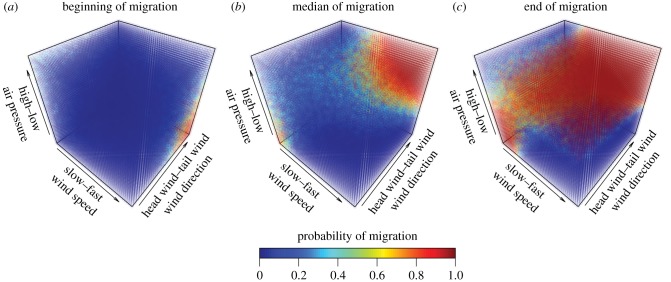
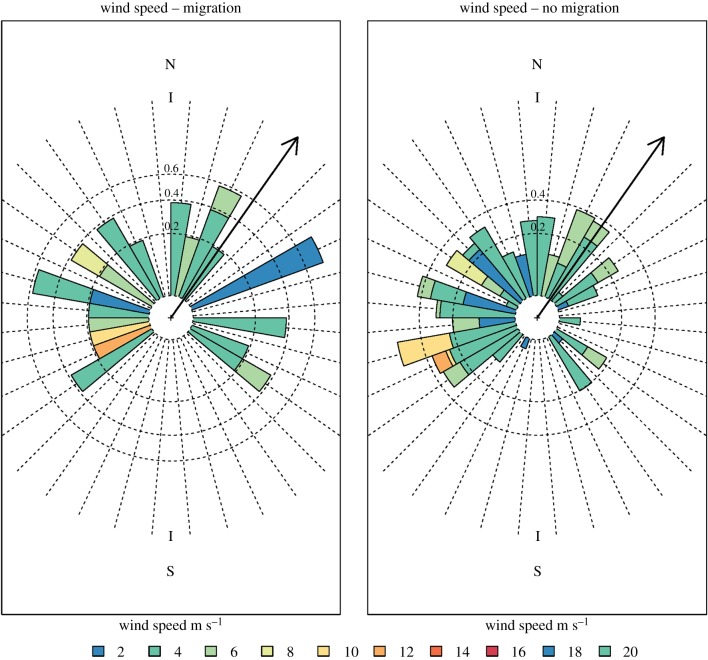
Migratory decisions in birds are closely tied to environmental cues and fat stores, but it remains unknown if the same variables trigger bat migration. To learn more about the rare phenomenon of bat migration, we studied departure decisions of female common noctules () in southern Germany. We did not find the fattening period that modulates departure decisions in birds. Female noctules departed after a regular evening foraging session, uniformly heading northeast. As the day of year increased, migratory decisions were based on the interactions among wind speed, wind direction and air pressure. As the migration season progressed, bats were likely to migrate on nights with higher air pressure and faster tail winds in the direction of travel, and also show high probability of migration on low-pressure nights with slow head winds. Common noctules thus monitor complex environmental conditions to find the optimal migration night.
鸟类的迁徙决策与环境线索和脂肪储备密切相关,但同样的变量是否会触发蝙蝠迁徙仍不清楚。为了更多地了解蝙蝠迁徙这一罕见现象,我们研究了德国南部雌性普通长翼蝠()的出发决策。我们没有发现调节鸟类出发决策的育肥期。雌性长翼蝠在常规的夜间觅食活动结束后出发,统一向东北方向飞行。随着一年中的天数增加,迁徙决策基于风速、风向和气压之间的相互作用。随着迁徙季节的推进,蝙蝠更有可能在气压较高、顺风速度较快且与飞行方向一致的夜晚迁徙,在逆风缓慢的低压夜晚也有较高的迁徙概率。因此,普通长翼蝠会监测复杂的环境条件以找到最佳的迁徙夜晚。