Hume Taylor, Geiser Fritz, Currie Shannon E, Körtner Gerhard, Stawski Clare
Centre for Behavioural and Physiological Ecology, Zoology, University of New England, Armidale, NSW, 2351, Australia.
Leibniz Institute for Zoo and Wildlife Research, Alfred-Kowalke-Str. 17, Berlin, 10315, Germany.
Curr Zool. 2020 Feb;66(1):15-20. doi: 10.1093/cz/zoz023. Epub 2019 May 17.
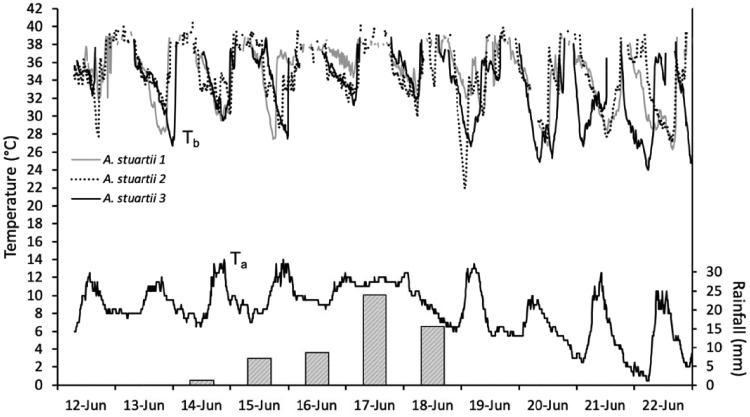
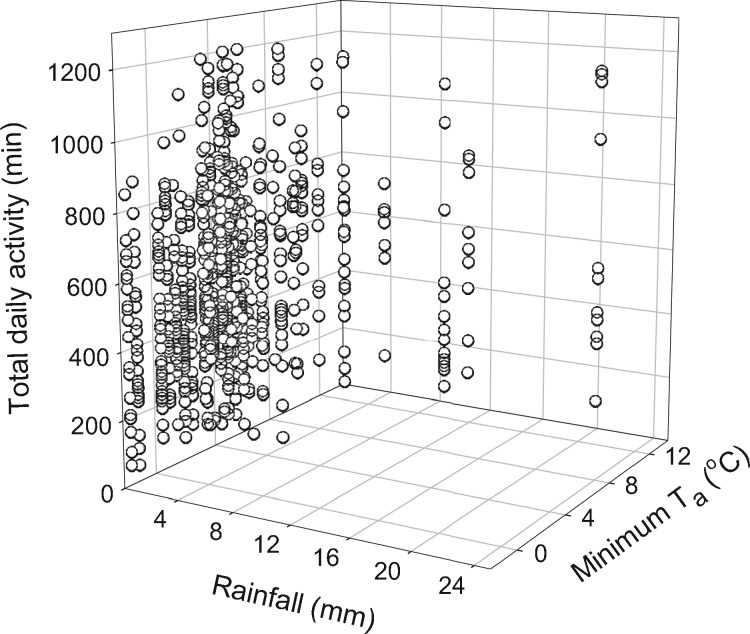
Energy conservation is paramount for small mammals because of their small size, large surface area to volume ratio, and the resultant high heat loss to the environment. To survive on limited food resources and to fuel their expensive metabolism during activity, many small mammals employ daily torpor to reduce energy expenditure during the rest phase. We hypothesized that a small terrestrial semelparous marsupial, the brown antechinus , would maximize activity when foraging conditions were favorable to gain fat reserves before their intense breeding period, but would increase torpor use when conditions were poor to conserve these fat reserves. Female antechinus were trapped and implanted with small temperature-sensitive radio transmitters to record body temperature and to quantify torpor expression and activity patterns in the wild. Most antechinus used torpor at least once per day over the entire study period. Total daily torpor use increased and mean daily body temperature decreased significantly with a reduction in minimum ambient temperature. Interestingly, antechinus employed less torpor on days with more rain and decreasing barometric pressure. In contrast to torpor expression, activity was directly related to ambient temperature and inversely related to barometric pressure. Our results reveal that antechinus use a flexible combination of physiology and behavior that can be adjusted to manage their energy budget according to weather variables.
由于体型小、表面积与体积之比大,以及由此导致的向环境散热多,能量守恒对小型哺乳动物至关重要。为了依靠有限的食物资源生存,并在活动期间为其昂贵的新陈代谢提供能量,许多小型哺乳动物采用每日蛰伏来减少休息阶段的能量消耗。我们假设,一种小型陆生一次性繁殖有袋动物——褐袋鼩,在觅食条件有利时会最大化活动,以便在其激烈的繁殖期之前积累脂肪储备,但在条件不佳时会增加蛰伏行为以保存这些脂肪储备。捕获雌性袋鼩并给它们植入小型温度敏感无线电发射器,以记录体温,并量化野外的蛰伏表现和活动模式。在整个研究期间,大多数袋鼩每天至少使用一次蛰伏。随着最低环境温度降低,每日总蛰伏时间增加,平均每日体温显著下降。有趣的是,在降雨较多和气压下降的日子里,袋鼩使用蛰伏的次数较少。与蛰伏表现相反,活动与环境温度直接相关,与气压呈负相关。我们的研究结果表明,袋鼩采用生理和行为的灵活组合,可根据天气变量进行调整以管理其能量预算。