Division of Gastroenterology, Department of Medicine, McGill University Health Center, Montreal, QC H3G1A4, Canada.
Division of Internal Medicine, Department of Medicine, La Tour Hospital and University of Geneva, 1217 Geneva, Switzerland.
World J Gastroenterol. 2017 Aug 28;23(32):5994-6002. doi: 10.3748/wjg.v23.i32.5994.
To performed a systematic review and meta-analysis to determine any possible differences in terms of effectiveness, safety and tolerability between existing colon-cleansing products in patients with inflammatory bowel disease.
Systematic searches were performed (January 1980-September 2016) using MEDLINE, EMBASE, Scopus, CENTRAL and ISI Web of knowledge for randomized trials assessing preparations with or without adjuvants, given in split and non-split dosing, and in high (> 3 L) or low-volume (2 L or less) regimens. Bowel cleansing quality was the primary outcome. Secondary outcomes included patient willingness-to-repeat the procedure and side effects/complications.
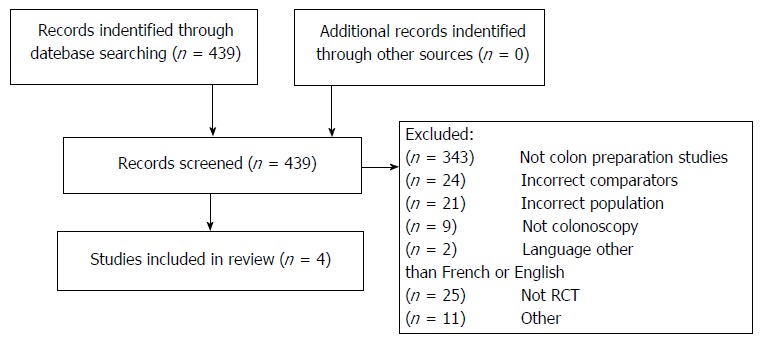
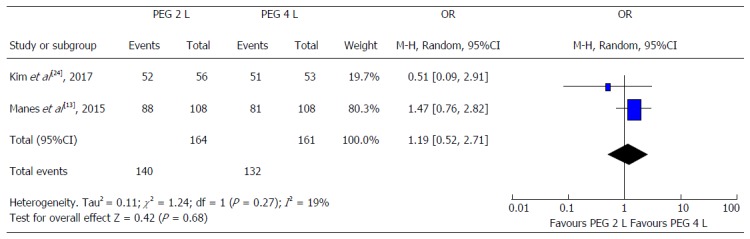
Out of 439 citations, 4 trials fulfilled our inclusion criteria ( = 449 patients). One trial assessed the impact of adding simethicone to polyethylene glycol (PEG) 4 L with no effect on bowel cleansing quality, but a better tolerance. Another trial compared senna to castor oil, again without any differences in term of bowel cleansing. Two trials compared the efficacy of PEG high-volume PEG low-volume associated to an adjuvant in split-dose regimens: PEG low-dose efficacy was not different to PEG high-dose; OR = 0.84 (0.37-1.92). A higher proportion of patients were willing to repeat low-volume preparations high-volume; OR = 5.11 (1.31-20.0).
In inflammatory bowel disease population, PEG low-volume regimen seems not inferior to PEG high-volume to clean the colon, and yields improved willingness-to-repeat. Further additional research is urgently required to compare contemporary products in this population.
系统评价和荟萃分析,以确定在炎症性肠病患者中,现有结肠清洁剂产品在有效性、安全性和耐受性方面是否存在差异。
系统检索(1980 年 1 月至 2016 年 9 月)MEDLINE、EMBASE、Scopus、CENTRAL 和 ISI Web of Knowledge,以评估使用或不使用辅助剂、分剂量和非分剂量给药、高剂量(>3L)或低剂量(2L 或更少)方案的制剂的随机试验。肠道清洁质量是主要结局。次要结局包括患者愿意重复该程序和不良反应/并发症。
在 439 条引用中,有 4 项试验符合我们的纳入标准(=449 名患者)。一项试验评估了在聚乙二醇(PEG)4L 中添加二甲硅油对肠道清洁质量的影响,结果表明对肠道清洁质量没有影响,但耐受性更好。另一项试验比较了番泻叶和蓖麻油,在肠道清洁方面也没有差异。两项试验比较了 PEG 高容量和 PEG 低容量与辅助剂在分剂量方案中的疗效:PEG 低容量的疗效与 PEG 高容量没有差异;OR=0.84(0.37-1.92)。更多的患者愿意重复低容量制剂而不是高容量制剂;OR=5.11(1.31-20.0)。
在炎症性肠病患者中,PEG 低容量方案似乎与 PEG 高容量方案一样能够清洁结肠,且提高了患者的意愿重复使用。在该人群中,迫切需要进一步比较现代产品的研究。