Departamento de Química Física y Analítica, Universidad de Oviedo, Julián Clavería 8, 33006, Oviedo, Spain.
Anal Bioanal Chem. 2018 Jan;410(3):679-693. doi: 10.1007/s00216-017-0620-3. Epub 2017 Sep 20.
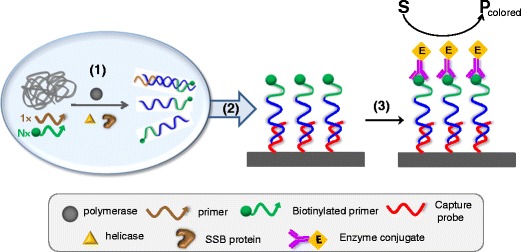
Highly sensitive testing of nucleic acids is essential to improve the detection of pathogens, which pose a major threat for public health worldwide. Currently available molecular assays, mainly based on PCR, have a limited utility in point-of-need control or resource-limited settings. Consequently, there is a strong interest in developing cost-effective, robust, and portable platforms for early detection of these harmful microorganisms. Since its description in 2004, isothermal helicase-dependent amplification (HDA) has been successfully applied in the development of novel molecular-based technologies for rapid, sensitive, and selective detection of viruses and bacteria. In this review, we highlight relevant analytical systems using this simple nucleic acid amplification methodology that takes place at a constant temperature and that is readily compatible with microfluidic technologies. Different strategies for monitoring HDA amplification products are described. In addition, we present technological advances for integrating sample preparation, HDA amplification, and detection. Future perspectives and challenges toward point-of-need use not only for clinical diagnosis but also in food safety testing and environmental monitoring are also discussed. Graphical Abstract Expanding the analytical toolbox for the detection of DNA sequences specific of pathogens with isothermal helicase dependent amplification (HDA).
高灵敏度的核酸检测对于提高病原体的检测至关重要,这些病原体对全球公共卫生构成了重大威胁。目前可用的分子检测方法主要基于 PCR,但在即时检测或资源有限的环境中的应用有限。因此,人们强烈希望开发具有成本效益、稳健和便携式的平台,以早期检测这些有害微生物。自 2004 年被描述以来,等温解旋酶依赖性扩增(HDA)已成功应用于新型分子生物技术的开发,用于快速、灵敏和选择性检测病毒和细菌。在这篇综述中,我们重点介绍了使用这种简单的核酸扩增方法的相关分析系统,该方法在恒温下进行,并且与微流控技术兼容。描述了用于监测 HDA 扩增产物的不同策略。此外,我们还介绍了用于整合样品制备、HDA 扩增和检测的技术进展。还讨论了针对即时使用的未来展望和挑战,不仅用于临床诊断,还用于食品安全检测和环境监测。