Exner Jörg, Albrecht Gaby, Schönauer-Kamin Daniela, Kita Jaroslaw, Moos Ralf
Department of Functional Materials, University of Bayreuth, Universitätsstraße 30, 95440 Bayreuth, Germany.
Sensors (Basel). 2017 Jul 26;17(8):1715. doi: 10.3390/s17081715.
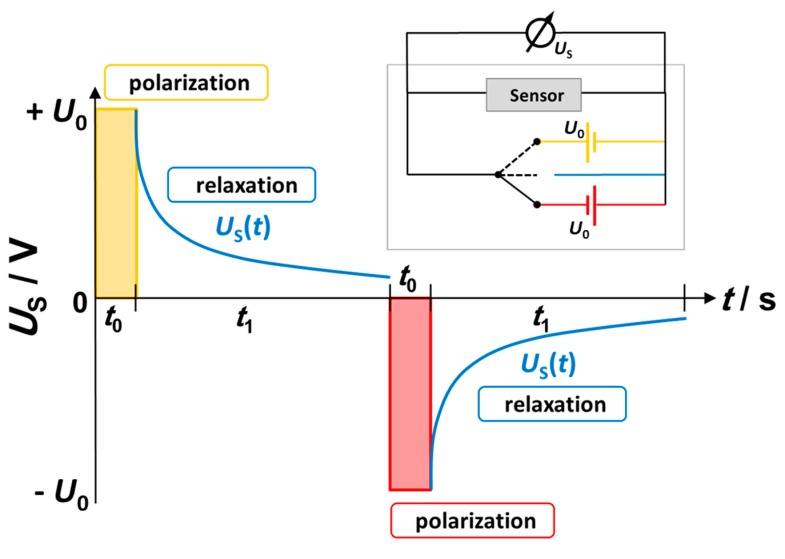
The pulsed polarization technique on solid electrolytes is based on alternating potential pulses interrupted by self-discharge pauses. Since even small concentrations of nitrogen oxides (NO) in the ppm range significantly change the polarization and discharge behavior, pulsed polarization sensors are well suited to measure low amounts of NO. In contrast to all previous investigations, planar pulsed polarization sensors were built using an electrolyte thick film and platinum interdigital electrodes on alumina substrates. Two different sensor layouts were investigated, the first with buried Pt electrodes under the electrolyte and the second one with conventional overlying Pt electrodes. Electrolyte thick films were either formed by aerosol deposition or by screen-printing, therefore exhibiting a dense or porous microstructure, respectively. For screen-printed electrolytes, the influence of the electrolyte resistance on the NO sensing ability was investigated as well. Sensors with buried electrodes showed little to no response even at higher NO concentrations, in good agreement with the intended sensor mechanism. Electrolyte films with overlying electrodes, however, allowed the quantitative detection of NO. In particular, aerosol deposited electrolytes exhibited high sensitivities with a sensor output signal Δ of 50 mV and 75 mV for 3 ppm of NO and NO₂, respectively. For screen-printed electrolytes, a clear trend indicated a decrease in sensitivity with increased electrolyte resistance.
固体电解质上的脉冲极化技术基于由自放电暂停中断的交变电势脉冲。由于即使在ppm范围内的低浓度氮氧化物(NO)也会显著改变极化和放电行为,脉冲极化传感器非常适合测量低含量的NO。与之前所有的研究不同,平面脉冲极化传感器是在氧化铝基板上使用电解质厚膜和铂叉指电极构建的。研究了两种不同的传感器布局,第一种是电解质下方埋入式铂电极,第二种是传统的覆盖式铂电极。电解质厚膜通过气溶胶沉积或丝网印刷形成,因此分别呈现致密或多孔的微观结构。对于丝网印刷的电解质,还研究了电解质电阻对NO传感能力的影响。带有埋入式电极的传感器即使在较高的NO浓度下也几乎没有响应,这与预期的传感器机制高度一致。然而,带有覆盖式电极的电解质膜能够对NO进行定量检测。特别是,气溶胶沉积的电解质表现出高灵敏度,对于3 ppm的NO和NO₂,传感器输出信号Δ分别为50 mV和75 mV。对于丝网印刷的电解质,一个明显的趋势表明,随着电解质电阻的增加,灵敏度降低。