Berger Hester Rijkje, Nyman Axel K G, Morken Tora Sund, Vettukattil Riyas, Brubakk Ann-Mari, Widerøe Marius
Department of Laboratory Medicine, Children's and Women's Health, Norwegian University of Science and Technology, Trondheim, Norway.
Department of Pediatrics, St. Olavs University Hospital HF, Trondheim, Norway.
PLoS One. 2017 Sep 21;12(9):e0185202. doi: 10.1371/journal.pone.0185202. eCollection 2017.
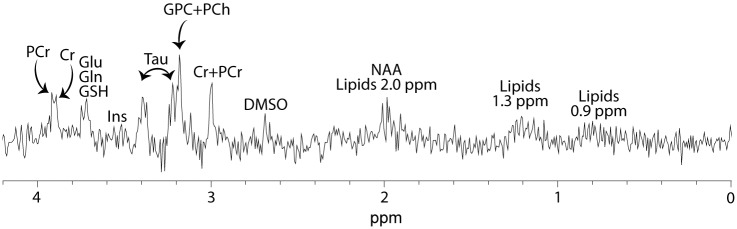
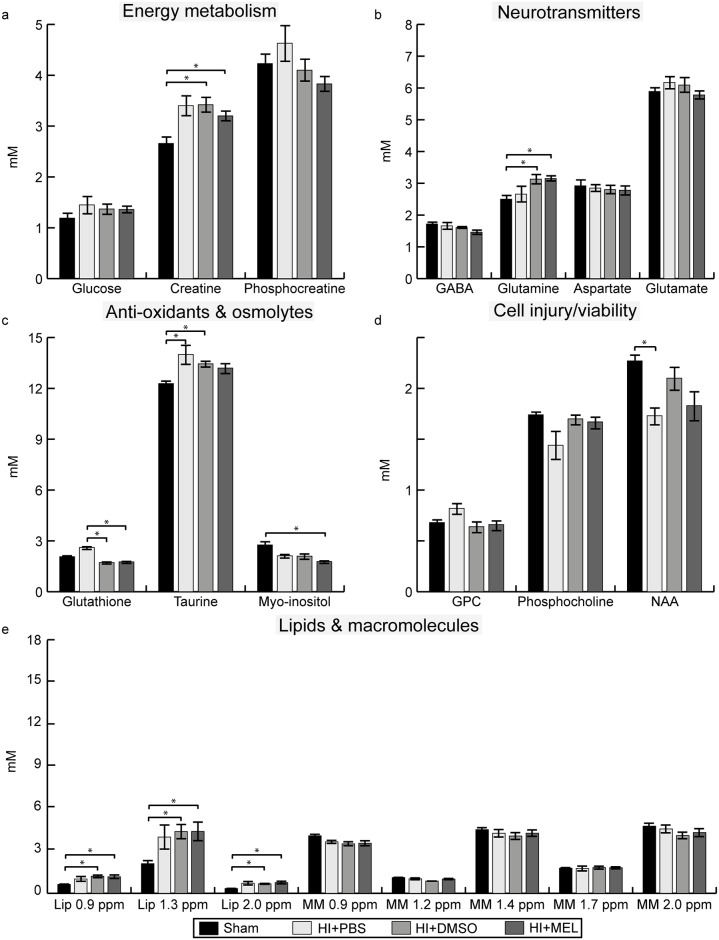
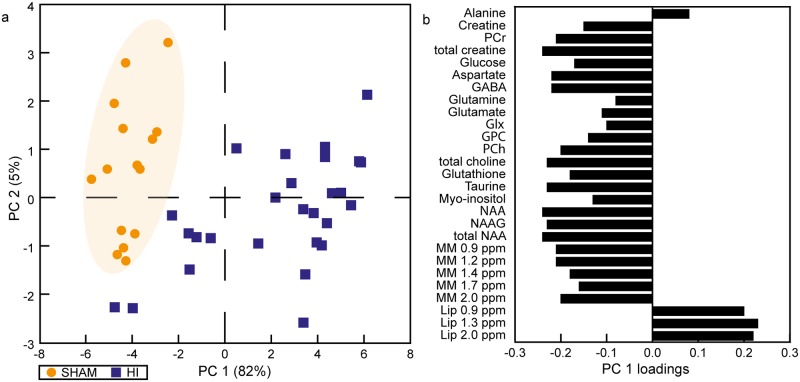
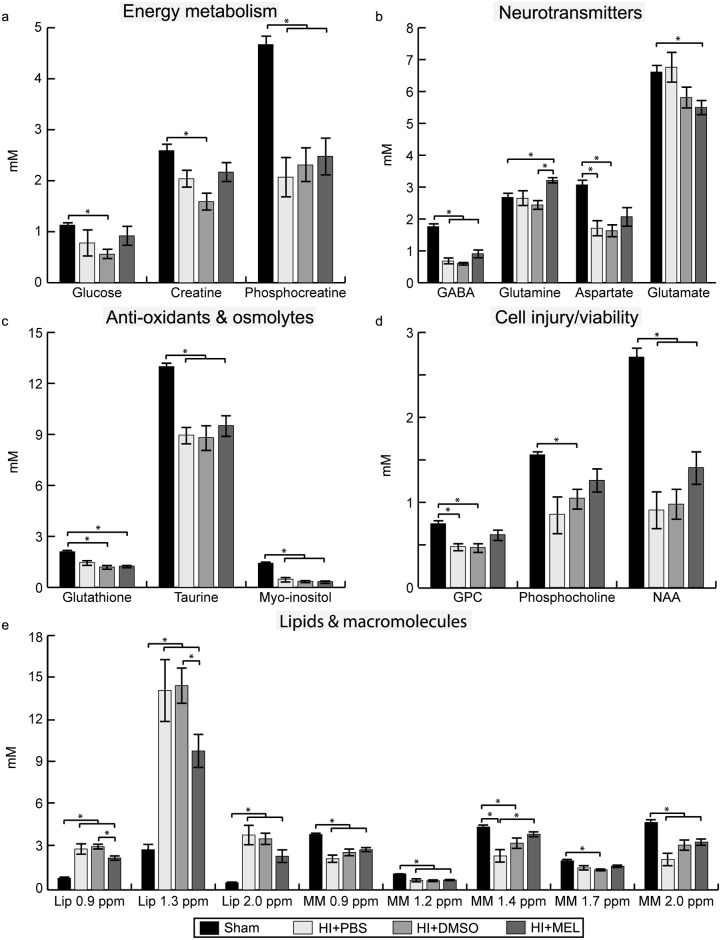
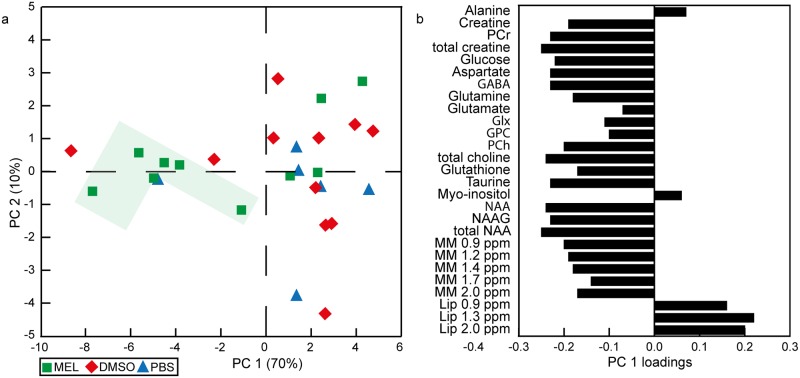
Melatonin is a promising neuroprotective agent after perinatal hypoxic-ischemic (HI) brain injury. We used in-vivo 1H magnetic resonance spectroscopy to investigate effects of melatonin treatment on brain metabolism after HI. Postnatal day 7 Sprague-Dawley rats with unilateral HI brain injury were treated with either melatonin 10 mg/kg dissolved in phosphate-buffered saline (PBS) with 5% dimethyl sulfoxide (DMSO) or vehicle (5% DMSO and/or PBS) directly and at 6 hours after HI. 1H MR spectra from the thalamus in the ipsilateral and contralateral hemisphere were acquired 1 day after HI. Our results showed that injured animals had a distinct metabolic profile in the ipsilateral thalamus compared to sham with low concentrations of total creatine, choline, N-acetyl aspartate (NAA), and high concentrations of lipids. A majority of the melatonin-treated animals had a metabolic profile characterized by higher total creatine, choline, NAA and lower lipid levels than other HI animals. When comparing absolute concentrations, melatonin treatment resulted in higher glutamine levels and lower lipid concentrations compared to DMSO treatment as well as higher macromolecule levels compared to PBS treatment day 1 after HI. DMSO treated animals had lower concentrations of glucose, creatine, phosphocholine and macromolecules compared to sham animals. In conclusion, the neuroprotective effects of melatonin were reflected in a more favorable metabolic profile including reduced lipid levels that likely represents reduced cell injury. Neuroprotective effects may also be related to the influence of melatonin on glutamate/glutamine metabolism. The modulatory effects of the solvent DMSO on cerebral energy metabolism might have masked additional beneficial effects of melatonin.
褪黑素是围产期缺氧缺血性(HI)脑损伤后一种很有前景的神经保护剂。我们使用体内1H磁共振波谱来研究褪黑素治疗对HI后脑代谢的影响。对出生后第7天患有单侧HI脑损伤的Sprague-Dawley大鼠,在HI后直接以及6小时后,用溶解于含5%二甲基亚砜(DMSO)的磷酸盐缓冲盐水(PBS)中的10mg/kg褪黑素或赋形剂(5%DMSO和/或PBS)进行治疗。在HI后1天采集同侧和对侧半球丘脑的1H磁共振波谱。我们的结果表明,与假手术组相比,损伤动物同侧丘脑具有独特的代谢谱,总肌酸、胆碱、N-乙酰天门冬氨酸(NAA)浓度低,脂质浓度高。大多数接受褪黑素治疗的动物的代谢谱特征是,与其他HI动物相比,总肌酸、胆碱、NAA水平较高,脂质水平较低。在比较绝对浓度时,与DMSO治疗相比,褪黑素治疗导致HI后第1天谷氨酰胺水平较高,脂质浓度较低,与PBS治疗相比,大分子水平较高。与假手术动物相比,DMSO治疗的动物葡萄糖、肌酸、磷酸胆碱和大分子浓度较低。总之,褪黑素的神经保护作用体现在更有利的代谢谱中,包括脂质水平降低,这可能代表细胞损伤减少。神经保护作用也可能与褪黑素对谷氨酸/谷氨酰胺代谢的影响有关。溶剂DMSO对脑能量代谢的调节作用可能掩盖了褪黑素的其他有益作用。