• 文献检索
  • 文档翻译
  • 深度研究
  • 学术资讯
  • Suppr Zotero 插件Zotero 插件
  • 邀请有礼
  • 套餐&价格
  • 历史记录
应用&插件
Suppr Zotero 插件Zotero 插件浏览器插件Mac 客户端Windows 客户端微信小程序
定价
高级版会员购买积分包购买API积分包
服务
文献检索文档翻译深度研究API 文档MCP 服务
关于我们
关于 Suppr公司介绍联系我们用户协议隐私条款
关注我们

Suppr 超能文献

核心技术专利:CN118964589B侵权必究
粤ICP备2023148730 号-1Suppr @ 2026

文献检索

告别复杂PubMed语法,用中文像聊天一样搜索,搜遍4000万医学文献。AI智能推荐,让科研检索更轻松。

立即免费搜索

文件翻译

保留排版,准确专业,支持PDF/Word/PPT等文件格式,支持 12+语言互译。

免费翻译文档

深度研究

AI帮你快速写综述,25分钟生成高质量综述,智能提取关键信息,辅助科研写作。

立即免费体验

动脉瘤性蛛网膜下腔出血后早期高液体输入:与迟发性脑缺血的关联及心输出量指导的液体限制可行性的联合报告。

High Early Fluid Input After Aneurysmal Subarachnoid Hemorrhage: Combined Report of Association With Delayed Cerebral Ischemia and Feasibility of Cardiac Output-Guided Fluid Restriction.

机构信息

Department of Intensive Care, Erasmus MC, University Medical Center, Rotterdam, The Netherlands.

Department of Neurology, Erasmus MC, University Medical Center, Rotterdam, The Netherlands.

出版信息

J Intensive Care Med. 2020 Feb;35(2):161-169. doi: 10.1177/0885066617732747. Epub 2017 Sep 22.

DOI:10.1177/0885066617732747
PMID:28934895
原文链接:https://pmc.ncbi.nlm.nih.gov/articles/PMC6927070/
Abstract

BACKGROUND

Guidelines on the management of aneurysmal subarachnoid hemorrhage (aSAH) recommend euvolemia, whereas hypervolemia may cause harm. We investigated whether high early fluid input is associated with delayed cerebral ischemia (DCI), and if fluid input can be safely decreased using transpulmonary thermodilution (TPT).

METHODS

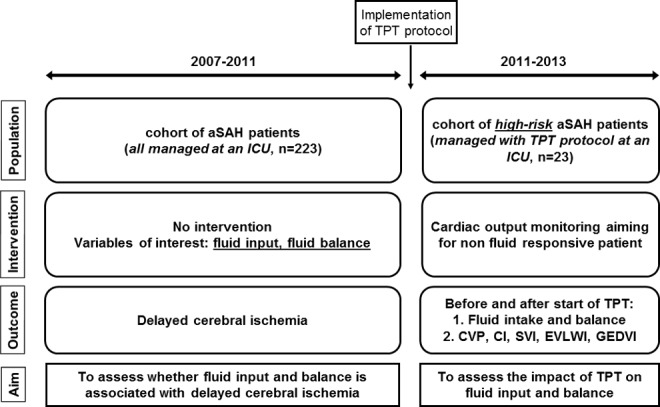
We retrospectively included aSAH patients treated at an academic intensive care unit (2007-2011; cohort 1) or managed with TPT (2011-2013; cohort 2). Local guidelines recommended fluid input of 3 L daily. More fluids were administered when daily fluid balance fell below +500 mL. In cohort 2, fluid input in high-risk patients was guided by cardiac output measured by TPT per a strict protocol. Associations of fluid input and balance with DCI were analyzed with multivariable logistic regression (cohort 1), and changes in hemodynamic indices after institution of TPT assessed with linear mixed models (cohort 2).

RESULTS

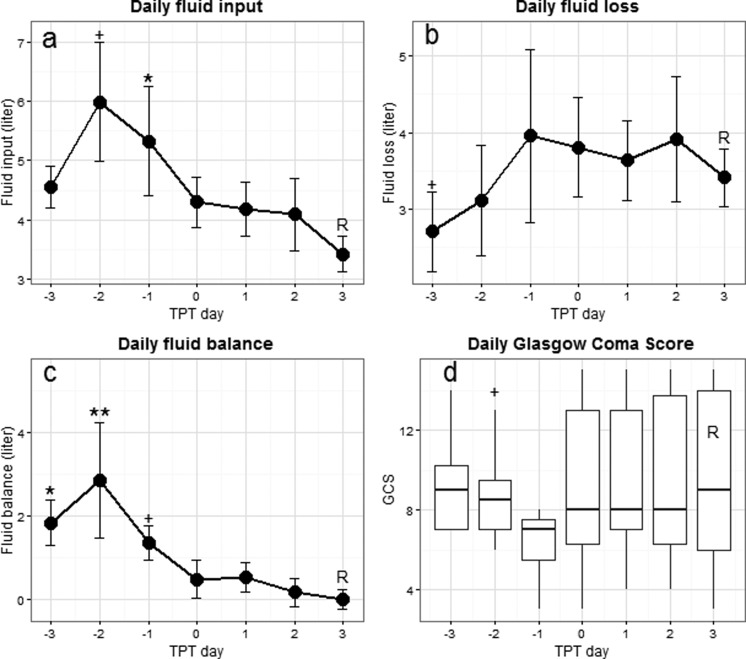
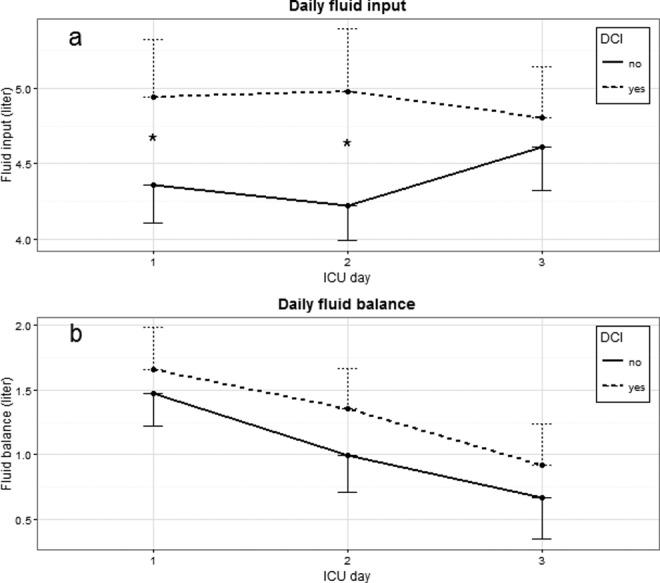
Cumulative fluid input 0 to 72 hours after admission was associated with DCI in cohort 1 (n=223; odds ratio [OR] 1.19/L; 95% confidence interval 1.07-1.32), whereas cumulative fluid balance was not. In cohort 2 (23 patients), using TPT fluid input could be decreased from 6.0 ± 1.0 L before to 3.4 ± 0.3 L; = .012), while preload parameters and consciousness remained stable.

CONCLUSION

High early fluid input was associated with DCI. Invasive hemodynamic monitoring was feasible to reduce fluid input while maintaining preload. These results indicate that fluid loading beyond a normal preload occurs, may increase DCI risk, and can be minimized with TPT.

摘要

背景

关于蛛网膜下腔出血(aSAH)管理的指南建议血容量正常,而血容量过多可能会造成伤害。我们研究了早期高液体输入是否与迟发性脑缺血(DCI)相关,以及是否可以使用经肺热稀释(TPT)安全减少液体输入。

方法

我们回顾性纳入了在学术性重症监护病房接受治疗的 aSAH 患者(2007-2011 年;队列 1)或接受 TPT 治疗的患者(2011-2013 年;队列 2)。当地指南建议每日液体输入量为 3 L。当每日液体平衡低于+500 mL 时,会给予更多的液体。在队列 2 中,高危患者的液体输入由 TPT 测量的每搏量指导,遵循严格的方案。使用多变量逻辑回归分析了队列 1 中液体输入和平衡与 DCI 的相关性,并使用线性混合模型评估了 TPT 实施后血流动力学指数的变化(队列 2)。

结果

队列 1(n=223)中,入院后 0-72 小时的累积液体输入与 DCI 相关(优势比[OR]1.19/L;95%置信区间 1.07-1.32),而累积液体平衡与 DCI 不相关。在队列 2(23 例患者)中,使用 TPT 可将液体输入从 6.0±1.0 L 降低至 3.4±0.3 L;P=0.012),同时前负荷参数和意识状态保持稳定。

结论

早期高液体输入与 DCI 相关。侵入性血流动力学监测可在维持前负荷的情况下减少液体输入。这些结果表明,存在超过正常前负荷的液体加载,可能增加 DCI 风险,并且可以通过 TPT 最小化。
https://cdn.ncbi.nlm.nih.gov/pmc/blobs/9874/6927070/32cfd547c663/10.1177_0885066617732747-fig3.jpg
https://cdn.ncbi.nlm.nih.gov/pmc/blobs/9874/6927070/c6ec77e58c98/10.1177_0885066617732747-fig1.jpg
https://cdn.ncbi.nlm.nih.gov/pmc/blobs/9874/6927070/b655fc2256ef/10.1177_0885066617732747-fig2.jpg
https://cdn.ncbi.nlm.nih.gov/pmc/blobs/9874/6927070/32cfd547c663/10.1177_0885066617732747-fig3.jpg
https://cdn.ncbi.nlm.nih.gov/pmc/blobs/9874/6927070/c6ec77e58c98/10.1177_0885066617732747-fig1.jpg
https://cdn.ncbi.nlm.nih.gov/pmc/blobs/9874/6927070/b655fc2256ef/10.1177_0885066617732747-fig2.jpg
https://cdn.ncbi.nlm.nih.gov/pmc/blobs/9874/6927070/32cfd547c663/10.1177_0885066617732747-fig3.jpg

相似文献

1
High Early Fluid Input After Aneurysmal Subarachnoid Hemorrhage: Combined Report of Association With Delayed Cerebral Ischemia and Feasibility of Cardiac Output-Guided Fluid Restriction.动脉瘤性蛛网膜下腔出血后早期高液体输入:与迟发性脑缺血的关联及心输出量指导的液体限制可行性的联合报告。
J Intensive Care Med. 2020 Feb;35(2):161-169. doi: 10.1177/0885066617732747. Epub 2017 Sep 22.
2
Transpulmonary thermodilution monitoring-guided hemodynamic management improves cognitive function in patients with aneurysmal subarachnoid hemorrhage: a prospective cohort comparison.经肺热稀释监测指导的血流动力学管理可改善颅内动脉瘤性蛛网膜下腔出血患者的认知功能:一项前瞻性队列比较。
Acta Neurochir (Wien). 2019 Jul;161(7):1317-1324. doi: 10.1007/s00701-019-03922-4. Epub 2019 May 18.
3
Early intensive versus minimally invasive approach to postoperative hemodynamic management after subarachnoid hemorrhage.早期强化与微创术后蛛网膜下腔出血后血流动力学管理方法的比较。
Stroke. 2014 May;45(5):1280-4. doi: 10.1161/STROKEAHA.114.004739. Epub 2014 Apr 1.
4
Acute impairment of saccadic eye movements is associated with delayed cerebral ischemia after aneurysmal subarachnoid hemorrhage.急性扫视眼动障碍与动脉瘤性蛛网膜下腔出血后迟发性脑缺血有关。
J Neurosurg. 2017 Oct;127(4):754-760. doi: 10.3171/2016.8.JNS16408. Epub 2016 Dec 9.
5
Performance of bedside transpulmonary thermodilution monitoring for goal-directed hemodynamic management after subarachnoid hemorrhage.床旁经肺温度稀释监测在蛛网膜下腔出血后目标导向血流动力学管理中的应用
Stroke. 2009 Jul;40(7):2368-74. doi: 10.1161/STROKEAHA.109.547463. Epub 2009 May 21.
6
Effect of triple-h prophylaxis on global end-diastolic volume and clinical outcomes in patients with aneurysmal subarachnoid hemorrhage.三联预防性治疗对动脉瘤性蛛网膜下腔出血患者整体舒张末期容积及临床结局的影响。
Neurocrit Care. 2014 Dec;21(3):462-9. doi: 10.1007/s12028-014-9973-z.
7
Optimal range of global end-diastolic volume for fluid management after aneurysmal subarachnoid hemorrhage: a multicenter prospective cohort study.最佳的全球舒张末期容积范围用于动脉瘤性蛛网膜下腔出血后的液体管理:一项多中心前瞻性队列研究。
Crit Care Med. 2014 Jun;42(6):1348-56. doi: 10.1097/CCM.0000000000000163.
8
Positive Fluid Balance Is Associated With Poor Outcomes in Subarachnoid Hemorrhage.液体正平衡与蛛网膜下腔出血的不良预后相关。
J Stroke Cerebrovasc Dis. 2015 Oct;24(10):2245-51. doi: 10.1016/j.jstrokecerebrovasdis.2015.05.027. Epub 2015 Aug 13.
9
The Impact of Fluid Balance on Acute Kidney Injury in Nontraumatic Subarachnoid Hemorrhage.液体平衡对非创伤性蛛网膜下腔出血患者急性肾损伤的影响
J Intensive Care Med. 2024 Jul;39(7):693-700. doi: 10.1177/08850666241226900. Epub 2024 Feb 19.
10
Multicenter prospective cohort study on volume management after subarachnoid hemorrhage: hemodynamic changes according to severity of subarachnoid hemorrhage and cerebral vasospasm.多中心前瞻性队列研究:蛛网膜下腔出血后容量管理:根据蛛网膜下腔出血和脑血管痉挛的严重程度的血液动力学变化。
Stroke. 2013 Aug;44(8):2155-61. doi: 10.1161/STROKEAHA.113.001015. Epub 2013 Jun 4.

引用本文的文献

1
Acute care of aneurysmal subarachnoid hemorrhage: practical consensus statement from a multidisciplinary group of German-speaking neurointensivists and neuroradiologists on behalf of the DIVI neurology section.动脉瘤性蛛网膜下腔出血的急性治疗:一组德语区神经重症监护医师和神经放射科医师代表DIVI神经科发布的实用共识声明
Neurol Res Pract. 2025 Jul 30;7(1):54. doi: 10.1186/s42466-025-00407-x.
2
Spontaneous subarachnoid hemorrhage: A primer for acute care practitioners.自发性蛛网膜下腔出血:急性护理从业者入门指南。
J Intensive Care Soc. 2025 May 27:17511437251333269. doi: 10.1177/17511437251333269.
3
Preventing Fluid Retention After Subarachnoid Haemorrhage During Administration of Endothelin Receptor Antagonist.

本文引用的文献

1
Fluid management of the neurological patient: a concise review.神经科患者的液体管理:简要综述
Crit Care. 2016 May 31;20(1):126. doi: 10.1186/s13054-016-1309-2.
2
Is venous congestion associated with reduced cerebral oxygenation and worse neurological outcome after cardiac arrest?心脏骤停后,静脉淤血是否与脑氧合降低及更差的神经学预后相关?
Crit Care. 2016 May 15;20(1):146. doi: 10.1186/s13054-016-1297-2.
3
Early Liberal Fluids for Sepsis Patients Are Harmful.早期给予脓毒症患者使用平衡液是有害的。
预防蛛网膜下腔出血后内皮素受体拮抗剂治疗期间的液体潴留。
Adv Exp Med Biol. 2024;1463:167-172. doi: 10.1007/978-3-031-67458-7_28.
4
Contemporary management of aneurysmal subarachnoid haemorrhage. An update for the intensivist.颅内动脉瘤性蛛网膜下腔出血的当代治疗。强化治疗医师的最新进展。
Intensive Care Med. 2024 May;50(5):646-664. doi: 10.1007/s00134-024-07387-7. Epub 2024 Apr 10.
5
Sodium and Its Impact on Outcome After Aneurysmal Subarachnoid Hemorrhage in Patients With and Without Delayed Cerebral Ischemia.钠及其对伴或不伴迟发性脑缺血的动脉瘤性蛛网膜下腔出血患者预后的影响
Crit Care Med. 2024 May 1;52(5):752-763. doi: 10.1097/CCM.0000000000006182. Epub 2024 Jan 11.
6
Real-world data of clazosentan in combination therapy for aneurysmal subarachnoid hemorrhage: a multicenter retrospective cohort study.克拉生坦联合治疗颅内动脉瘤性蛛网膜下腔出血的真实世界数据:一项多中心回顾性队列研究。
Neurosurg Rev. 2023 Aug 9;46(1):195. doi: 10.1007/s10143-023-02104-2.
7
Cerebral Perfusion Pressure-Guided Therapy in Patients with Subarachnoid Haemorrhage-A Retrospective Analysis.蛛网膜下腔出血患者的脑灌注压导向治疗——一项回顾性分析
Life (Basel). 2023 Jul 21;13(7):1597. doi: 10.3390/life13071597.
8
Hemodynamic Management in the Prevention and Treatment of Delayed Cerebral Ischemia After Aneurysmal Subarachnoid Hemorrhage.动脉瘤性蛛网膜下腔出血后预防和治疗迟发性脑缺血的血流动力学管理。
Neurocrit Care. 2023 Aug;39(1):81-90. doi: 10.1007/s12028-023-01738-w. Epub 2023 May 9.
9
Acute Multidisciplinary Management of Aneurysmal Subarachnoid Hemorrhage (aSAH).急性多学科管理颅内动脉瘤性蛛网膜下腔出血(aSAH)。
Balkan Med J. 2023 Mar 8;40(2):74-81. doi: 10.4274/balkanmedj.galenos.2023.2023-1-100.
10
Spontaneous subarachnoid haemorrhage.自发性蛛网膜下腔出血。
Lancet. 2022 Sep 10;400(10355):846-862. doi: 10.1016/S0140-6736(22)00938-2. Epub 2022 Aug 16.
Crit Care Med. 2016 Dec;44(12):2258-2262. doi: 10.1097/CCM.0000000000001829.
4
ARDS in the brain-injured patient: what's different?脑损伤患者的急性呼吸窘迫综合征:有何不同?
Intensive Care Med. 2016 May;42(5):790-793. doi: 10.1007/s00134-016-4298-3. Epub 2016 Mar 11.
5
Randomized pilot trial of intensive management of blood pressure or volume expansion in subarachnoid hemorrhage (IMPROVES).蛛网膜下腔出血强化血压管理或容量扩张随机试点试验(IMPROVES)。
Neurosurgery. 2015 Feb;76(2):125-34; discussion 134-5; quiz 135. doi: 10.1227/NEU.0000000000000592.
6
Anaesthetic and ICU management of aneurysmal subarachnoid haemorrhage: a survey of European practice.动脉瘤性蛛网膜下腔出血的麻醉与重症监护管理:欧洲实践调查
Eur J Anaesthesiol. 2015 Mar;32(3):168-76. doi: 10.1097/EJA.0000000000000163.
7
Long-term outcome call into question the benefit of positive fluid balance and colloid treatment after aneurysmal subarachnoid hemorrhage.长期结果对动脉瘤性蛛网膜下腔出血后积极的液体平衡和胶体治疗的益处提出了质疑。
Neurocrit Care. 2013 Oct;19(2):137-9. doi: 10.1007/s12028-013-9900-8.
8
The effects of fluid balance and colloid administration on outcomes in patients with aneurysmal subarachnoid hemorrhage: a propensity score-matched analysis.液体平衡和胶体输注对动脉瘤性蛛网膜下腔出血患者结局的影响:倾向评分匹配分析。
Neurocrit Care. 2013 Oct;19(2):140-9. doi: 10.1007/s12028-013-9860-z.
9
Early prediction of delayed cerebral ischemia after subarachnoid hemorrhage: development and validation of a practical risk chart.蛛网膜下腔出血后迟发性脑缺血的早期预测:实用风险图表的制定和验证。
Stroke. 2013 May;44(5):1288-94. doi: 10.1161/STROKEAHA.113.001125. Epub 2013 Mar 19.
10
Randomized, double-blind trial of the effect of fluid composition on electrolyte, acid-base, and fluid homeostasis in patients early after subarachnoid hemorrhage.随机、双盲试验研究了蛛网膜下腔出血后早期患者液体成分对电解质、酸碱平衡和液体稳态的影响。
Neurocrit Care. 2013 Feb;18(1):5-12. doi: 10.1007/s12028-012-9764-3.