Labib Homeyra, Tjerkstra Maud A, Coert Bert A, Post René, Vandertop W Peter, Verbaan Dagmar, Müller Marcella C A
Department of Neurosurgery, Amsterdam UMC location University of Amsterdam, Neurosurgery, Amsterdam, The Netherlands.
Amsterdam Neurosciences, Neurovascular Disorders, Amsterdam, The Netherlands.
Crit Care Med. 2024 May 1;52(5):752-763. doi: 10.1097/CCM.0000000000006182. Epub 2024 Jan 11.
To perform a detailed examination of sodium levels, hyponatremia and sodium fluctuations, and their association with delayed cerebral ischemia (DCI) and poor outcome after aneurysmal subarachnoid hemorrhage (aSAH).
An observational cohort study from a prospective SAH Registry.
Tertiary referral center focused on SAH treatment in the Amsterdam metropolitan area.
A total of 964 adult patients with confirmed aSAH were included between 2011 and 2021.
None.
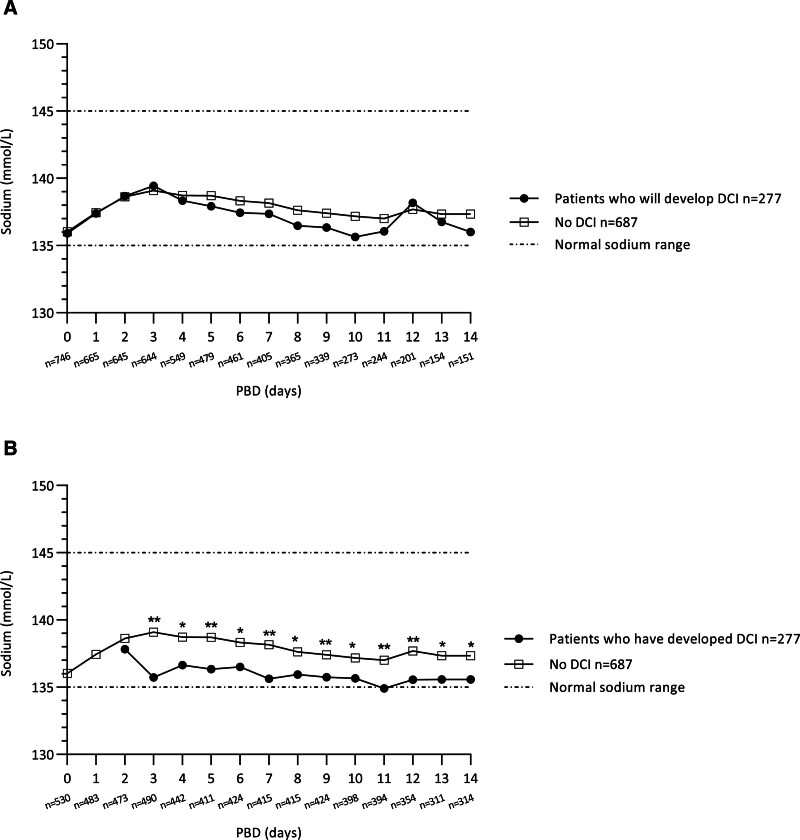
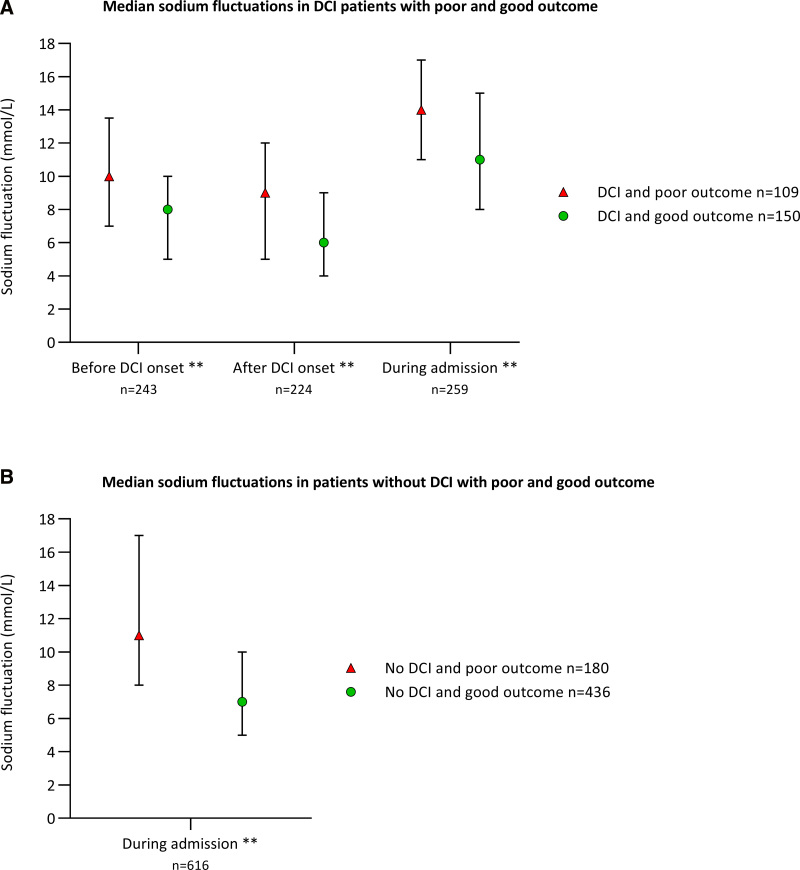
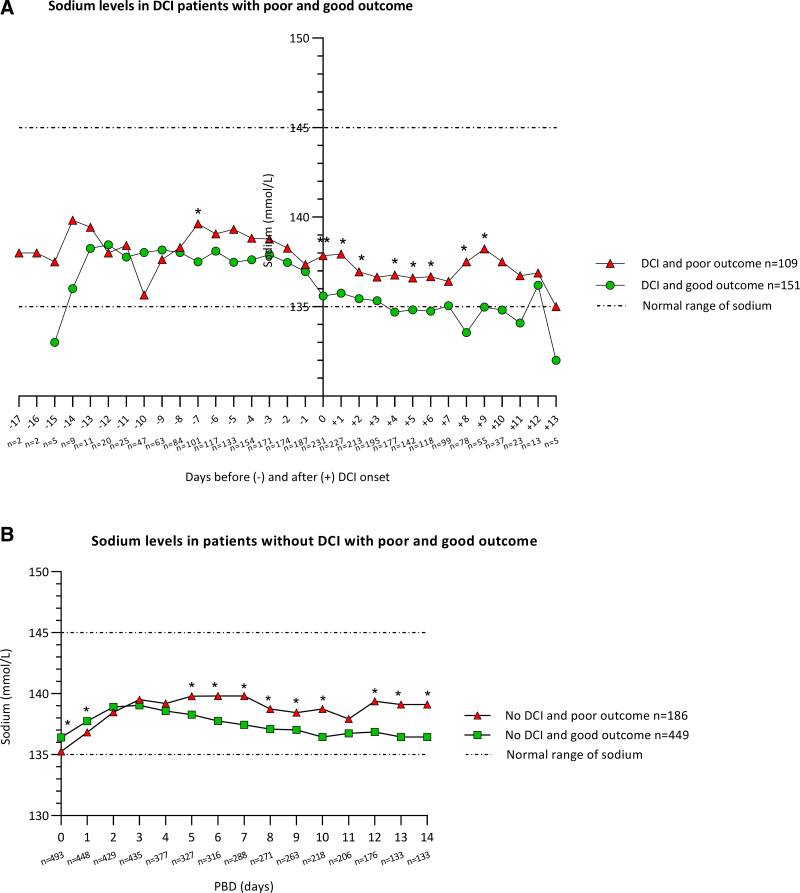
A total of 277 (29%) developed DCI. Hyponatremia occurred significantly more often in DCI patients compared with no-DCI patients (77% vs. 48%). Sodium levels, hyponatremia, hypernatremia, and sodium fluctuations did not predict DCI. However, higher sodium levels were significantly associated with poor outcome in DCI patients (DCI onset -7, DCI +0, +1, +2, +4, +5, +8, +9 d), and in no-DCI patients (postbleed day 6-10 and 12-14). Also, hypernatremia and greater sodium fluctuations were significantly associated with poor outcome in both DCI and no-DCI patients.
Sodium levels, hyponatremia, and sodium fluctuations were not associated with the occurrence of DCI. However, higher sodium levels, hypernatremia, and greater sodium fluctuations were associated with poor outcome after aSAH irrespective of the presence of DCI. Therefore, sodium levels, even with mild changes in levels, warrant close attention.
详细研究钠水平、低钠血症和钠波动情况,及其与动脉瘤性蛛网膜下腔出血(aSAH)后迟发性脑缺血(DCI)和不良预后的关系。
一项来自前瞻性SAH注册研究的观察性队列研究。
阿姆斯特丹都会区专注于SAH治疗的三级转诊中心。
2011年至2021年期间共纳入964例确诊aSAH的成年患者。
无。
共277例(29%)发生DCI。与未发生DCI的患者相比,DCI患者低钠血症的发生率显著更高(77%对48%)。钠水平、低钠血症、高钠血症和钠波动不能预测DCI。然而,较高的钠水平与DCI患者(DCI发作后-7、DCI+0、+1、+2、+4、+5、+8、+9天)和未发生DCI的患者(出血后第6 - 10天和12 - 14天)的不良预后显著相关。此外,高钠血症和更大的钠波动与DCI患者和未发生DCI的患者的不良预后均显著相关。
钠水平、低钠血症和钠波动与DCI的发生无关。然而,无论是否存在DCI,较高的钠水平、高钠血症和更大的钠波动与aSAH后的不良预后相关。因此,即使钠水平有轻微变化也值得密切关注。