Yuan Xuefei, Wang Nanbo, Geng Haiyan, Zhang Shen
Beijing Key Laboratory of Behavior and Mental Health, School of Psychological and Cognitive Sciences, Peking UniversityBeijing, China.
Department of Psychology, University of Wisconsin-WhitewaterWhitewater, WI, United States.
Front Psychol. 2017 Sep 7;8:1535. doi: 10.3389/fpsyg.2017.01535. eCollection 2017.
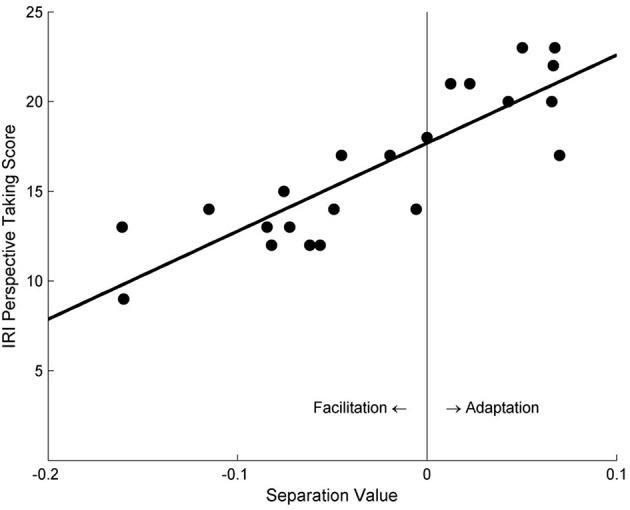
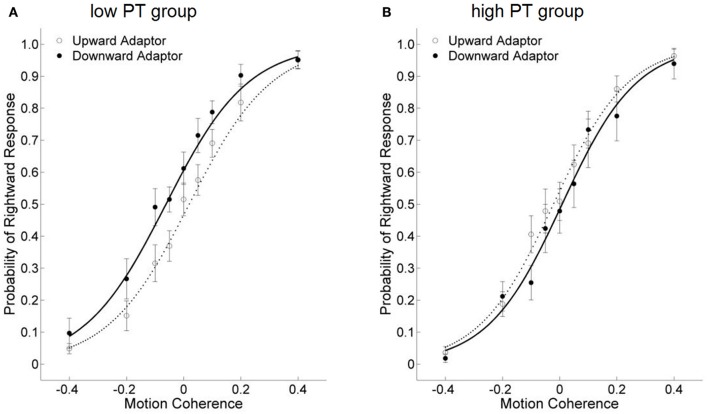
Past research on level 2 visual perspective-taking (VPT) has mostly focused on understanding the mental rotation involved when one adopts others' perspective; the mechanisms underlying how the visual world of others is mentally represented remain unclear. In three studies, we addressed this question by adopting a novel VPT task with motion stimuli and exploring the aftereffect on motion discrimination from the self-perspective. Overall the results showed a facilitation aftereffect when participants were instructed to take the avatar's perspective. Meanwhile, participants' self-reported perspective-taking tendencies correlated with the aftereffect for both instructed and spontaneous VPT tasks, when the "to-be-adopted" perspective required the participants to mentally transform their self-body clockwise. Specifically, while facilitation was induced for participants with low self-reported perspective-taking tendencies (e.g., viewing a leftward motion stimulus under another's perspective enhanced subsequent perception of leftward motion from the self-perspective), those with high self-reported perspective-taking tendencies showed an adaptation aftereffect (e.g., viewing a leftward motion stimulus under another's perspective weakened subsequent perception of leftward motion from the self-perspective). For these individuals, the adaptation effect indicated the engagement of direction-selective neurons in processing of the subsequent congruent-direction motion from self's perspective. These findings suggest that motion perception from different perspectives (self vs. another) may share the same direction-selective neural circuitry, and this possibility depends on observers' general perspective-taking tendencies.
以往关于二级视觉视角采择(VPT)的研究大多集中在理解当一个人采用他人视角时所涉及的心理旋转;他人视觉世界在心理上是如何表征的潜在机制仍不清楚。在三项研究中,我们通过采用一种带有运动刺激的新颖VPT任务并探索来自自我视角的运动辨别后效来解决这个问题。总体而言,结果显示当参与者被指示采用虚拟化身的视角时会出现促进后效。同时,当“要采用的”视角要求参与者在心理上顺时针转换自身身体时,参与者自我报告的视角采择倾向与指示性和自发性VPT任务的后效相关。具体来说,虽然自我报告视角采择倾向较低的参与者会产生促进作用(例如,从他人视角观看向左的运动刺激会增强随后从自我视角对向左运动的感知),但自我报告视角采择倾向较高的参与者则表现出适应后效(例如,从他人视角观看向左的运动刺激会削弱随后从自我视角对向左运动的感知)。对于这些个体,适应效应表明方向选择性神经元参与了从自我视角处理随后的同向运动。这些发现表明,来自不同视角(自我与他人)的运动感知可能共享相同的方向选择性神经回路,而这种可能性取决于观察者的一般视角采择倾向。