May Mark, Wendt Mike
Spatial Cognition Research Unit, Helmut-Schmidt-University, Hamburg, Germany.
Front Hum Neurosci. 2013 Sep 6;7:549. doi: 10.3389/fnhum.2013.00549.
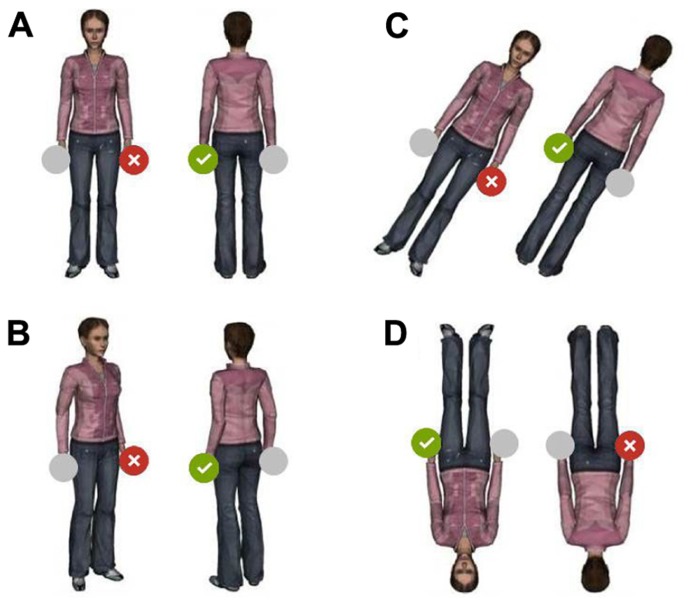
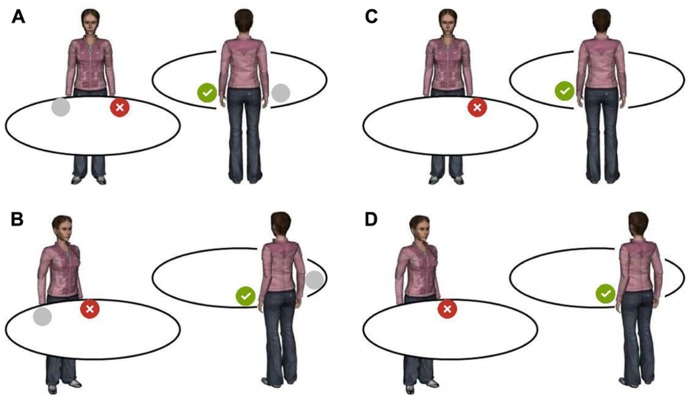
Perspective taking plays an important role in different areas of psychological and neuroscientific research. Visual perspective taking is an especially prominent approach generally using one of two experimental tasks: in the own-body-transformation task observers are asked to judge the laterality of a salient feature of a human figure (e.g., is the glove on the left or right hand?) from the figure's perspective. In the avatar-in-scene task they decide about the laterality of objects in a scene (e.g., is the flower on the left or right?) from the avatar's point of view. Increases in latencies and/or errors are interpreted as originating from additional cognitive processes predominately described as observer-based perspective transformations. A closer look reveals that such an account is disputable on grounds related to the use of laterality judgments. Other transformation accounts, i.e., object or array transformations, as well as non-transformational accounts, i.e., extra processing due to spatial conflicts, have not been adequately considered, tested, or ruled out by existing research. Our review examines visual perspective tasks in detail, identifies problems and makes recommendations for future research.
换位思考在心理学和神经科学研究的不同领域中发挥着重要作用。视觉换位思考是一种特别突出的方法,通常使用两种实验任务之一:在自身身体转换任务中,观察者被要求从人物的角度判断人物显著特征的方向(例如,手套是在左手还是右手上?)。在场景中的虚拟化身任务中,他们从虚拟化身的角度判断场景中物体的方向(例如,花在左边还是右边?)。反应时和/或错误的增加被解释为主要源于以观察者为基础的视角转换的额外认知过程。仔细观察会发现,这样的解释在与方向判断的使用相关的方面是有争议的。其他转换解释,即物体或阵列转换,以及非转换解释,即由于空间冲突导致的额外处理,尚未得到现有研究的充分考虑、测试或排除。我们的综述详细研究了视觉换位思考任务,识别了问题并为未来研究提出了建议。