Kallenberg F G J, Aalfs C M, The F O, Wientjes C A, Depla A C, Mundt M W, Bossuyt P M M, Dekker E
Department of Gastroenterology and Hepatology, Academic Medical Center, University of Amsterdam, Meibergdreef 9, 1105 AZ, Amsterdam, The Netherlands.
Department of Clinical Genetics, Academic Medical Center, University of Amsterdam, Amsterdam, The Netherlands.
Fam Cancer. 2018 Jul;17(3):371-380. doi: 10.1007/s10689-017-0041-7.
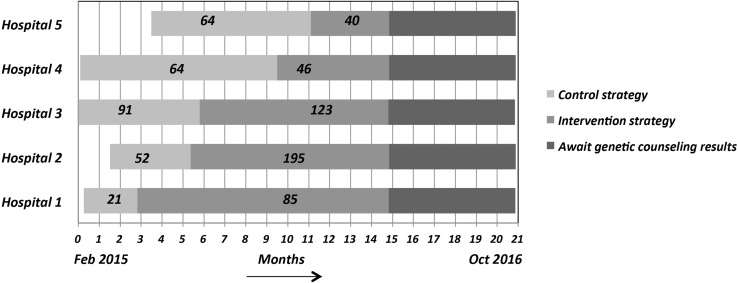
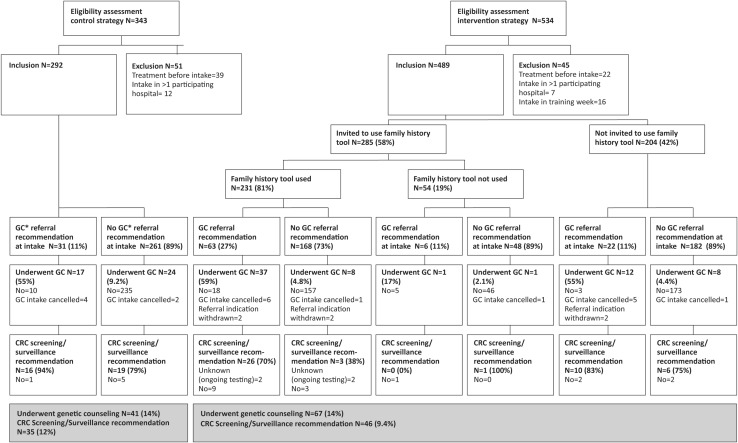
Identifying a hereditary colorectal cancer (CRC) syndrome or familial CRC (FCC) in a CRC patient may enable the patient and relatives to enroll in surveillance protocols. As these individuals are insufficiently recognized, we evaluated an online family history tool, consisting of a patient-administered family history questionnaire and an automated genetic referral recommendation, to facilitate the identification of patients with hereditary CRC or FCC. Between 2015 and 2016, all newly diagnosed CRC patients in five Dutch outpatient clinics, were included in a trial with a stepped-wedge design, when first visiting the clinic. Each hospital continued standard procedures for identifying patients at risk (control strategy) and then, after a predetermined period, switched to offering the family history tool to included patients (intervention strategy). After considering the tool-based recommendation, the health care provider could decide on and arrange the referral. Primary outcome was the relative number of CRC patients who received screening or surveillance recommendations for themselves or relatives because of hereditary CRC or FCC, provided by genetic counseling. The intervention effect was evaluated using a logit-linear model. With the tool, 46/489 (9.4%) patients received a screening or surveillance recommendation, compared to 35/292 (12.0%) in the control group. In the intention-to-treat-analysis, accounting for time trends and hospital effects, this difference was not statistically significant (p = 0.58). A family history tool does not necessarily assist in increasing the number of CRC patients and relatives enrolled in screening or surveillance recommendations for hereditary CRC or FCC. Other interventions should be considered.
在结直肠癌(CRC)患者中识别遗传性结直肠癌综合征或家族性结直肠癌(FCC),可能会使患者及其亲属能够参与监测方案。由于这些个体未得到充分识别,我们评估了一种在线家族史工具,该工具包括患者自行填写的家族史问卷和自动生成的遗传转诊建议,以促进遗传性CRC或FCC患者的识别。在2015年至2016年期间,荷兰五家门诊诊所所有新诊断的CRC患者在首次就诊时被纳入一项采用阶梯楔形设计的试验。每家医院继续采用识别高危患者的标准程序(对照策略),然后在预定时期后,改为向纳入的患者提供家族史工具(干预策略)。在考虑基于工具的建议后,医疗保健提供者可以决定并安排转诊。主要结局是因遗传性CRC或FCC而接受针对自身或亲属的筛查或监测建议的CRC患者的相对数量,这些建议由遗传咨询提供。使用对数线性模型评估干预效果。使用该工具时,46/489(9.4%)的患者接受了筛查或监测建议,而对照组为35/292(12.0%)。在意向性分析中,考虑时间趋势和医院效应后,这种差异无统计学意义(p = 0.58)。家族史工具不一定有助于增加因遗传性CRC或FCC而参与筛查或监测建议的CRC患者及其亲属的数量。应考虑其他干预措施。