Department of Gynecology, Jena University Hospital-Friedrich Schiller University Jena, 07747 Jena, Germany.
Institute of Medical Statistics, Information Sciences and Documentation, Jena University Hospital-Friedrich Schiller University Jena, 07743 Jena, Germany.
Int J Mol Sci. 2017 Sep 22;18(10):2032. doi: 10.3390/ijms18102032.
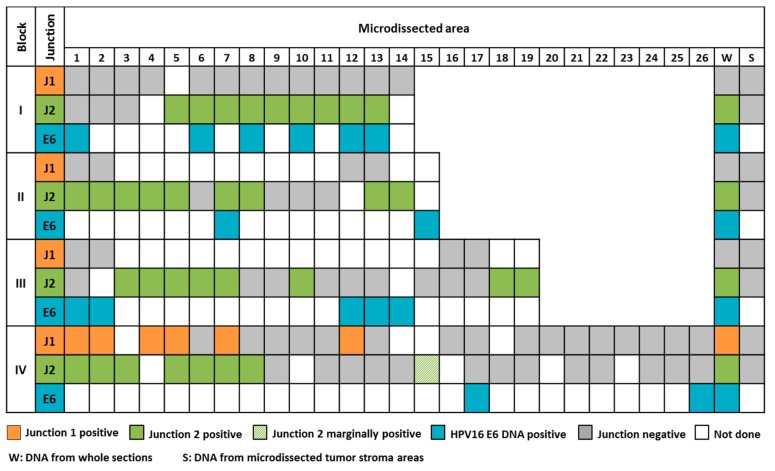
The development of cervical cancer is frequently accompanied by the integration of human papillomaviruses (HPV) DNA into the host genome. Viral-cellular junction sequences, which arise in consequence, are highly tumor specific. By using these fragments as markers for tumor cell origin, we examined cervical cancer clonality in the context of intra-tumor heterogeneity. Moreover, we assessed the potential of these fragments as molecular tumor markers and analyzed their suitability for the detection of circulating tumor DNA in sera of cervical cancer patients. For intra-tumor heterogeneity analyses tumors of 8 patients with up to 5 integration sites per tumor were included. Tumor islands were micro-dissected from cryosections of several tissue blocks representing different regions of the tumor. Each micro-dissected tumor area served as template for a single junction-specific PCR. For the detection of circulating tumor-DNA (ctDNA) junction-specific PCR-assays were applied to sera of 21 patients. Samples were collected preoperatively and during the course of disease. In 7 of 8 tumors the integration site(s) were shown to be homogenously distributed throughout different tumor regions. Only one tumor displayed intra-tumor heterogeneity. In 5 of 21 analyzed preoperative serum samples we specifically detected junction fragments. Junction-based detection of ctDNA was significantly associated with reduced recurrence-free survival. Our study provides evidence that HPV-DNA integration is as an early step in cervical carcinogenesis. Clonality with respect to HPV integration opens new perspectives for the application of viral-cellular junction sites as molecular biomarkers in a clinical setting such as disease monitoring.
宫颈癌的发展通常伴随着人类乳头瘤病毒 (HPV) DNA 整合到宿主基因组中。由此产生的病毒-细胞连接序列具有高度的肿瘤特异性。我们使用这些片段作为肿瘤细胞起源的标记,研究了肿瘤内异质性背景下的宫颈癌克隆性。此外,我们评估了这些片段作为分子肿瘤标志物的潜力,并分析了它们在检测宫颈癌患者血清循环肿瘤 DNA 中的适用性。对于肿瘤内异质性分析,纳入了 8 名患者的肿瘤,每个肿瘤最多有 5 个整合点。从代表肿瘤不同区域的多个组织块的冷冻切片中微切割肿瘤岛。每个微切割的肿瘤区域都作为单个连接特异性 PCR 的模板。为了检测循环肿瘤 DNA(ctDNA),我们应用连接特异性 PCR 分析了 21 名患者的血清。样本在术前和疾病过程中采集。在 8 个肿瘤中的 7 个中,整合部位均匀分布在不同的肿瘤区域。只有一个肿瘤显示出肿瘤内异质性。在分析的 21 个术前血清样本中的 5 个中,我们特异性地检测到了连接片段。基于连接的 ctDNA 检测与无复发生存率降低显著相关。我们的研究提供了证据表明 HPV-DNA 整合是宫颈癌发生的早期步骤。HPV 整合的克隆性为将病毒-细胞连接位点作为分子生物标志物在临床环境(如疾病监测)中的应用开辟了新的前景。