Zhang Zheng, Fan Wei, Deng Qiaoling, Tang Shihui, Wang Ping, Xu Peipei, Wang June, Yu Mingxia
Department of Clinical Laboratory, Zhongnan Hospital of Wuhan University, Wuhan, Hubei, 430071, China.
Department of Pathology, Zhongnan Hospital of Wuhan University, Wuhan, Hubei, 430071, China.
Oncotarget. 2017 Jun 16;8(35):59527-59538. doi: 10.18632/oncotarget.18521. eCollection 2017 Aug 29.
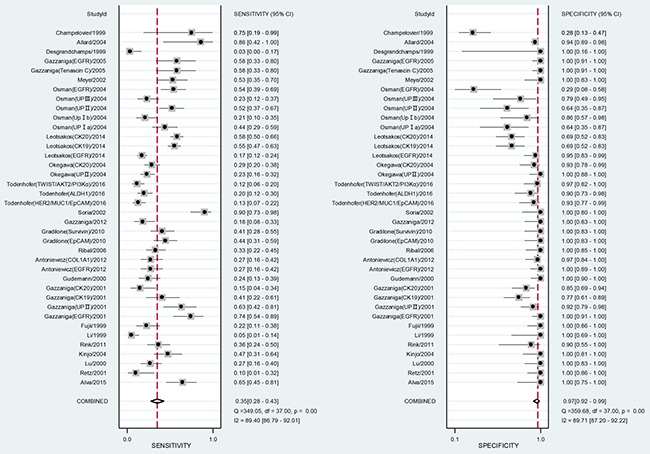
There are inconsistent conclusions in the association between circulating tumor cells (CTCs) and urothelial cancer (UC). We performed a meta-analysis to assess the prognostic and diagnostic value of CTCs in UC. We search Medline, Embase and Web of science for relevant studies. The study was set up according to the inclusion/exclusion criteria. 30 published studies with a total of 2161 urothelial cancer patients were included. Meta-analysis showed that CTC-positive was significantly associated with tumor stage (≤ II vs III, IV) (OR = 4.60, 95% CI: 2.34-9.03), histological grade (I, II vs III) (OR = 2.91, 95% CI: 1.92-4.40), metastasis (OR = 5.12, 95% CI: 3.47-7.55) and regional lymph node metastasis (OR = 2.47, 95% CI: 1.75-3.49). It was also significantly associated with poor overall survival (OS) (HR = 3.98, 95% CI: 2.20-7.21), progression/disease-free survival (PFS/DFS) (HR = 2.22, 95% CI: 1.80-2.73) and cancer-specific survival (CSS) (HR = 5.18, 95% CI: 2.21-12.13). Overall sensitivity and specificity of CTC detection assays were 0.35 (95% CI: 0.28-0.43) and 0.97 (95% CI: 0.92-0.99) respectively. In summary, our meta-analysis suggests that the presence of CTCs in the peripheral blood is an independent predictive indicator of poor outcomes for urothelial cancer patients. It can also be used as a noninvasive method for the confirmation of cancer diagnosis. More studies are required to further explore the role of this marker in clinical practice.
循环肿瘤细胞(CTC)与尿路上皮癌(UC)之间的关联存在不一致的结论。我们进行了一项荟萃分析,以评估CTC在UC中的预后和诊断价值。我们在Medline、Embase和科学网中搜索相关研究。该研究根据纳入/排除标准设立。纳入了30项已发表的研究,共2161例尿路上皮癌患者。荟萃分析表明,CTC阳性与肿瘤分期(≤II期与III期、IV期)(OR = 4.60,95%CI:2.34 - 9.03)、组织学分级(I级、II级与III级)(OR = 2.91,95%CI:1.92 - 4.40)、转移(OR = 5.12,95%CI:3.47 - 7.55)和区域淋巴结转移(OR = 2.47,95%CI:1.75 - 3.49)显著相关。它还与总体生存期(OS)较差(HR = 3.98,95%CI:2.20 - 7.21)、进展/无病生存期(PFS/DFS)(HR = 2.22,95%CI:1.80 - 2.73)和癌症特异性生存期(CSS)(HR = 5.18,95%CI:2.21 - 12.13)显著相关。CTC检测方法的总体敏感性和特异性分别为0.35(95%CI:0.28 - 0.43)和0.97(95%CI:0.92 - 0.99)。总之,我们的荟萃分析表明,外周血中CTC的存在是尿路上皮癌患者预后不良的独立预测指标。它还可以用作癌症诊断确认的非侵入性方法。需要更多研究来进一步探索该标志物在临床实践中的作用。