• 文献检索
  • 文档翻译
  • 深度研究
  • 学术资讯
  • Suppr Zotero 插件Zotero 插件
  • 邀请有礼
  • 套餐&价格
  • 历史记录
应用&插件
Suppr Zotero 插件Zotero 插件浏览器插件Mac 客户端Windows 客户端微信小程序
定价
高级版会员购买积分包购买API积分包
服务
文献检索文档翻译深度研究API 文档MCP 服务
关于我们
关于 Suppr公司介绍联系我们用户协议隐私条款
关注我们

Suppr 超能文献

核心技术专利:CN118964589B侵权必究
粤ICP备2023148730 号-1Suppr @ 2026

文献检索

告别复杂PubMed语法,用中文像聊天一样搜索,搜遍4000万医学文献。AI智能推荐,让科研检索更轻松。

立即免费搜索

文件翻译

保留排版,准确专业,支持PDF/Word/PPT等文件格式,支持 12+语言互译。

免费翻译文档

深度研究

AI帮你快速写综述,25分钟生成高质量综述,智能提取关键信息,辅助科研写作。

立即免费体验

新型低轮廓可视化腔内支撑(LVIS Blue)支架与血流导向装置(FRED)在台架和尸体研究中的比较。

A comparison between the new Low-profile Visualized Intraluminal Support (LVIS Blue) stent and the Flow Redirection Endoluminal Device (FRED) in bench-top and cadaver studies.

机构信息

Department of Neurological Surgery, Rush University Medical Center, Chicago, Illinois, USA.

Department of Neurosurgery, Wakayama Medical University, Wakayama City, Japan.

出版信息

J Neurointerv Surg. 2018 Mar;10(3):274-278. doi: 10.1136/neurintsurg-2017-013074. Epub 2017 Sep 22.

DOI:10.1136/neurintsurg-2017-013074
PMID:28939583
原文链接:https://pmc.ncbi.nlm.nih.gov/articles/PMC5869451/
Abstract

OBJECT

The aim of this study is to demonstrate the differences between the new Low-profile Visualized Intraluminal Support (LVIS Blue) stenting device and the Flow Redirection Endoluminal Device (FRED) using a series of bench-top evaluations and optical coherence tomography (OCT) images in a cadaveric preparation of the basilar artery.

METHODS

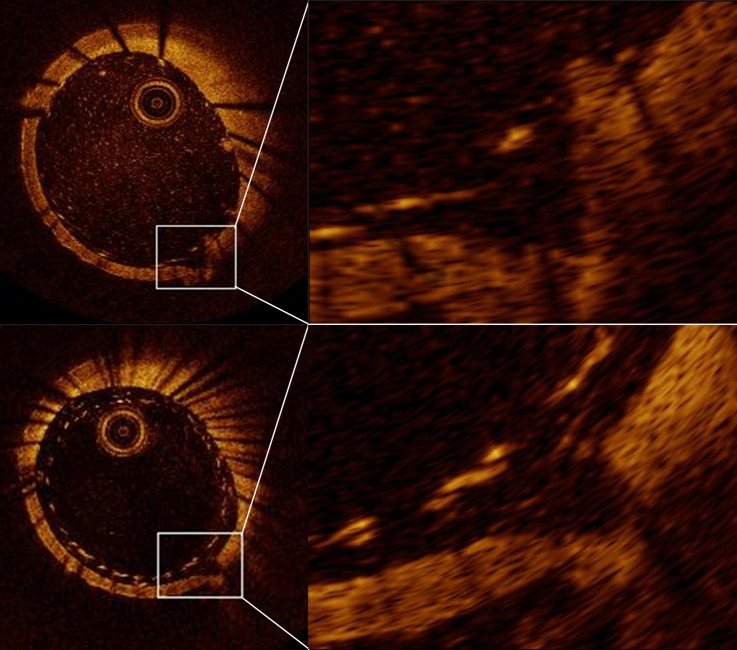
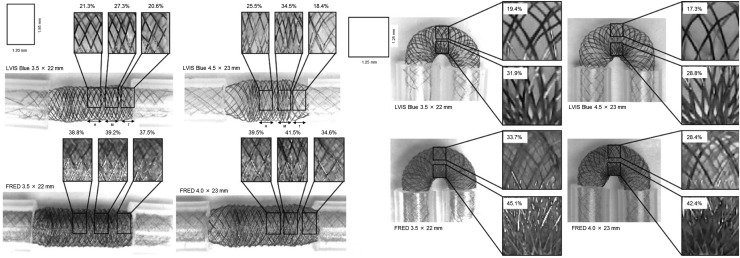
The first part of the evaluation was bench-top microscopic documentation of metal coverage for LVIS Blue and FRED stents. OCT images of the cerebral vessels and deployed stents were acquired using OCT intravascular imaging. The stents were deployed from the left posterior cerebral artery to the basilar artery in a fresh frozen cadaver. Wall apposition and the relationship to jailed perforators were evaluated.

RESULTS

The metal coverage along the inner curves of the LVIS Blue stent was similar to that along the outer curves of the FRED stent. The LVIS Blue stent cell size was compatible for crossing with the tested microcatheters after deployment of the stent. The LVIS Blue stent showed better wall apposition and less coverage of the perforator than the FRED stent in the cadaver experiment.

CONCLUSIONS

LVIS Blue has a good crossing profile for microcatheters, better wall apposition, and less perforator coverage than FRED. These are desirable features in territories with high densities of perforators such as the posterior circulation.

摘要

目的

本研究旨在通过基底动脉尸体标本的一系列台架评估和光学相干断层扫描(OCT)图像,展示新型低轮廓可视化腔内支撑(LVIS Blue)支架与血流转向腔内装置(FRED)之间的差异。

方法

评估的第一部分是对 LVIS Blue 和 FRED 支架的金属覆盖率进行台架显微镜记录。使用 OCT 血管内成像获取脑血管和展开支架的 OCT 图像。支架从左大脑后动脉部署到基底动脉,在新鲜冷冻的尸体中进行。评估壁贴附和与受困穿支动脉的关系。

结果

LVIS Blue 支架内曲线的金属覆盖率与 FRED 支架外曲线的金属覆盖率相似。LVIS Blue 支架展开后,其支架细胞尺寸与测试微导管兼容,可穿过微导管。在尸体实验中,与 FRED 支架相比,LVIS Blue 支架具有更好的贴壁和更少的穿支动脉覆盖。

结论

与 FRED 相比,LVIS Blue 具有良好的微导管穿越特性、更好的贴壁效果和更少的穿支动脉覆盖。这些是在穿支动脉密度较高的区域(如后循环)所期望的特性。
https://cdn.ncbi.nlm.nih.gov/pmc/blobs/f7ac/5869451/8c6fd7fd05d1/neurintsurg-2017-013074f03.jpg
https://cdn.ncbi.nlm.nih.gov/pmc/blobs/f7ac/5869451/0c9e0eed9fc1/neurintsurg-2017-013074f01.jpg
https://cdn.ncbi.nlm.nih.gov/pmc/blobs/f7ac/5869451/2279f04190e4/neurintsurg-2017-013074f02.jpg
https://cdn.ncbi.nlm.nih.gov/pmc/blobs/f7ac/5869451/8c6fd7fd05d1/neurintsurg-2017-013074f03.jpg
https://cdn.ncbi.nlm.nih.gov/pmc/blobs/f7ac/5869451/0c9e0eed9fc1/neurintsurg-2017-013074f01.jpg
https://cdn.ncbi.nlm.nih.gov/pmc/blobs/f7ac/5869451/2279f04190e4/neurintsurg-2017-013074f02.jpg
https://cdn.ncbi.nlm.nih.gov/pmc/blobs/f7ac/5869451/8c6fd7fd05d1/neurintsurg-2017-013074f03.jpg

相似文献

1
A comparison between the new Low-profile Visualized Intraluminal Support (LVIS Blue) stent and the Flow Redirection Endoluminal Device (FRED) in bench-top and cadaver studies.新型低轮廓可视化腔内支撑(LVIS Blue)支架与血流导向装置(FRED)在台架和尸体研究中的比较。
J Neurointerv Surg. 2018 Mar;10(3):274-278. doi: 10.1136/neurintsurg-2017-013074. Epub 2017 Sep 22.
2
A new low-profile visualized intraluminal support (LVIS) device, LVIS Blue: laboratory comparison between old and new LVIS.一种新型低调可视化腔内支撑(LVIS)装置,LVIS Blue:新旧LVIS的实验室比较
Neurol Res. 2018 Jan;40(1):78-85. doi: 10.1080/01616412.2017.1398881. Epub 2017 Nov 5.
3
Preliminary experience with the use of low profile visualized intraluminal support device in basilar artery for aneurysm treatment.在基底动脉动脉瘤治疗中使用低位可视化腔内支撑装置的初步经验。
J Neurointerv Surg. 2019 Apr;11(4):405-410. doi: 10.1136/neurintsurg-2018-014393. Epub 2018 Nov 10.
4
Hemodynamic differences between Pipeline and coil-adjunctive intracranial stents.血流动力学差异:Pipeline 与 coil-辅助颅内支架。
J Neurointerv Surg. 2019 Sep;11(9):908-911. doi: 10.1136/neurintsurg-2018-014439. Epub 2019 Feb 27.
5
Utility of bulging technique for endovascular treatment of small and wide-necked aneurysms with a Low-profile Visualized Intraluminal Support (LVIS Jr.) device: A case report and review of the literature.使用低轮廓可视化腔内支撑(LVIS Jr.)装置的球囊扩张技术在小颈宽颈动脉瘤血管内治疗中的应用:病例报告及文献综述
Interv Neuroradiol. 2018 Apr;24(2):125-129. doi: 10.1177/1591019917743065. Epub 2017 Nov 21.
6
Incomplete stent apposition of low-profile visualized intraluminal support stents in the treatment of cerebral aneurysms.低轮廓可视化腔内支撑支架在治疗脑动脉瘤中支架贴壁不完整的情况。
J Neurointerv Surg. 2020 Jun;12(6):591-597. doi: 10.1136/neurintsurg-2019-015505. Epub 2019 Dec 9.
7
Hemodynamic differences by increasing low profile visualized intraluminal support (LVIS) stent local compaction across intracranial aneurysm orifice.通过增加低轮廓可视化腔内支撑(LVIS)支架在颅内动脉瘤口的局部压缩来改变血流动力学差异。
Interv Neuroradiol. 2020 Oct;26(5):557-565. doi: 10.1177/1591019920952903. Epub 2020 Aug 23.
8
Treatment of wide-necked aneurysms with the Low-profile Visualized Intraluminal Support (LVIS Jr) device: a multicenter experience.使用低轮廓可视化腔内支撑(LVIS Jr)装置治疗宽颈动脉瘤:多中心经验。
J Neurointerv Surg. 2017 Nov;9(11):1098-1102. doi: 10.1136/neurintsurg-2016-012687. Epub 2016 Oct 27.
9
225 intracranial aneurysms treated with the Low-profile Visualized Intraluminal Support (LVIS) stent: a single-center retrospective study.采用低轮廓可视化腔内支撑(LVIS)支架治疗的225例颅内动脉瘤:一项单中心回顾性研究。
Neurol Res. 2018 Jun;40(6):445-451. doi: 10.1080/01616412.2018.1457608. Epub 2018 Apr 23.
10
Comparison of Recanalization and In-Stent Stenosis Between the Low-Profile Visualized Intraluminal Support Stent and Enterprise Stent-Assisted Coiling for 254 Intracranial Aneurysms.254 例颅内动脉瘤患者采用可视化小口径颅内支撑导管与 Enterprise 支架辅助弹簧圈治疗的再通率与支架内狭窄比较。
World Neurosurg. 2018 Jan;109:e99-e104. doi: 10.1016/j.wneu.2017.09.112. Epub 2017 Sep 27.

引用本文的文献

1
Endovascular Treatment of Large Proximal Basilar Artery Fenestrated Aneurysms: Overlapping Stent with Coil Embolization-A Case Report.大型基底动脉近端开窗动脉瘤的血管内治疗:支架重叠联合弹簧圈栓塞——病例报告
NMC Case Rep J. 2024 Nov 16;11:305-312. doi: 10.2176/jns-nmc.2024-0068. eCollection 2024.
2
Comparison of pipeline embolization device and flow redirection endoluminal device in the treatment of intracranial aneurysms: A systematic review and meta-analysis.管道栓塞装置与血流导向腔内装置治疗颅内动脉瘤的比较:一项系统评价和荟萃分析。
Interv Neuroradiol. 2024 Jul 25:15910199241264345. doi: 10.1177/15910199241264345.
3

本文引用的文献

1
Flow diverter effect of LVIS stent on cerebral aneurysm hemodynamics: a comparison with Enterprise stents and the Pipeline device.LVIS支架对脑动脉瘤血流动力学的分流作用:与Enterprise支架及Pipeline装置的比较
J Transl Med. 2016 Jul 2;14(1):199. doi: 10.1186/s12967-016-0959-9.
2
Final results of the US humanitarian device exemption study of the low-profile visualized intraluminal support (LVIS) device.美国低轮廓可视化腔内支撑(LVIS)装置人道主义器械豁免研究的最终结果。
J Neurointerv Surg. 2016 Sep;8(9):894-7. doi: 10.1136/neurintsurg-2015-011937. Epub 2015 Sep 21.
3
The FRED flow-diverter stent for intracranial aneurysms: clinical study to assess safety and efficacy.
A Patient with a Large Basilar Artery Aneurysm in Whom Coil Embolization Was Performed by Protruding an LVIS into the Aneurysmal Neck in a Barrel-like Shape and Preserving a Branch Vessel.
一例大型基底动脉动脉瘤患者,通过将LVIS以桶状形状突出至动脉瘤颈部并保留一支分支血管进行了弹簧圈栓塞治疗。
J Neuroendovasc Ther. 2020;14(10):447-453. doi: 10.5797/jnet.cr.2020-0044. Epub 2020 Aug 10.
4
Low-profile visualized intraluminal support-within-Enterprise overlapping-stent technique versus flow diversion in the treatment of intracranial vertebrobasilar trunk dissecting aneurysms.低轮廓可视化腔内支撑-Enterprise重叠支架技术与血流导向术治疗颅内椎基底动脉主干夹层动脉瘤的对比
Quant Imaging Med Surg. 2023 Jun 1;13(6):3536-3546. doi: 10.21037/qims-22-970. Epub 2023 Apr 14.
5
LVIS-within-enterprise double-stent technique with coil embolization in the treatment of patients with acutely ruptured intracranial vertebrobasilar artery-dissecting aneurysms.企业内LVIS双支架技术联合弹簧圈栓塞治疗急性破裂颅内椎基底动脉夹层动脉瘤患者
Front Neurol. 2023 Mar 24;14:1069380. doi: 10.3389/fneur.2023.1069380. eCollection 2023.
6
Intermediate-porosity stent for coil-reconstruction of mixed saccular-fusiform basilar trunk aneurysm.中等孔隙支架用于线圈重建混合型梭形基底干动脉瘤。
Interv Neuroradiol. 2024 Feb;30(1):127. doi: 10.1177/15910199221113643. Epub 2022 Aug 2.
7
Prospects and Dilemmas of Endovascular Treatment for Vertebrobasilar Dolichoectasia.椎基底动脉延长扩张症血管内治疗的前景与困境
Front Neurol. 2022 Jul 5;13:895527. doi: 10.3389/fneur.2022.895527. eCollection 2022.
8
Evaluation of Stent Apposition in the LVIS Blue Stent-Assisted Coiling of Distal Internal Carotid Artery Aneurysms : Correlation with Clinical and Angiographic Outcomes.远端颈内动脉动脉瘤LVIS蓝色支架辅助弹簧圈栓塞中支架贴壁情况的评估:与临床和血管造影结果的相关性
J Korean Neurosurg Soc. 2022 Nov;65(6):801-815. doi: 10.3340/jkns.2022.0021. Epub 2022 Jun 22.
9
Venous outflow-targeted coil embolization of direct carotid-cavernous fistulas.针对颈内动脉海绵窦瘘的静脉引流靶向性弹簧圈栓塞术。
Interv Neuroradiol. 2023 Jun;29(3):251-259. doi: 10.1177/15910199221084787. Epub 2022 Mar 3.
10
Computational Study of Hemodynamic Changes Induced by Overlapping and Compacting of Stents and Flow Diverter in Cerebral Aneurysms.支架与血流导向装置重叠和压缩对脑动脉瘤血流动力学影响的计算研究
Front Neurol. 2021 Aug 2;12:705841. doi: 10.3389/fneur.2021.705841. eCollection 2021.
用于颅内动脉瘤的FRED血流导向支架:评估安全性和有效性的临床研究。
AJNR Am J Neuroradiol. 2015 Jun;36(6):1155-61. doi: 10.3174/ajnr.A4251. Epub 2015 Feb 26.
4
International retrospective study of the pipeline embolization device: a multicenter aneurysm treatment study.管道栓塞装置的国际回顾性研究:一项多中心动脉瘤治疗研究。
AJNR Am J Neuroradiol. 2015 Jan;36(1):108-15. doi: 10.3174/ajnr.A4111. Epub 2014 Oct 29.
5
Building multidevice pipeline constructs of favorable metal coverage: a practical guide.构建具有良好金属覆盖率的多设备管道结构:实用指南。
AJNR Am J Neuroradiol. 2014 Aug;35(8):1556-61. doi: 10.3174/ajnr.A3902. Epub 2014 Mar 27.
6
Variable porosity of the pipeline embolization device in straight and curved vessels: a guide for optimal deployment strategy.直弯血管中Pipeline 栓塞装置的可变孔隙率:最佳部署策略的指南。
AJNR Am J Neuroradiol. 2014 Apr;35(4):727-33. doi: 10.3174/ajnr.A3742. Epub 2013 Sep 26.
7
New generation of Flow Diverter (surpass) for unruptured intracranial aneurysms: a prospective single-center study in 37 patients.新一代血流导向装置(超越)治疗未破裂颅内动脉瘤:37 例前瞻性单中心研究。
Stroke. 2013 Jun;44(6):1567-77. doi: 10.1161/STROKEAHA.111.000434. Epub 2013 May 16.
8
Pipeline for uncoilable or failed aneurysms: results from a multicenter clinical trial.不可操控或失败的动脉瘤的治疗流程:多中心临床试验结果。
Radiology. 2013 Jun;267(3):858-68. doi: 10.1148/radiol.13120099. Epub 2013 Feb 15.
9
Endovascular treatment of intracranial aneurysms with flow diverters: a meta-analysis.血流导向装置治疗颅内动脉瘤的血管内治疗:荟萃分析。
Stroke. 2013 Feb;44(2):442-7. doi: 10.1161/STROKEAHA.112.678151. Epub 2013 Jan 15.
10
Safety of the pipeline embolization device in treatment of posterior circulation aneurysms.Pipeline 栓塞装置治疗后循环动脉瘤的安全性。
AJNR Am J Neuroradiol. 2012 Aug;33(7):1225-31. doi: 10.3174/ajnr.A3166. Epub 2012 Jun 7.