Centre for Primary Care and Public Health, Barts and The London School of Medicine and Dentistry, London, UK.
School of Social and Community Medicine, University of Bristol, Bristol, UK.
Clin Exp Allergy. 2017 Dec;47(12):1615-1624. doi: 10.1111/cea.13034. Epub 2017 Oct 16.
Limited epidemiological evidence suggests that low maternal iron status and anaemia in pregnancy may increase the risk of childhood respiratory and allergic outcomes.
To investigate the relation between maternal haemoglobin concentrations in pregnancy and childhood respiratory and allergic outcomes.
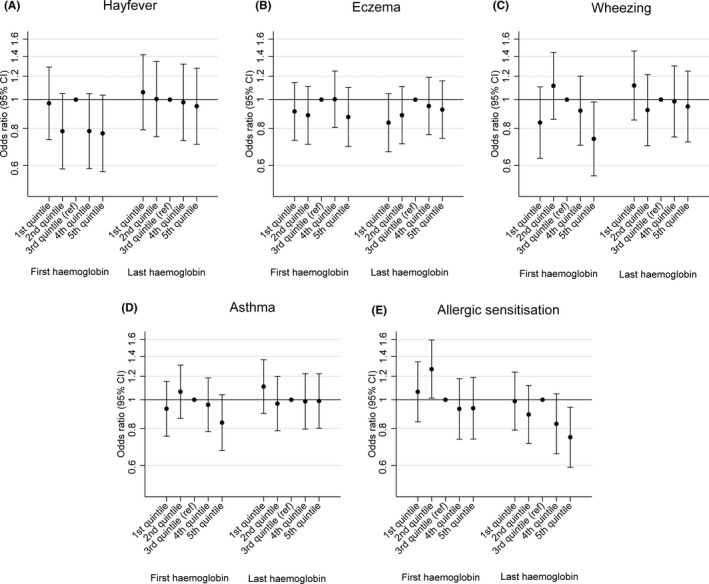
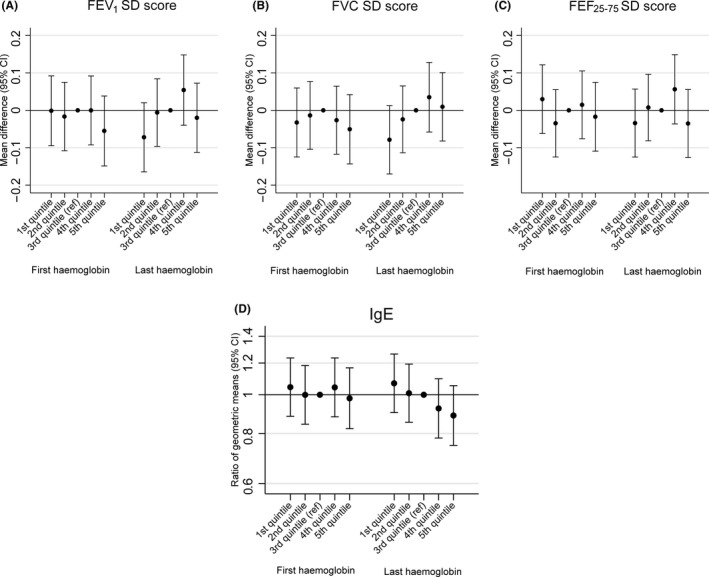
In the Avon Longitudinal Study of Parents and Children (ALSPAC), we examined associations of maternal haemoglobin concentrations (g/dL) in pregnancy with hayfever, eczema, wheezing, doctor-diagnosed asthma, allergic sensitisation and total IgE at 7 years, and with lung function at 8-9 years in the offspring, after controlling for potential confounders (N = 3234-5335).
Maternal haemoglobin was not associated with offspring hayfever, eczema, wheezing or asthma. However, the first haemoglobin measurement in pregnancy (<18 weeks' gestation) and the last measurement (>28 weeks' gestation) were negatively associated with allergic sensitisation (adjusted odds ratio [95% CI] per g/dL 0.91 [0.83 to 0.99] and 0.90 [0.83 to 0.98], respectively). The last haemoglobin measurement was also negatively associated with total IgE (adjusted geometric mean ratio 0.94 [0.88 to 0.99]). Anaemia (haemoglobin <11 g/dL) in late pregnancy was negatively associated with forced vital capacity (difference in standard deviation score -0.07 [-0.13 to -0.01]).
Lower maternal haemoglobin in pregnancy may be a risk factor for allergic sensitisation, elevated IgE and lower FVC in childhood, which may reflect effects of lower prenatal iron status. However, maternal haemoglobin was not associated with risk of childhood asthma or other allergic disorders.
有限的流行病学证据表明,孕妇铁营养状况低下和贫血可能会增加儿童呼吸道和过敏结局的风险。
研究孕妇妊娠期间血红蛋白浓度与儿童呼吸道和过敏结局的关系。
在阿冯纵向研究父母和子女(ALSPAC)中,我们检测了妊娠期间母亲血红蛋白浓度(g/dL)与花粉症、湿疹、喘息、医生诊断的哮喘、过敏致敏和总 IgE 在 7 岁时的关系,并在控制了潜在混杂因素后(N=3234-5335),检测了与子女 8-9 岁时的肺功能的关系。
母亲血红蛋白与子女花粉症、湿疹、喘息或哮喘均无关联。然而,妊娠早期(<18 周妊娠)和妊娠晚期(>28 周妊娠)的首次血红蛋白测量值与过敏致敏呈负相关(每 g/dL 的调整后比值比[95%CI]为 0.91[0.83 至 0.99]和 0.90[0.83 至 0.98])。最后一次血红蛋白测量值也与总 IgE 呈负相关(调整后的几何均数比为 0.94[0.88 至 0.99])。妊娠晚期贫血(血红蛋白<11 g/dL)与用力肺活量(标准偏差评分差值-0.07[-0.13 至 -0.01])呈负相关。
孕妇妊娠期间血红蛋白浓度较低可能是儿童期过敏致敏、IgE 升高和 FVC 降低的危险因素,这可能反映了产前铁营养状况较低的影响。然而,母亲血红蛋白与儿童哮喘或其他过敏疾病的风险无关。