Department of Biomedical Informatics, Harvard Medical School, Boston, Massachusetts.
CPT Pharmacometrics Syst Pharmacol. 2018 Feb;7(2):124-129. doi: 10.1002/psp4.12258. Epub 2018 Jan 24.
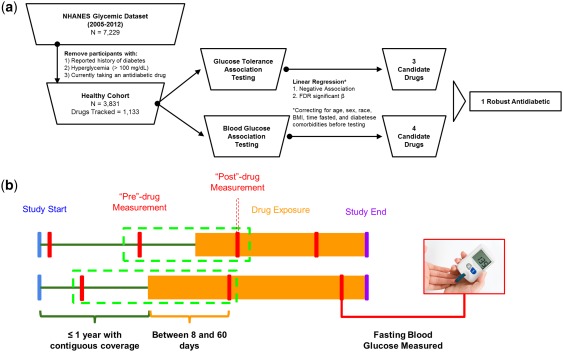
Computational drug repositioning methods can scalably nominate approved drugs for new diseases, with reduced risk of unforeseen side effects. The majority of methods eschew individual-level phenotypes despite the promise of biomarker-driven repositioning. In this study, we propose a framework for discovering serendipitous interactions between drugs and routine clinical phenotypes in cross-sectional observational studies. Key to our strategy is the use of a healthy and nondiabetic population derived from the National Health and Nutrition Examination Survey, mitigating risk for confounding by indication. We combine complementary diagnostic phenotypes (fasting glucose and glucose response) and associate them with prescription drug usage. We then sought confirmation of phenotype-drug associations in unidentifiable member claims data from the Aetna Insurance company using a retrospective self-controlled case analysis approach. We identify bupropion as a plausible glucose lowering agent, suggesting that surveying otherwise healthy individuals in cross-sectional studies can discover new drug repositioning hypotheses that have applicability to longitudinal clinical practice.
计算药物重定位方法可以大规模地将已批准的药物用于新的疾病,降低出现不可预见的副作用的风险。尽管有生物标志物驱动的药物重定位的前景,但大多数方法都回避了个体水平的表型。在这项研究中,我们提出了一种在横断面观察性研究中发现药物与常规临床表型之间偶然相互作用的框架。我们策略的关键是使用来自全国健康和营养检查调查的健康和非糖尿病人群,减轻了指示性混杂的风险。我们结合了互补的诊断表型(空腹血糖和血糖反应),并将其与处方药使用相关联。然后,我们使用回顾性自身对照病例分析方法,在 Aetna 保险公司的无法识别成员索赔数据中寻找表型-药物关联的确认。我们确定安非他酮是一种合理的降血糖药物,这表明在横断面研究中调查其他健康个体可以发现新的药物重定位假说,这些假说适用于纵向临床实践。