Sugarcane Research Institute, Guangxi Academy of Agricultural Sciences, Nanning, 530007, People's Republic of China.
Guangxi Academy of Agricultural Sciences, Nanning, 530007, People's Republic of China.
BMC Genomics. 2017 Sep 25;18(1):754. doi: 10.1186/s12864-017-4053-3.
Sugarcane (Saccharum officinarum L.) is an economically important crop, mainly due to the production of sugar and biofuel (Azevedo RA, Carvalho RF, Cia MC, & Gratão PL, Trop Plant Biol 4:42-51, 2011). Grown mainly in tropical and subtropical countries, sugarcane is a highly polyploid plant with up to ten copies of each chromosome, which increases the difficulties of genome assembly and genetic, physiologic and biochemical analyses. The increasing demands of sugar and the increasing cost of sugarcane harvest require sugarcane varieties which can shed their leaves during the maturity time, so it is important to study the mechanism of leaf abscission in sugarcane.
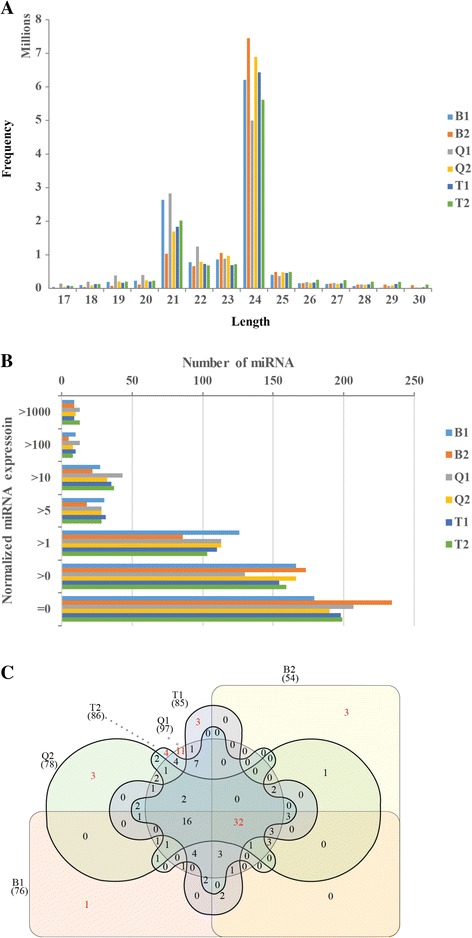
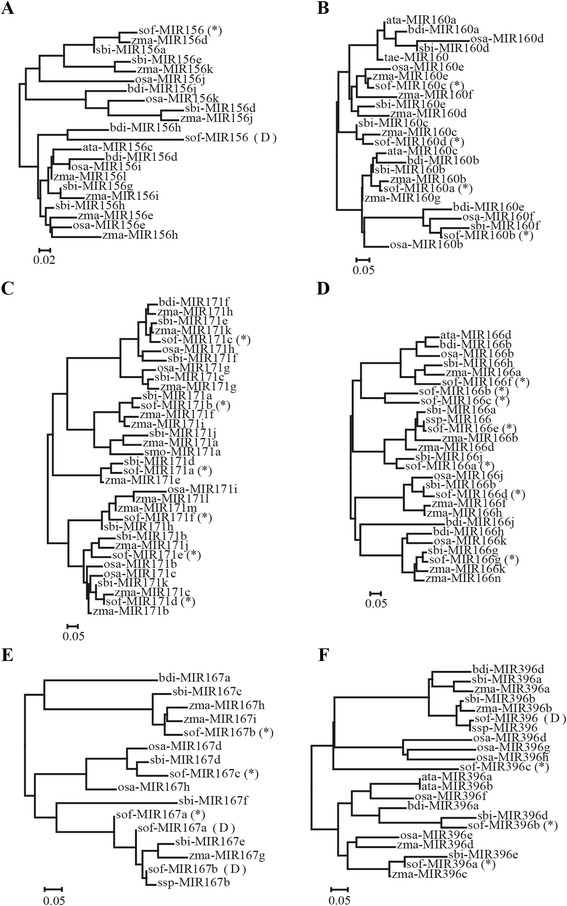
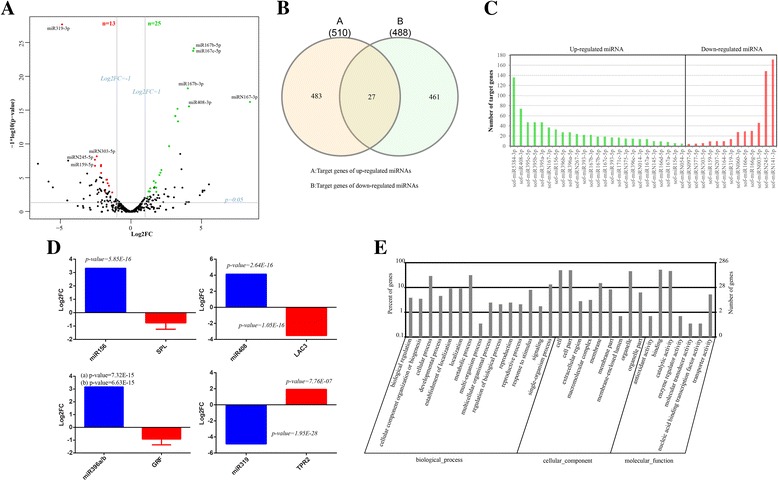
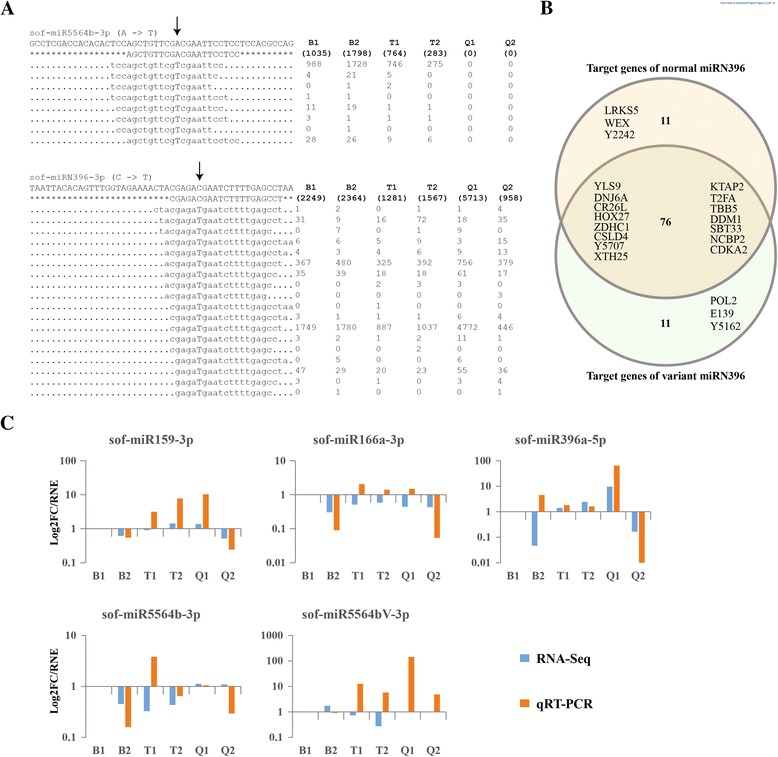
To improve the understanding of miRNA roles in sugarcane leaf abscission, we reported the genome-wide characterization of miRNAs and their putative targets in sugarcane using deep sequencing for six small RNA libraries. In total, 93 conserved miRNAs and 454 novel miRNAs were identified in sugarcane using previously reported transcriptome as reference. Among them, 25 up-regulated and 13 down-regulated miRNAs were identified in leaf abscission sugarcane plants (LASP) compared to leaf packaging sugarcane plants (LPSP). Target prediction revealed several miRNA-mRNA modules including miR156-SPL, miR319-TPR2, miR396-GRF and miR408-LAC3 might be involved in the sugarcane leaf abscission. KEGG pathway enrichment analysis showed differentially expressed miRNAs may regulate pathways like "plant hormone signal transduction" and "plant-pathogen interaction", which is consistent with previous transcriptome study. In addition, we identified 96 variant miRNAs with 135 single nucleotide polymorphisms (SNPs). The expression of sugarcane miRNAs and variant miRNAs were confirmed by qRT-PCR. We identified a possible poaceae specific miRNA called miR5384 for the first time in sugarcane.
We not only reported miR5384, a possible poaceae specific miRNA, for the first time in sugarcane but also presented some miRNA-mRNA modules including miR156-SPL, miR319-TPR2, miR396-GRF and miR408-LAC in sugarcane. These modules might be involved in the regulation of sugarcane leaf abscission during the maturity time. All of these findings may lay ground work for future application of sugarcane breeding program and benefit research studies of sugarcane miRNAs.
甘蔗(Saccharum officinarum L.)是一种经济上重要的作物,主要是因为它可以生产糖和生物燃料(Azevedo RA、Carvalho RF、Cia MC 和 Gratão PL,热带植物生物学 4:42-51, 2011)。甘蔗主要生长在热带和亚热带国家,是一种高度多倍体植物,每条染色体有多达十个拷贝,这增加了基因组组装和遗传、生理和生化分析的难度。对糖的需求不断增加和甘蔗收获成本的不断增加,要求甘蔗品种在成熟时能够脱落叶片,因此研究甘蔗叶片脱落的机制非常重要。
为了提高对 miRNA 在甘蔗叶片脱落中的作用的认识,我们使用深度测序技术,对六个小 RNA 文库进行了研究,报告了 miRNA 及其在甘蔗中的假定靶标在全基因组范围内的特征。总共在甘蔗中使用之前报道的转录组作为参考,鉴定了 93 个保守 miRNA 和 454 个新的 miRNA。其中,在与叶片包装甘蔗(LPSP)相比的叶片脱落甘蔗(LASP)中,鉴定出 25 个上调和 13 个下调的 miRNA。靶预测显示,miR156-SPL、miR319-TPR2、miR396-GRF 和 miR408-LAC3 等几个 miRNA-mRNA 模块可能参与了甘蔗叶片的脱落。KEGG 途径富集分析表明,差异表达的 miRNA 可能调节“植物激素信号转导”和“植物-病原体相互作用”等途径,这与之前的转录组研究一致。此外,我们还鉴定了 96 个具有 135 个单核苷酸多态性(SNP)的变异 miRNA。通过 qRT-PCR 验证了甘蔗 miRNA 和变异 miRNA 的表达。我们首次在甘蔗中鉴定出一种可能的禾本科特异 miRNA,称为 miR5384。
我们不仅首次在甘蔗中报道了 miR5384,一种可能的禾本科特异 miRNA,还提出了一些与甘蔗叶片脱落有关的 miRNA-mRNA 模块,包括 miR156-SPL、miR319-TPR2、miR396-GRF 和 miR408-LAC。这些模块可能参与了成熟过程中甘蔗叶片的脱落调控。所有这些发现都可能为未来的甘蔗育种计划奠定基础,并有助于甘蔗 miRNA 的研究。