Trimarchi Hernán
Nephrology Service, Hospital Británico de Buenos Aires, Buenos Aires 1280AEB, Argentina.
World J Nephrol. 2017 Sep 6;6(5):221-228. doi: 10.5527/wjn.v6.i5.221.
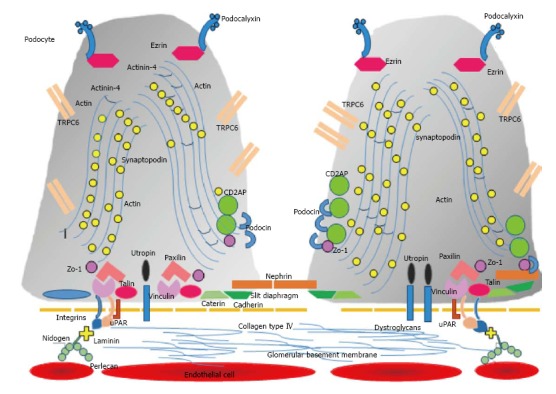
Chronic kidney disease is a prevalent condition that affects millions of people worldwide and is a major risk factor of cardiovascular morbidity and mortality. The main diseases that lead to chronic kidney disease are frequent entities as diabetes mellitus, hypertension and glomerulopathies. One of the clinical markers of kidney disease progression is proteinuria. Moreover, the histological hallmark of kidney disease is sclerosis, located both in the glomerular and in the interstitial compartments. Glomerulosclerosis underscores an irreversible lesion that is clinically accompanied by proteinuria. In this regard, proteinuria and glomerular sclerosis are linked by the cell that has been conserved phylogenetically not only to prevent the loss of proteins in the urine, but also to maintain the health of the glomerular filtration barrier: The podocyte. It can then be concluded that the link between proteinuria, kidney disease progression and chronic kidney disease is mainly related to the podocyte. What is this situation due to? The podocyte is unable to proliferate under normal conditions, and a complex molecular machinery exists to avoid its detachment and eventual loss. When the loss of podocytes in the urine, or podocyturia, is taking place and its glomerular absolute number decreased, glomerulosclerosis is the predominant histological feature in a kidney biopsy. Therefore, tissular podocyte shortage is the cause of proteinuria and chronic kidney disease. In this regard, podocyturia has been demonstrated to precede proteinuria, showing that the clinical management of proteinuria cannot be considered an early intervention. The identification of urinary podocytes could be an additional tool to be considered by nephrologists to assess the activity of glomerulopathies, for follow-up purposes and also to unravel the pathophysiology of podocyte detachment in order to tailor the therapy of glomerular diseases more appropriately.
慢性肾脏病是一种普遍存在的疾病,影响着全球数百万人,是心血管疾病发病和死亡的主要危险因素。导致慢性肾脏病的主要疾病常见于糖尿病、高血压和肾小球病等。蛋白尿是肾脏疾病进展的临床标志物之一。此外,肾脏疾病的组织学特征是硬化,存在于肾小球和间质区域。肾小球硬化强调了一种不可逆的病变,临床上伴有蛋白尿。在这方面,蛋白尿和肾小球硬化与一种在系统发育上保守的细胞相关联,这种细胞不仅能防止尿液中蛋白质的流失,还能维持肾小球滤过屏障的健康:足细胞。因此,可以得出结论,蛋白尿、肾脏疾病进展和慢性肾脏病之间的联系主要与足细胞有关。这种情况是由什么引起的呢?足细胞在正常情况下无法增殖,并且存在一个复杂的分子机制来避免其脱离和最终丢失。当尿液中出现足细胞丢失,即足细胞尿,且其肾小球绝对数量减少时,肾小球硬化是肾活检中主要的组织学特征。因此,组织性足细胞短缺是蛋白尿和慢性肾脏病的原因。在这方面,已证明足细胞尿先于蛋白尿出现,这表明蛋白尿的临床管理不能被视为早期干预。尿足细胞的识别可能是肾病学家在评估肾小球病活动、进行随访以及阐明足细胞脱离的病理生理学以更恰当地调整肾小球疾病治疗方案时应考虑的另一种工具。