Olivera Mario J, Cucunubá Zulma M, Valencia-Hernández Carlos A, Herazo Rafael, Agreda-Rudenko Diana, Flórez Carolina, Duque Sofía, Nicholls Rubén S
Red Chagas Colombia, Bogotá DC, Colombia.
Grupo de Parasitología, Instituto Nacional de Salud, Bogotá DC, Colombia.
PLoS One. 2017 Sep 26;12(9):e0185033. doi: 10.1371/journal.pone.0185033. eCollection 2017.
Etiological treatment of Chagas disease in chronic asymptomatic patients is still in debate and the adverse effects of traditional drugs are one of the main concerns in clinical practice. This study evaluated retrospectively the safety profile of benznidazole (BZN) and identified predictive factors for definite treatment interruption and development of severe reactions in adult patients treated with BZN in Colombia.
Retrospective follow-up study conducted by review of medical records of adults with chronic Chagas disease treated with BZN in Colombia. A parametric survival analysis based on a generalized gamma distribution was used for assessing risk factors for treatment interruption. A multinomial logistic regression model was used to estimate the probability of severe adverse drug reactions (ADRs). Statistical associations were expressed as time ratios (TR) and adjusted odds ratios (aOR) respectively.
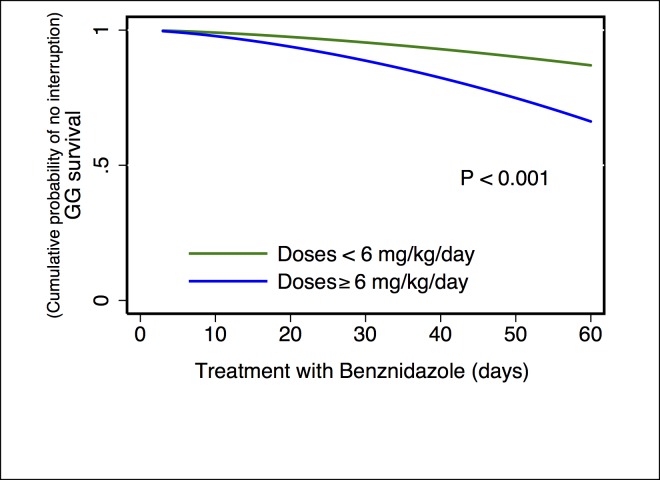
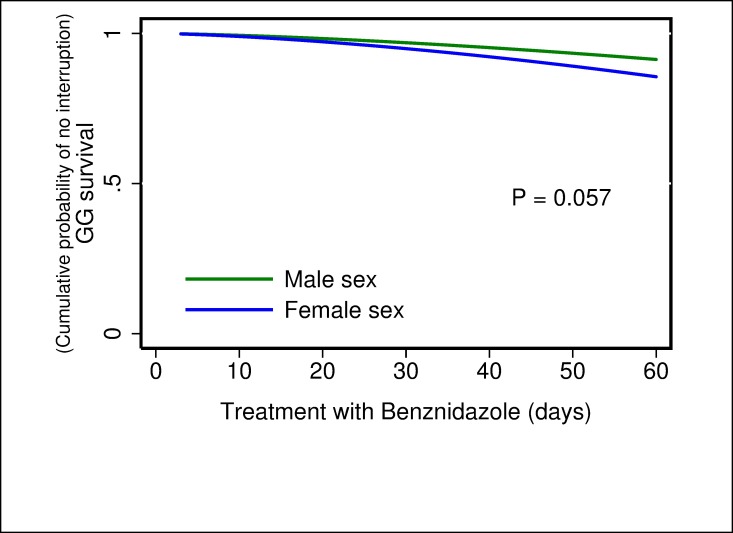
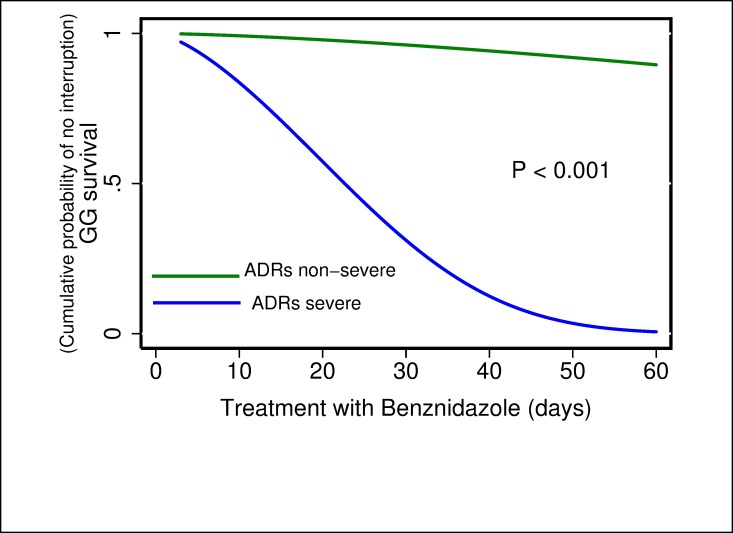
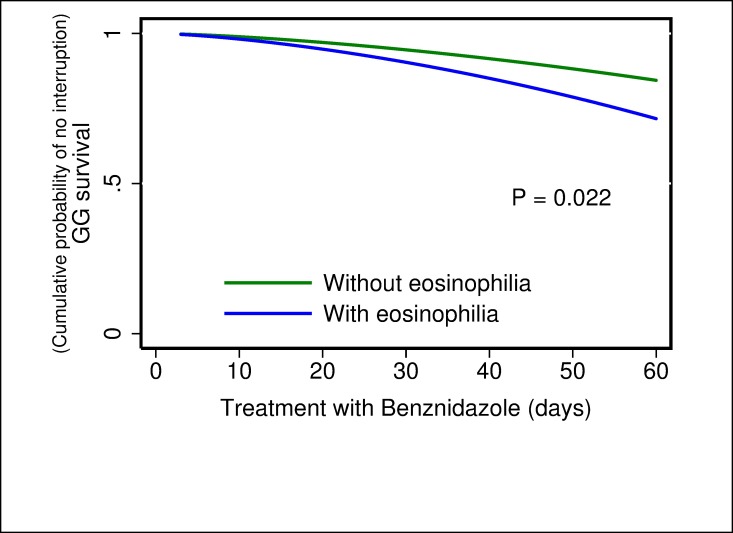
In total 224 adults patients treated with BZN were included; 172 (76.8%) completed the standard therapy (60 days of treatment), 205 (91.5%) presented ADRs and 52 cases (23.2%) required treatment interruption. The predominant symptoms were: rash (37.9%), itching (33.7%), epigastric pain (26.4%), abdominal bloating (24.2%) and nausea (22.1%). ADRs were mild (57.4%), moderate (35.5%) and severe (7.3%). Time to treatment interruption was significantly shorter when using doses of BZN ≥ 6 mg/kg/day (TR 0.55; 95% CI 0.39-0.76), presenting severe ADRs (TR 0.12; 95% CI: 0.07-0.19) and eosinophilia (TR 0.68; 95% CI: 0.49-0.94). Female sex (aOR 3.98; 95% CI 1.56-10.16), dose of BZN ≥ 6 mg/kg/day (aOR 1.41; 95% CI 1.17-1.70) and presence of > 3 ADRs (aOR 6.47; 95% CI 1.24-34.34) were considered as risk factors for developing severe ADRs.
Dose, severity of ADRs, eosinophilia and female sex were the main predictors for treatment interruption or severe ADRs. The potential implications of these findings are discussed.
慢性无症状查加斯病患者的病因治疗仍存在争议,传统药物的不良反应是临床实践中的主要关注点之一。本研究回顾性评估了苯硝唑(BZN)的安全性,并确定了哥伦比亚接受BZN治疗的成年患者明确治疗中断和发生严重反应的预测因素。
通过回顾哥伦比亚接受BZN治疗的慢性查加斯病成年患者的病历进行回顾性随访研究。基于广义伽马分布的参数生存分析用于评估治疗中断的危险因素。多项逻辑回归模型用于估计严重药物不良反应(ADR)的概率。统计关联分别表示为时间比(TR)和调整比值比(aOR)。
共纳入224例接受BZN治疗的成年患者;172例(76.8%)完成了标准治疗(60天治疗),205例(91.5%)出现ADR,52例(23.2%)需要中断治疗。主要症状为:皮疹(37.9%)、瘙痒(33.7%)、上腹部疼痛(26.4%)、腹胀(24.2%)和恶心(22.1%)。ADR为轻度(57.4%)、中度(35.5%)和重度(7.3%)。当使用BZN剂量≥6mg/kg/天时,治疗中断时间显著缩短(TR 0.55;95%CI 0.39 - 0.76),出现严重ADR(TR 0.12;95%CI:0.07 - 0.19)和嗜酸性粒细胞增多(TR 0.68;95%CI:0.49 - 0.94)。女性(aOR 3.98;95%CI 1.56 - 10.16)、BZN剂量≥6mg/kg/天(aOR 1.41;95%CI 1.17 - 1.70)以及出现>3种ADR(aOR 6.47;95%CI 1.24 - 34.34)被认为是发生严重ADR的危险因素。
剂量、ADR严重程度、嗜酸性粒细胞增多和女性是治疗中断或严重ADR的主要预测因素。讨论了这些发现的潜在影响。