Shehata Rasha H, Abdelmoneim Soha S, Osman Osman A, Hasanain Ahmad F, Osama Amany, Abdelmoneim Sahar S, Toraih Eman A
Department of Tropical Medicine and Gastroenterology, Faculty of Medicine, Assiut University, Assiut, Egypt. Email:
Asian Pac J Cancer Prev. 2017 Sep 27;18(9):2395-2401. doi: 10.22034/APJCP.2017.18.9.2395.
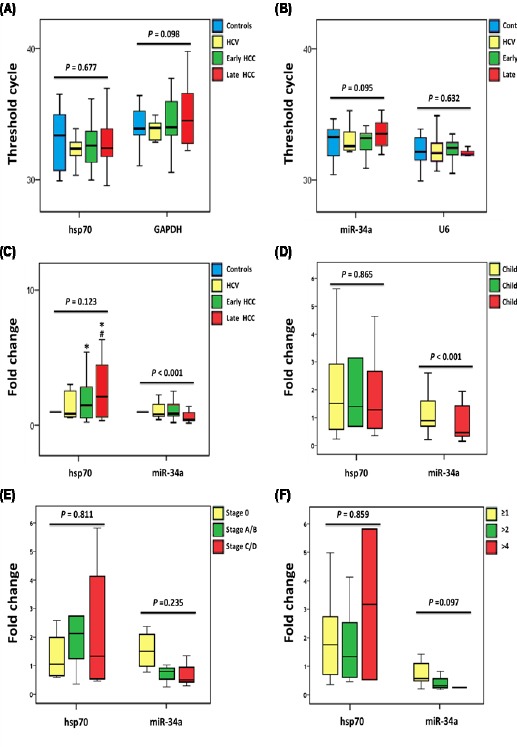
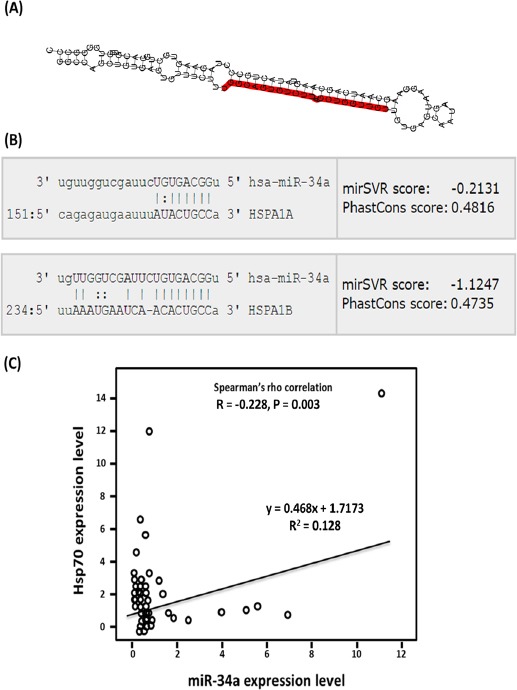
Background: MicroRNA deregulation may occur during hepatocellular carcinoma (HCC) genesis and progression stages. MicroRNA-34a (miR-34a) functions as a tumor suppressor and is down-regulated or silenced in a variety of human cancers, while heat shock proteins (Hsps) play important roles in assisting protein folding and preventing both protein aggregation and transport across membranes. The present study aimed to evaluating serum expression of miR-34a and its target Hsp70 for early detection of HCC in patients with liver cirrhosis (LC), focusing on correlations with clinicopathological features. Methods: A total of 180 patients were included: 120 with HCC on top of LC (60 with either early or late HCC) and 60 patients with HCV-related LC. In addition, 60 healthy individuals were considered as controls. Real-time polymerase chain reactions were performed for expression profiling of serum miR-34a and Hsp70 and for allelic discrimination of the promotor variant (rs2763979, C/T). In addition, in silico analysis was carried out. Results: All participants were heterozygote for the promotor polymorphism. miR-34a serum levels were significantly under-expressed in LC and especially HCC patients as compared to controls. Associations with a high Child-Turcotte- Pugh (CTP) score, advanced cancer stage, and number of masses were noted. In contrast the target Hsp70 was significantly overexpressed in cancer patients but not in LC group and inversely correlated with miR-34a levels. Conclusion: Utility of circulating miRNAs as biomarkers for early detection of HCC was raised. Future large-scale studies are warranted to confirm the current findings.
微小RNA失调可能发生在肝细胞癌(HCC)的发生和发展阶段。微小RNA-34a(miR-34a)作为一种肿瘤抑制因子,在多种人类癌症中表达下调或沉默,而热休克蛋白(Hsps)在协助蛋白质折叠、防止蛋白质聚集和跨膜转运方面发挥重要作用。本研究旨在评估肝硬化(LC)患者血清中miR-34a及其靶标Hsp70的表达,用于HCC的早期检测,并着重研究其与临床病理特征的相关性。方法:共纳入180例患者:120例为LC合并HCC患者(其中60例为早期或晚期HCC),60例为丙型肝炎病毒相关LC患者。此外,60名健康个体作为对照。采用实时聚合酶链反应检测血清miR-34a和Hsp70的表达谱以及启动子变异体(rs2763979,C/T)的等位基因鉴别。此外,还进行了计算机分析。结果:所有参与者启动子多态性均为杂合子。与对照组相比,LC患者尤其是HCC患者血清miR-34a水平显著低表达。观察到与高Child-Turcotte-Pugh(CTP)评分、癌症晚期和肿块数量有关。相反,靶标Hsp70在癌症患者中显著过表达,但在LC组中未过表达,并与miR-34a水平呈负相关。结论:循环微小RNA作为HCC早期检测生物标志物的实用性得到了提高。未来需要大规模研究来证实目前的发现。