National Institute of Advanced Industrial Science and Technology (AIST), Tsukuba, Japan.
Department of Biological Sciences, Graduate School of Science, the University of Tokyo, Tokyo, Japan.
mBio. 2017 Sep 26;8(5):e01482-17. doi: 10.1128/mBio.01482-17.
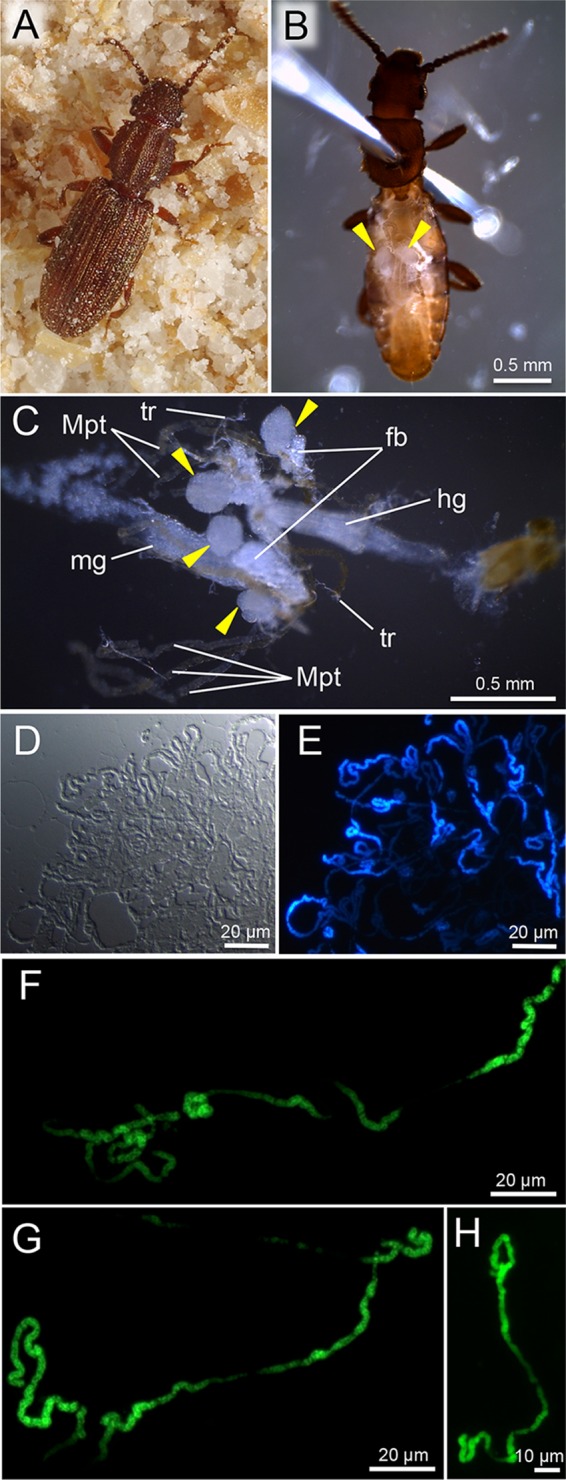
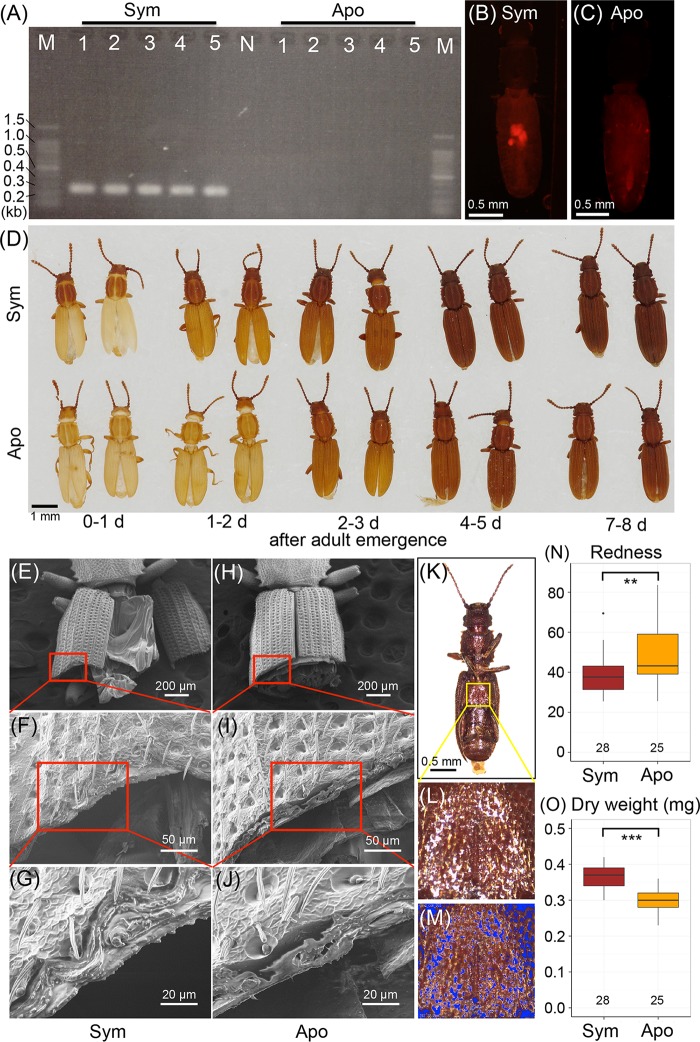
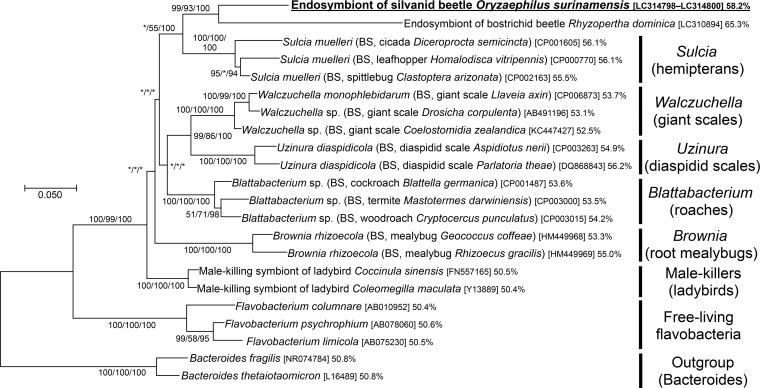
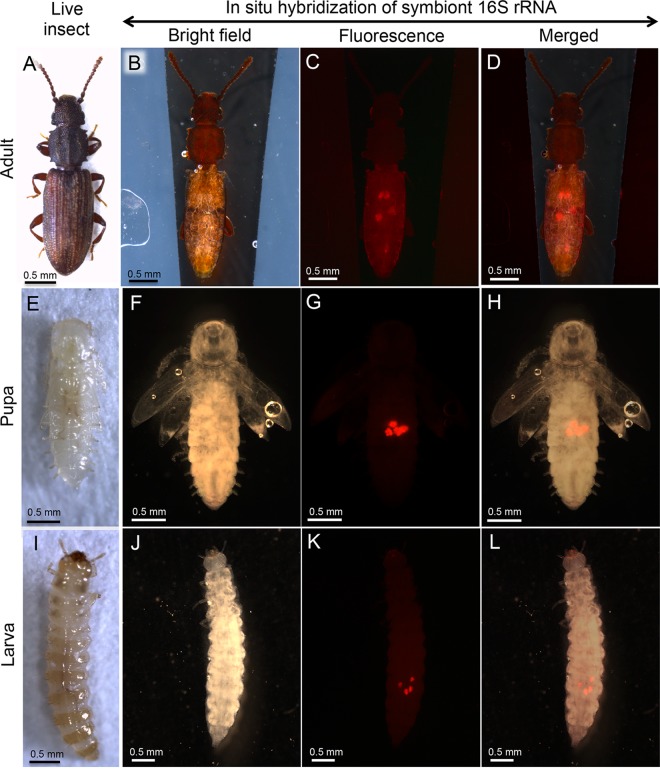
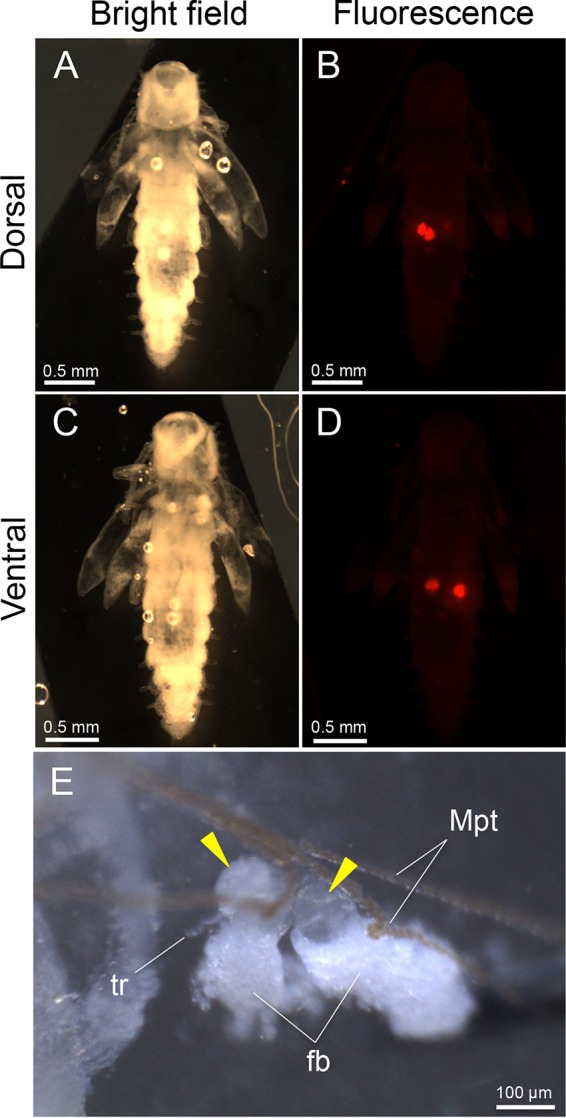
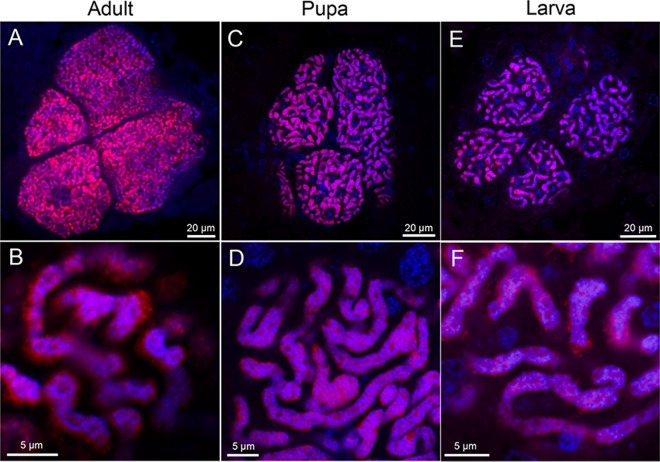
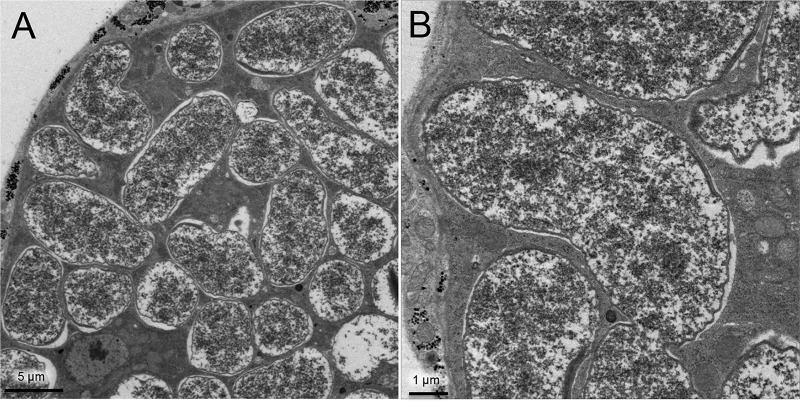
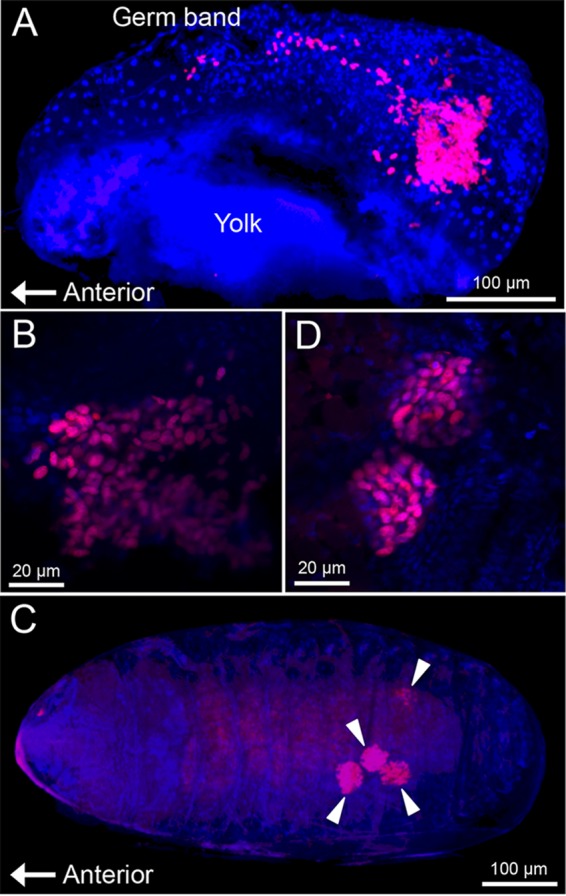
The saw-toothed grain beetle, (Silvanidae), is a cosmopolitan stored-product pest. Early studies on in the 1930s described the presence of peculiar bacteriomes harboring endosymbiotic bacteria in the abdomen. Since then, however, the microbiological nature of the symbiont has been elusive. Here we investigated the endosymbiotic system of in detail. In the abdomen of adults, pupae, and larvae, four oval bacteriomes were consistently identified, whose cytoplasm was full of extremely elongated tubular bacterial cells several micrometers wide and several hundred micrometers long. Molecular phylogenetic analysis identified the symbiont as a member of the , in which the symbiont was the most closely related to the endosymbiont of a grain pest beetle, (Bostrichidae). The symbiont was detected in developing embryos, corroborating vertical symbiont transmission through host generations. The symbiont gene showed AT-biased nucleotide composition and accelerated molecular evolution, plausibly reflecting degenerative evolution of the symbiont genome. When the symbiont infection was experimentally removed, the aposymbiotic insects grew and reproduced normally, but exhibited a slightly but significantly more reddish cuticle and lighter body mass. These results indicate that the symbiont of is not essential for the host's growth and reproduction but contributes to the host's cuticle formation. Symbiont genome sequencing and detailed comparison of fitness parameters between symbiotic and aposymbiotic insects under various environmental conditions will provide further insights into the symbiont's biological roles for the stored-product pest. Some beetles notorious as stored-product pests possess well-developed symbiotic organs called bacteriomes for harboring specific symbiotic bacteria, although their biological roles have been poorly understood. Here we report a peculiar endosymbiotic system of a grain pest beetle, , in which four oval bacteriomes in the abdomen are full of extremely elongated tubular bacterial cells. Experimental symbiont elimination did not hinder the host's growth and reproduction, but resulted in emergence of reddish beetles, uncovering the symbiont's involvement in host's cuticle formation. We speculate that the extremely elongated symbiont cell morphology might be due to the degenerative symbiont genome deficient in bacterial cell division and/or cell wall formation, which highlights an evolutionary consequence of intimate host-symbiont coevolution.
锯齿谷盗,(Silvanidae),是一种世界性的储藏物害虫。早在 20 世纪 30 年代的早期研究中就描述了在腹部存在具有特殊细菌体的奇特细菌体,其中含有内共生细菌。然而,从那时起,共生体的微生物学性质一直难以捉摸。在这里,我们详细研究了 的共生系统。在成虫、蛹和幼虫的腹部中,始终鉴定出四个椭圆形的细菌体,其细胞质充满了极其细长的管状细菌细胞,宽几微米,长数百微米。分子系统发育分析表明,共生体是 的一个成员,其中共生体与谷物害虫甲虫(Bostrichidae)的内共生体最为密切相关。在发育中的胚胎中检测到了共生体,证实了通过宿主世代垂直传递共生体。共生体基因表现出 AT 偏倚的核苷酸组成和加速的分子进化,这可能反映了共生体基因组的退化进化。当共生体感染被实验去除时,无共生体的昆虫正常生长和繁殖,但表现出略微但显著更红的表皮和更轻的体重。这些结果表明, 的共生体对于宿主的生长和繁殖不是必需的,但有助于宿主的表皮形成。共生体基因组测序和在各种环境条件下共生和无共生昆虫之间的适应度参数的详细比较将为储存物害虫的共生体的生物学作用提供进一步的见解。一些作为储藏物害虫而臭名昭著的甲虫拥有发育良好的共生器官,称为细菌体,用于容纳特定的共生细菌,尽管它们的生物学作用尚未得到很好的理解。在这里,我们报道了一种特殊的谷物害虫甲虫, 的共生系统,在腹部的四个椭圆形细菌体中充满了极其细长的管状细菌细胞。实验性共生体消除并没有阻碍宿主的生长和繁殖,但导致出现红色的甲虫,揭示了共生体参与宿主的表皮形成。我们推测,极其细长的共生体细胞形态可能是由于缺乏细菌细胞分裂和/或细胞壁形成的退化共生体基因组所致,这突出了宿主共生体共同进化的一个进化后果。