Lesniak Ines, Franz Mathias, Heckmann Ilja, Greenwood Alex D, Hofer Heribert, Krone Oliver
Leibniz Institute for Zoo and Wildlife Research, Alfred-Kowalke-Straße 17, 10315 Berlin, Germany.
Department of Veterinary Medicine, Freie Universität Berlin, Oertzenweg 19b, 14163 Berlin, Germany.
Int J Parasitol Parasites Wildl. 2017 Sep 7;6(3):278-286. doi: 10.1016/j.ijppaw.2017.09.001. eCollection 2017 Dec.
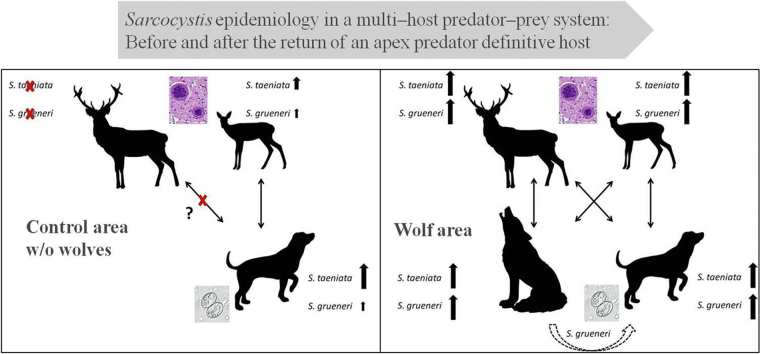
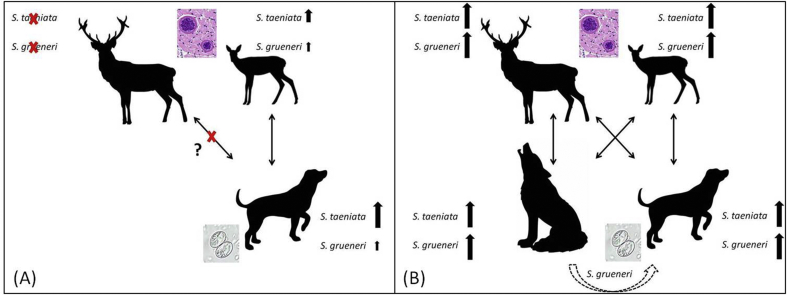
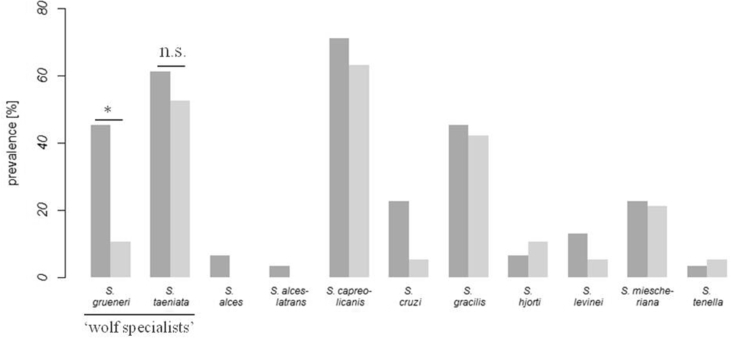
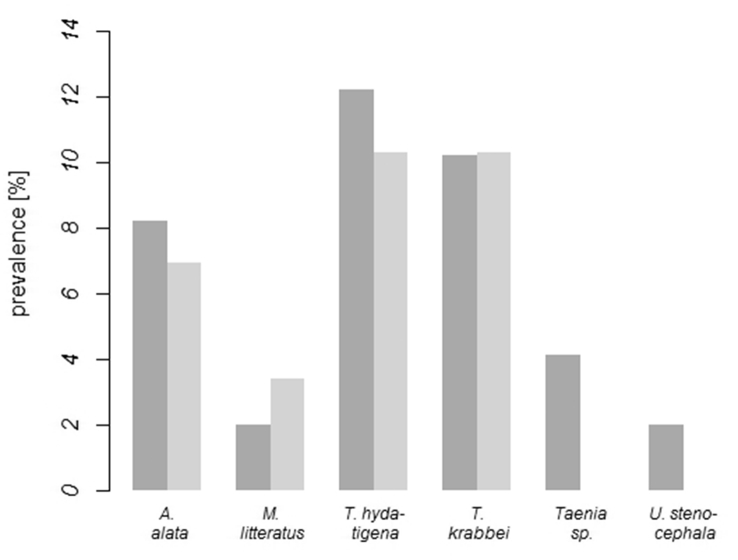
Understanding how closely related wildlife species and their domesticated counterparts exchange or share parasites, or replace each other in parasite life cycles, is of great interest to veterinary and human public health, and wildlife ecology. Grey wolves () host and spread endoparasites that can either directly infect canid conspecifics or their prey serving as intermediate hosts of indirectly transmitted species. The wolf recolonization of Central Europe represents an opportunity to study parasite transmission dynamics between wildlife and domestic species for cases when a definitive host returns after local extinction - a situation equivalent to a 'removal experiment'. Here we investigate whether the re-appearance of wolves has increased parasite pressure on hunting dogs - a group of companion animals of particular interest as they have a similar diet to wolves and flush wolf habitats when hunting. We compared prevalence (P) and species richness (SR) of helminths and the protozoan to determine whether they were higher in hunting dogs from wolf areas (n = 49) than a control area (n = 29) without wolves. Of particular interest were and , known as 'wolf specialists'. Five helminth and 11 species were identified, of which all helminths and eight species were shared between dogs and wolves. Overall prevalence and species richness of helminths (P:38.5% . 24.1%; SR:0.4 vs. 0.3 species) and (P:63.3% . 65.5%, SR:2.1 . 1.8 species) did not differ between study sites. However, hunting dogs were significantly more likely to be infected with in wolf areas (P:45.2% . 10.5%; p = 0.035). The findings suggest that wolves indirectly increase infection risk for hunting dogs since cervids are intermediate hosts and occasionally fed to dogs. Furthermore, a periodic anthelminthic treatment of hunting dogs may be an effective measure to control helminth infections regardless of wolf presence.
了解野生动物物种与其驯化同类之间寄生虫的交换或共享程度,或者它们在寄生虫生命周期中如何相互取代,这对兽医和人类公共卫生以及野生动物生态学具有重要意义。灰狼()宿主并传播内寄生虫,这些内寄生虫既可以直接感染犬科同类动物,也可以感染作为间接传播物种中间宿主的猎物。中欧狼的重新定居为研究野生动物和家养物种之间寄生虫传播动态提供了一个机会,即在终末宿主在当地灭绝后重新出现的情况下——这种情况等同于一个“清除实验”。在这里,我们调查狼的重新出现是否增加了对猎犬的寄生虫压力——猎犬是一类特别受关注的伴侣动物,因为它们的饮食与狼相似,并且在狩猎时会进入狼的栖息地。我们比较了蠕虫和原生动物的患病率(P)和物种丰富度(SR),以确定来自有狼地区的猎犬(n = 49)的患病率和物种丰富度是否高于没有狼的对照地区(n = 29)。特别令人感兴趣的是被称为“狼专家”的 和 。鉴定出了5种蠕虫和11种 物种,其中所有蠕虫和8种 物种在狗和狼之间共享。研究地点之间蠕虫(P:38.5% 对24.1%;SR:0.4对0.3种)和 (P:63.3% 对65.5%,SR:2.1对1.8种)的总体患病率和物种丰富度没有差异。然而,在有狼地区,猎犬感染 的可能性显著更高(P:45.2% 对10.5%;p = 0.035)。研究结果表明,由于鹿是中间宿主且偶尔被喂给狗,狼会间接增加猎犬感染 的风险。此外,无论是否有狼存在,定期对猎犬进行驱虫治疗可能是控制蠕虫感染的有效措施。