Villagra-Blanco R, Silva L M R, Aguilella-Segura A, Arcenillas-Hernández I, Martínez-Carrasco C, Seipp A, Gärtner U, Ruiz de Ybañez R, Taubert A, Hermosilla C
Institute of Parasitology, Justus Liebig University Giessen, Giessen, Germany.
Department of Animal Health, Veterinary Faculty, Regional Campus of International Excellence "Campus Mare Nostrum", University of Murcia, Murcia, Spain.
Int J Parasitol Parasites Wildl. 2017 Sep 14;6(3):287-294. doi: 10.1016/j.ijppaw.2017.09.002. eCollection 2017 Dec.
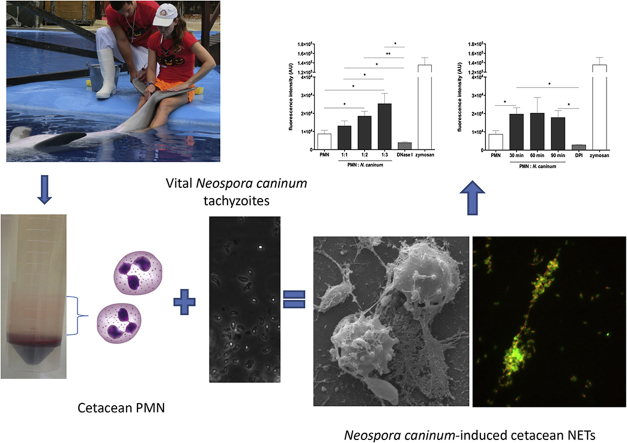
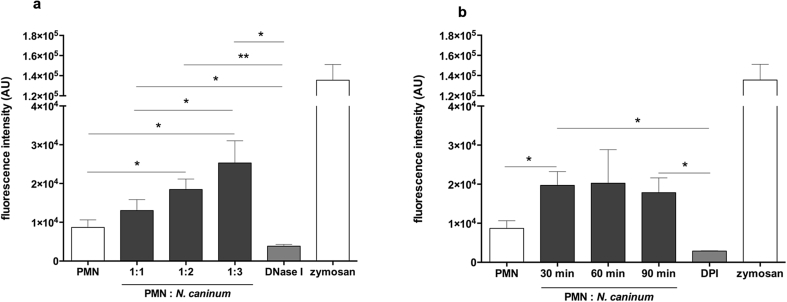
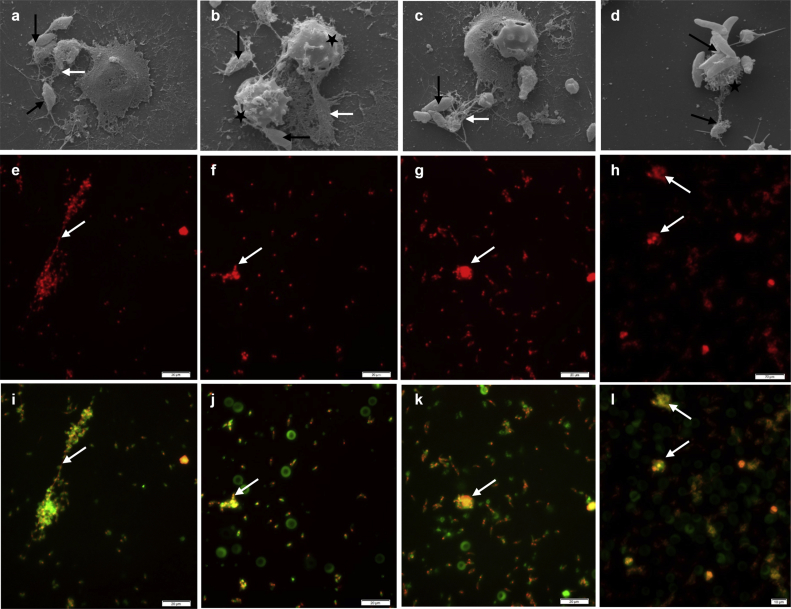
Neutrophil extracellular traps (NETs) are web-like structures composed of nuclear DNA decorated with histones and cytoplasmic peptides which antiparasitic properties have not previously been investigated in cetaceans. Polymorphonuclear neutrophils (PMN) were isolated from healthy bottlenose dolphins (), and stimulated with tachyzoites and the NETs-agonist zymosan. interactions of PMN with the tachyzoites resulted in rapid extrusion of NETs. For the demonstration and quantification of cetacean NETs, extracellular DNA was stained by using either Sytox Orange or Pico Green. Scanning electron microscopy (SEM) and fluorescence analyses demonstrated PMN-derived release of NETs upon exposure to tachyzoites of Co-localization studies of induced cetacean NETs proved the presence of DNA adorned with histones (H1, H2A/H2B, H3, H4), neutrophil elastase (NE), myeloperoxidase (MPO) and pentraxin (PTX) confirming the molecular properties of mammalian NETosis. Dolphin-derived -NETosis were efficiently suppressed by DNase I and diphenyleneiodonium (DPI) treatments. Our results indicate that cetacean-derived NETs represent an ancient, conserved and relevant defense effector mechanism of the host innate immune system against and probably other related neozoan parasites circulating in the marine environment.
中性粒细胞胞外陷阱(NETs)是由核DNA构成的网状结构,其表面装饰有组蛋白和细胞质肽,此前尚未在鲸类动物中研究过它们的抗寄生虫特性。从健康的宽吻海豚中分离出多形核中性粒细胞(PMN),并用刚地弓形虫速殖子和NETs激动剂酵母聚糖进行刺激。PMN与速殖子的相互作用导致NETs迅速挤出。为了证明和定量鲸类动物的NETs,使用Sytox Orange或Pico Green对细胞外DNA进行染色。扫描电子显微镜(SEM)和荧光分析表明,暴露于刚地弓形虫速殖子后,PMN会释放NETs。对诱导产生的鲸类动物NETs进行共定位研究,证实了存在装饰有组蛋白(H1、H2A/H2B、H3、H4)、中性粒细胞弹性蛋白酶(NE)、髓过氧化物酶(MPO)和五聚素(PTX)的DNA,这证实了哺乳动物NETosis的分子特性。DNA酶I和二苯基碘鎓(DPI)处理有效地抑制了海豚来源的NETosis。我们的结果表明,鲸类动物来源的NETs代表了宿主固有免疫系统针对刚地弓形虫以及可能存在于海洋环境中的其他相关新动物寄生虫的一种古老、保守且重要的防御效应机制。