Clinical and Experimental Sciences, Faculty of Medicine, University of Southampton, Southampton, UK.
Primate Genetics Laboratory, German Primate Centre, Göttingen, Germany.
Immun Inflamm Dis. 2018 Mar;6(1):34-46. doi: 10.1002/iid3.190. Epub 2017 Sep 27.
Murine hepatic NK cells exhibit adaptive features, with liver-specific adhesion molecules CXCR6 and CD49a acting as surface markers.
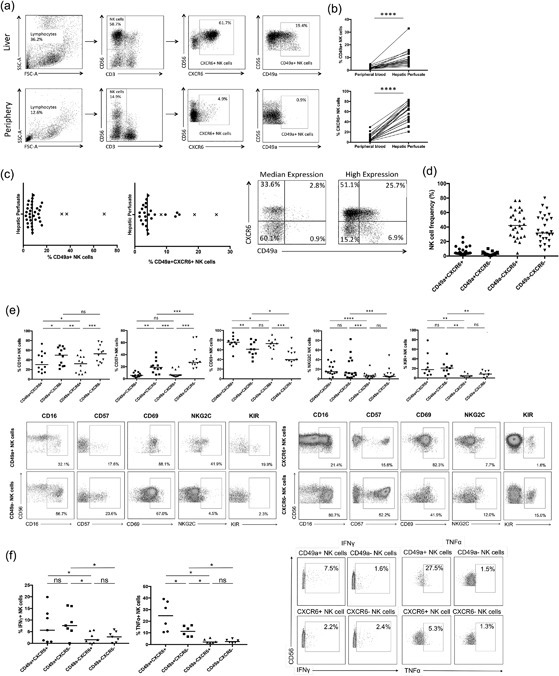
We investigated human liver-resident CXCR6+ and CD49a+ NK cells using RNA sequencing, flow cytometry, and functional analysis. We further assessed the role of cytokines in generating NK cells with these phenotypes from the peripheral blood.
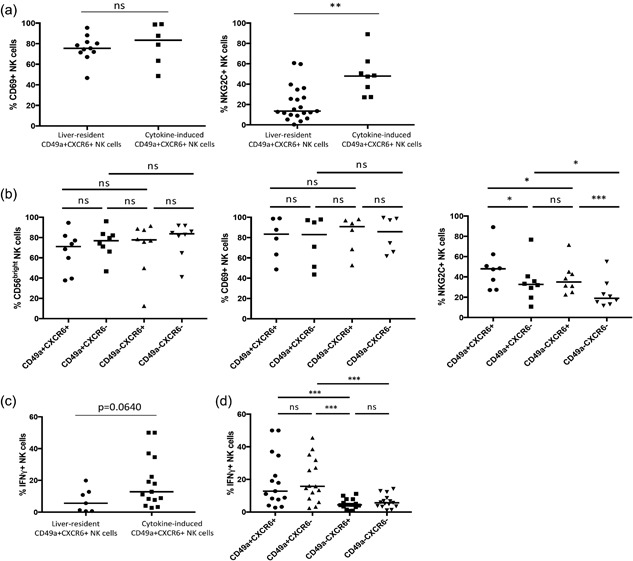
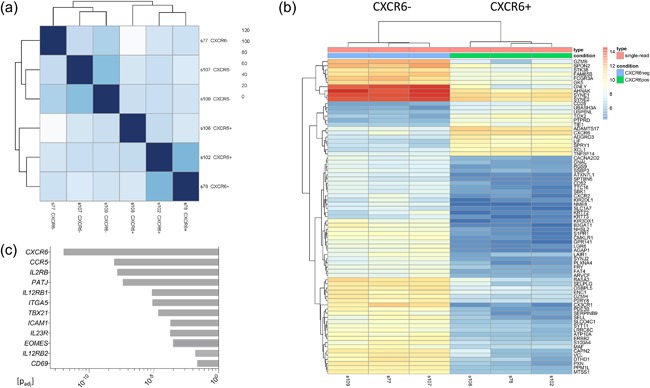
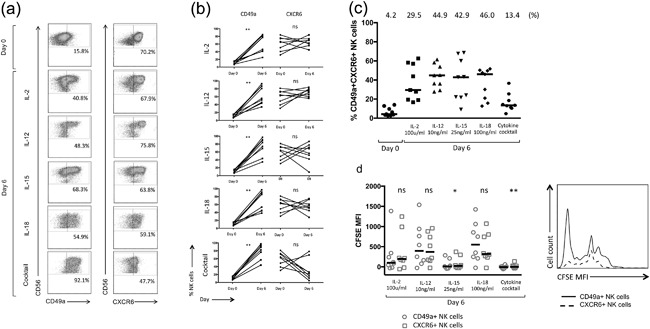
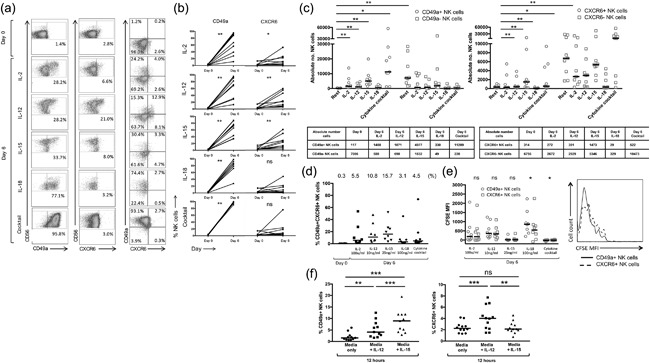
Hepatic CD49a+ NK cells could be induced using cytokines and produce high quantities of IFNγ and TNFα, in contrast to hepatic CXCR6+ NK cells. RNA sequencing of liver-resident CXCR6+ NK cells confirmed a tolerant immature phenotype with reduced expression of markers associated with maturity and cytotoxicity. Liver-resident double-positive CXCR6 + CD49a+ hepatic NK cells are immature but maintain high expression of Th1 cytokines as observed for single-positive CD49a+ NK cells. We show that stimulation with activating cytokines can readily induce upregulation of both CD49a and CXCR6 on NK cells in the peripheral blood. In particular, IL-12 and IL-15 can generate CXCR6 + CD49a+ NK cells in vitro from NK cells isolated from the peripheral blood, with comparable phenotypic and functional features to liver-resident CD49a+ NK cells, including enhanced IFNγ and NKG2C expression.
IL-12 and IL-15 may be key for generating NK cells with a tissue-homing phenotype and strong Th1 cytokine profile in the blood, and links peripheral activation of NK cells with tissue-homing. These findings may have important therapeutic implications for immunotherapy of chronic liver disease.
鼠类肝脏自然杀伤(NK)细胞表现出适应性特征,其肝脏特异性黏附分子 CXCR6 和 CD49a 可作为表面标志物。
我们使用 RNA 测序、流式细胞术和功能分析研究了人肝脏驻留的 CXCR6+和 CD49a+NK 细胞。我们进一步评估了细胞因子在从外周血中产生具有这些表型的 NK 细胞中的作用。
使用细胞因子可诱导肝 CD49a+NK 细胞,并产生大量 IFNγ和 TNFα,而肝 CXCR6+NK 细胞则不然。对肝脏驻留的 CXCR6+NK 细胞的 RNA 测序证实了一种耐受的不成熟表型,其与成熟和细胞毒性相关的标志物表达减少。肝脏驻留的双阳性 CXCR6+CD49a+肝 NK 细胞不成熟,但保持高水平的 Th1 细胞因子表达,如单阳性 CD49a+NK 细胞一样。我们表明,激活细胞因子的刺激可轻易诱导外周血 NK 细胞上调 CD49a 和 CXCR6。特别是,IL-12 和 IL-15 可以在体外从外周血中分离的 NK 细胞中产生 CXCR6+CD49a+NK 细胞,其表型和功能特征与肝脏驻留的 CD49a+NK 细胞相似,包括增强的 IFNγ和 NKG2C 表达。
IL-12 和 IL-15 可能是在外周激活 NK 细胞与组织归巢之间建立联系,从而在血液中产生具有组织归巢表型和强烈 Th1 细胞因子特征的 NK 细胞的关键。这些发现可能对慢性肝病的免疫治疗具有重要的治疗意义。