Bazarbashi Shouki, Al Eid Haya, Minguet Joan
King Faisal Specialist Hospital and Research Centre, Riyadh, Saudi Arabia. Email:
Asian Pac J Cancer Prev. 2017 Sep 27;18(9):2437-2444. doi: 10.22034/APJCP.2017.18.9.2437.
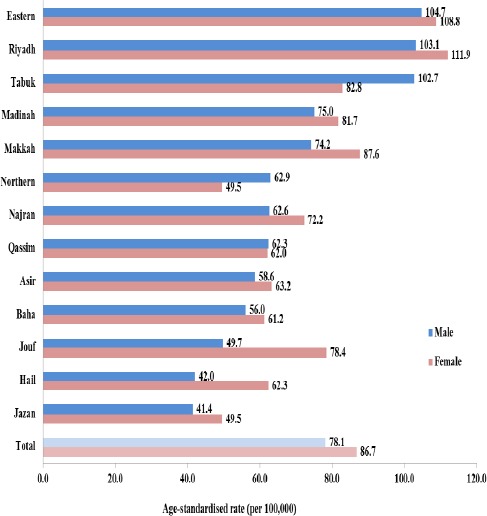
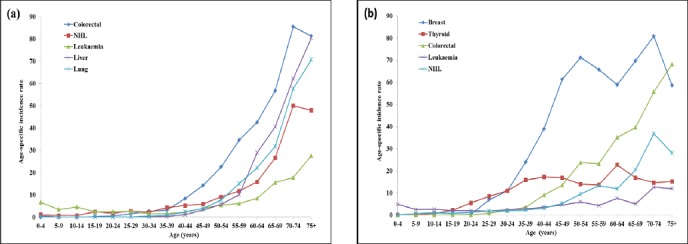
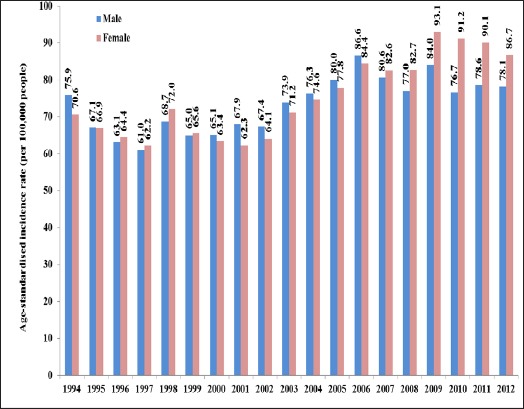
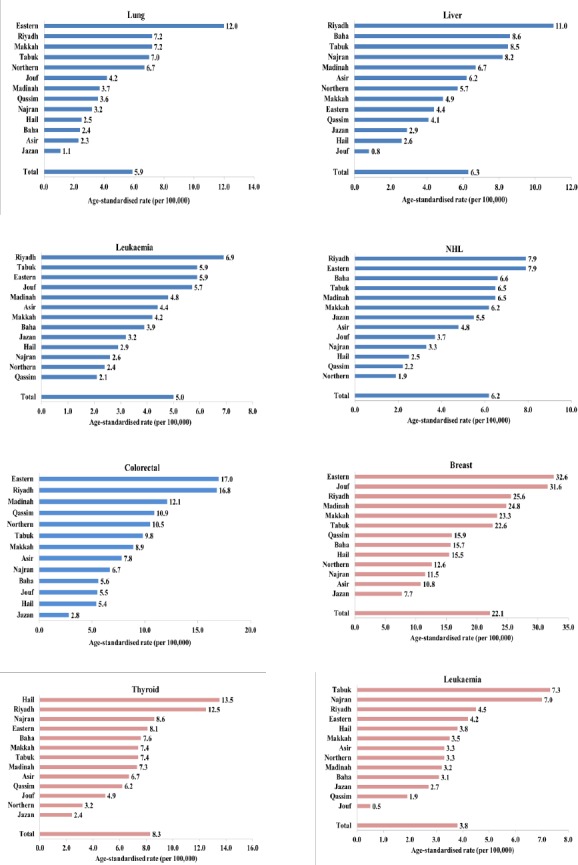
Background: In order to most appropriately allocate healthcare and research funding for cancer, it is important to have accurate population-based incidence data. The Saudi Cancer Registry (SCR) provides such information, covering the time period from 1994 to the present day. The current report concerns an overview of cancer incidence statistics for Saudi Arabia in 2012. Methods: The SCR collects data from healthcare facilities throughout the Kingdom of Saudi Arabia. All newly diagnosed cases of cancer are recorded, with information on site and histology. For the present report, age-standardised and age-specific incidence rates (ASR, AIR, respectively) were calculated, with attention to gender-specific and regional differences. Results: The total number of incident cases of cancer identified by the SCR in 2012 was 14,336, with 6,791 (47.5%) among males and 7,545 (52.6%) among females. Of this total, 11,034 cases (76.9%) occurred in patients of Saudi origin. For Saudi males, the overall ASR (inc. all cancer sites) was 78.1 per 100,000 people, while that for females was 86.7. Incidence varied by region, with the Eastern region and Riyadh displaying the highest ASRs for both males and females, and Hail and Jazan displaying the lowest. Incidence varied by gender, with colorectal cancer (13.3%), non-Hodgkin lymphoma (NHL; 8.4%), and leukaemia (8.2%) being the most common types in males, and breast (25.8%), thyroid (11.7%), and colorectal cancers (9.3%) being the most common in females. Conclusions: This analysis of cancer incidence in Saudi Arabia demonstrated significant differences according to gender, age, and region of the Kingdom. The data should help ensure the most appropriate allocation of resources, with the aim of minimising the healthcare burden associated with cancer.
为了最合理地分配癌症医疗保健和研究资金,获得基于准确人群的发病率数据至关重要。沙特癌症登记处(SCR)提供了涵盖1994年至今这一时间段的此类信息。本报告涉及2012年沙特阿拉伯癌症发病率统计概述。方法:SCR从沙特阿拉伯王国各地的医疗机构收集数据。记录所有新诊断的癌症病例,并提供有关部位和组织学的信息。对于本报告,计算了年龄标准化发病率和年龄特异性发病率(分别为ASR、AIR),并关注性别和地区差异。结果:SCR在2012年确定的癌症发病病例总数为14336例,其中男性6791例(47.5%),女性7545例(52.6%)。在这一总数中,11034例(76.9%)发生在沙特裔患者中。沙特男性的总体ASR(包括所有癌症部位)为每10万人78.1例,而女性为86.7例。发病率因地区而异,东部地区和利雅得的男性和女性ASR最高,哈伊勒和吉赞最低。发病率因性别而异,男性中最常见的类型是结直肠癌(13.3%)、非霍奇金淋巴瘤(NHL;8.4%)和白血病(8.2%),女性中最常见的是乳腺癌(25.8%)、甲状腺癌(11.7%)和结直肠癌(9.3%)。结论:对沙特阿拉伯癌症发病率的分析表明,根据该国的性别、年龄和地区存在显著差异。这些数据应有助于确保资源的最合理分配,以尽量减少与癌症相关的医疗负担。