Pawson Stephen M, Marcot Bruce G, Woodberry Owen G
Scion, Riccarton, Christchurch, New Zealand.
US Forest Service, Pacific Northwest Research Station, Portland, Oregon, United States.
PLoS One. 2017 Sep 27;12(9):e0183464. doi: 10.1371/journal.pone.0183464. eCollection 2017.
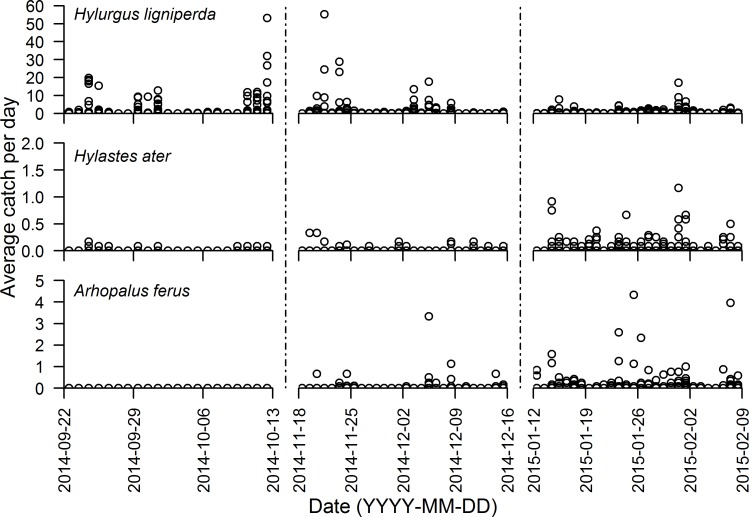
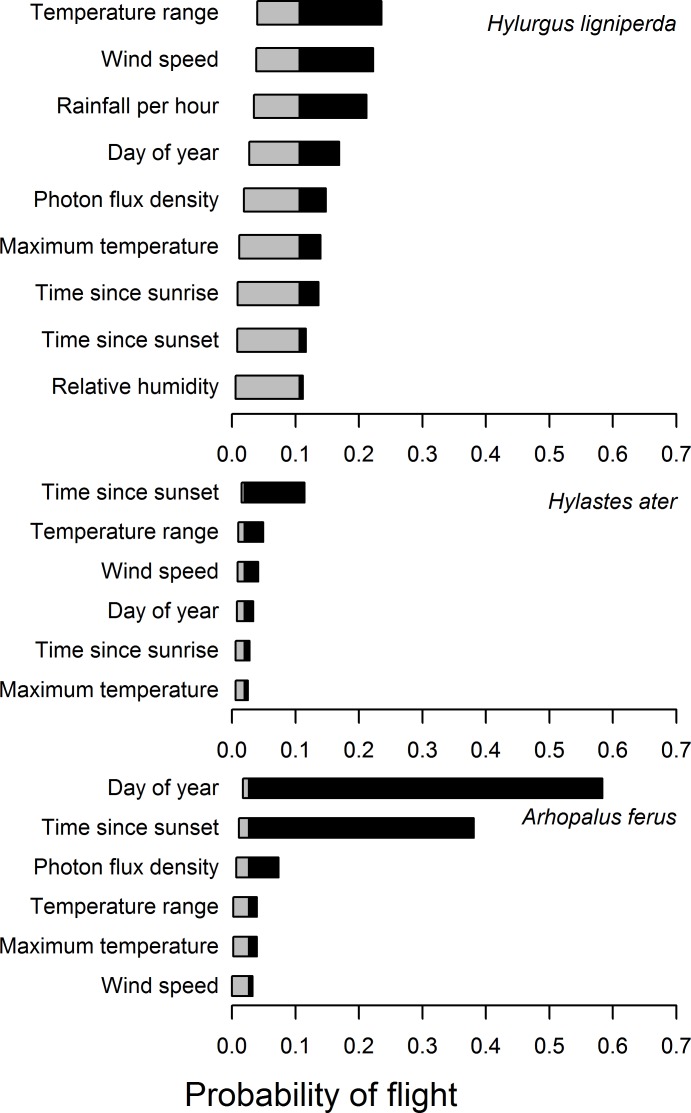
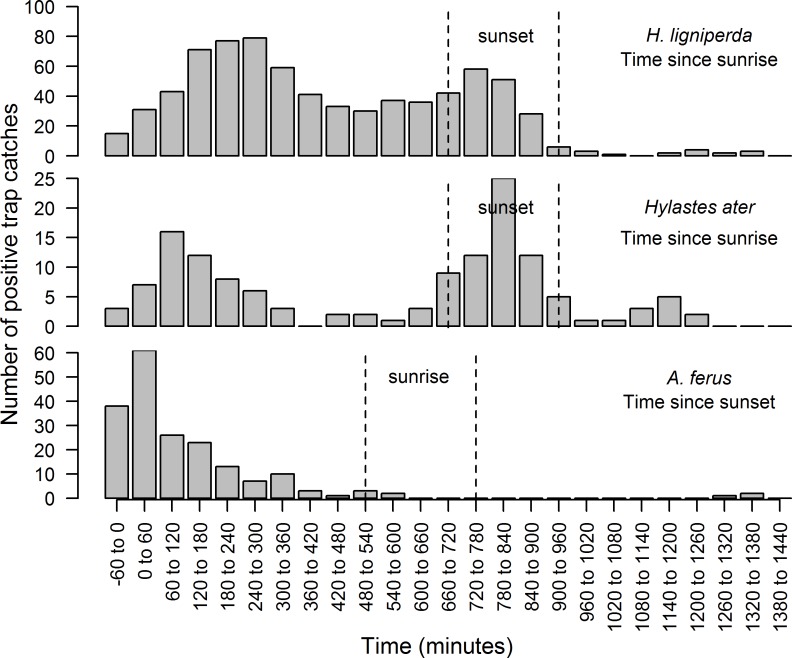
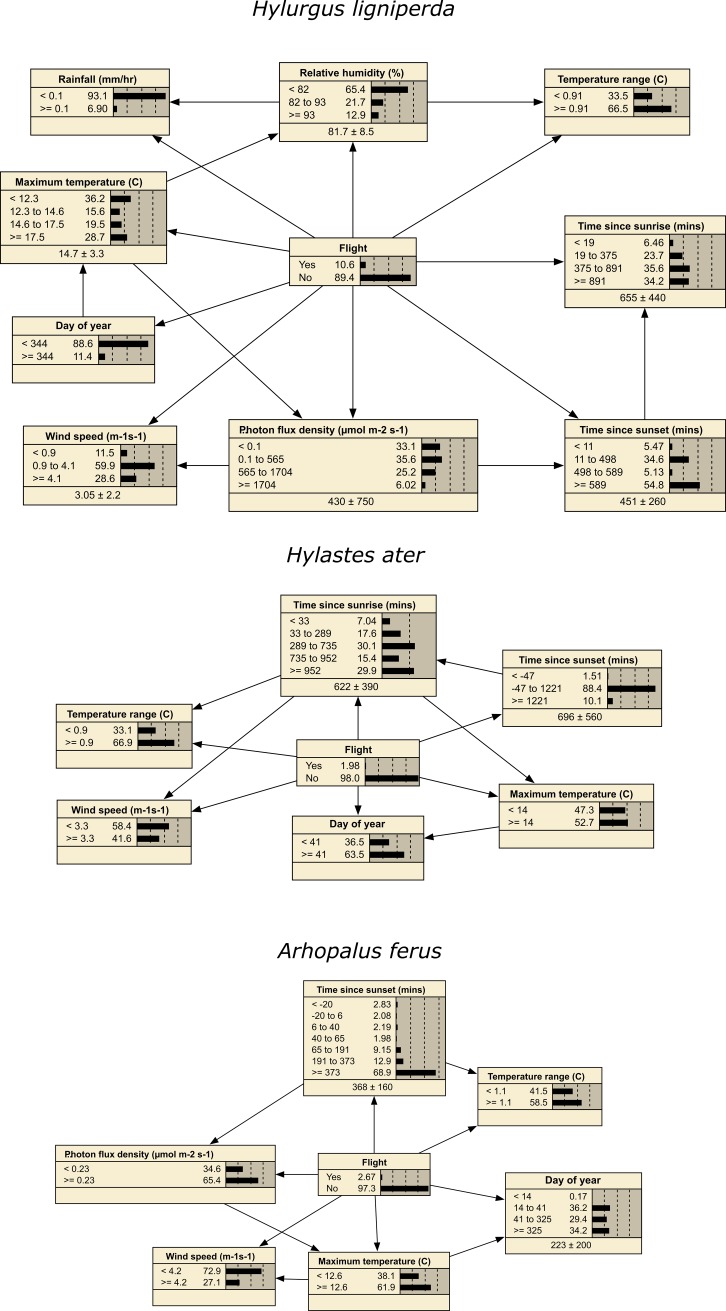
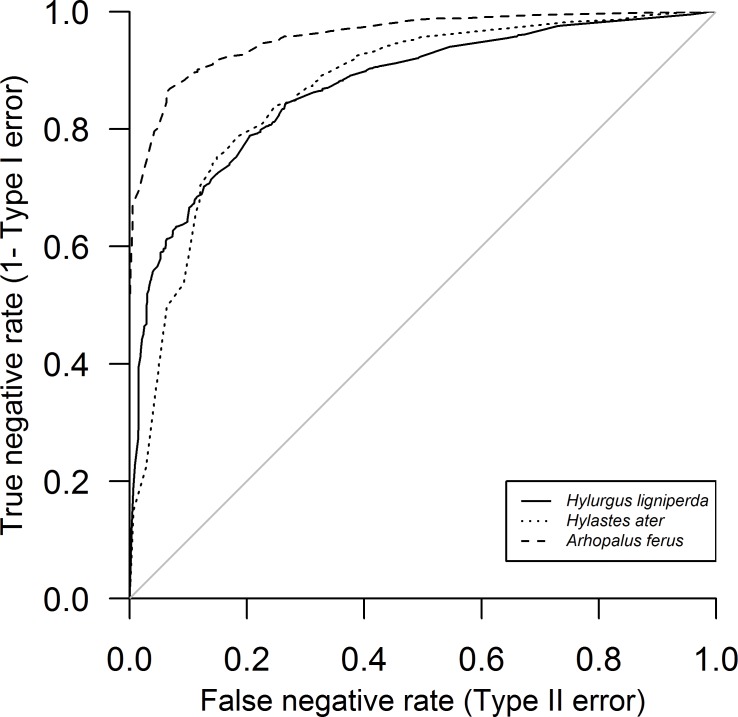
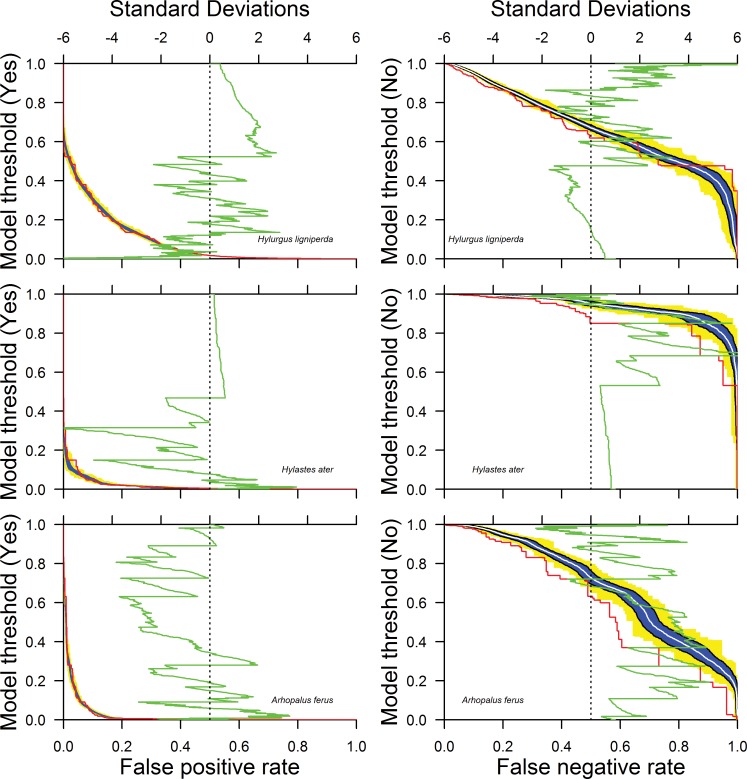
Daily flight activity patterns of forest insects are influenced by temporal and meteorological conditions. Temperature and time of day are frequently cited as key drivers of activity; however, complex interactions between multiple contributing factors have also been proposed. Here, we report individual Bayesian network models to assess the probability of flight activity of three exotic insects, Hylurgus ligniperda, Hylastes ater, and Arhopalus ferus in a managed plantation forest context. Models were built from 7,144 individual hours of insect sampling, temperature, wind speed, relative humidity, photon flux density, and temporal data. Discretized meteorological and temporal variables were used to build naïve Bayes tree augmented networks. Calibration results suggested that the H. ater and A. ferus Bayesian network models had the best fit for low Type I and overall errors, and H. ligniperda had the best fit for low Type II errors. Maximum hourly temperature and time since sunrise had the largest influence on H. ligniperda flight activity predictions, whereas time of day and year had the greatest influence on H. ater and A. ferus activity. Type II model errors for the prediction of no flight activity is improved by increasing the model's predictive threshold. Improvements in model performance can be made by further sampling, increasing the sensitivity of the flight intercept traps, and replicating sampling in other regions. Predicting insect flight informs an assessment of the potential phytosanitary risks of wood exports. Quantifying this risk allows mitigation treatments to be targeted to prevent the spread of invasive species via international trade pathways.
森林昆虫的每日飞行活动模式受时间和气象条件影响。温度和一天中的时间常被认为是活动的关键驱动因素;然而,也有人提出多个促成因素之间存在复杂的相互作用。在此,我们报告个体贝叶斯网络模型,以评估在人工种植林环境中三种外来昆虫,即欧洲材小蠹、黑条木小蠹和锈色粒肩天牛飞行活动的概率。模型基于7144个小时的昆虫采样、温度、风速、相对湿度、光子通量密度和时间数据构建。离散化的气象和时间变量用于构建朴素贝叶斯树增强网络。校准结果表明,黑条木小蠹和锈色粒肩天牛的贝叶斯网络模型对低I型误差和总体误差拟合最佳,而欧洲材小蠹对低II型误差拟合最佳。最高小时温度和日出后的时间对欧洲材小蠹飞行活动预测影响最大,而一天中的时间和年份对黑条木小蠹和锈色粒肩天牛的活动影响最大。通过提高模型的预测阈值可改善无飞行活动预测的II型模型误差。可通过进一步采样、提高飞行拦截陷阱的灵敏度以及在其他地区重复采样来提高模型性能。预测昆虫飞行有助于评估木材出口的潜在植物检疫风险。量化这种风险可使缓解措施有的放矢,以防止入侵物种通过国际贸易途径传播。