Juárez Miriam, Egoavil Cecilia, Rodríguez-Soler María, Hernández-Illán Eva, Guarinos Carla, García-Martínez Araceli, Alenda Cristina, Giner-Calabuig Mar, Murcia Oscar, Mangas Carolina, Payá Artemio, Aparicio José R, Ruiz Francisco A, Martínez Juan, Casellas Juan A, Soto José L, Zapater Pedro, Jover Rodrigo
Research Laboratory, Alicante University General Hospital, Alicante Institute for Health and Biomedical Research (ISABIAL-FISABIO Foundation), Alicante, Spain.
Department of Pathology, Alicante University General Hospital, Alicante Institute for Health and Biomedical Research (ISABIAL-FISABIO Foundation), Alicante, Spain.
PLoS One. 2017 Sep 27;12(9):e0184937. doi: 10.1371/journal.pone.0184937. eCollection 2017.
BACKGROUND & AIMS: High-risk features of colonic polyps are based on size, number, and pathologic characteristics. Surveillance colonoscopy is often recommended according to these findings. This study aimed to determine whether the molecular characteristics of polyps might provide information about the risk of metachronous advanced neoplasia.
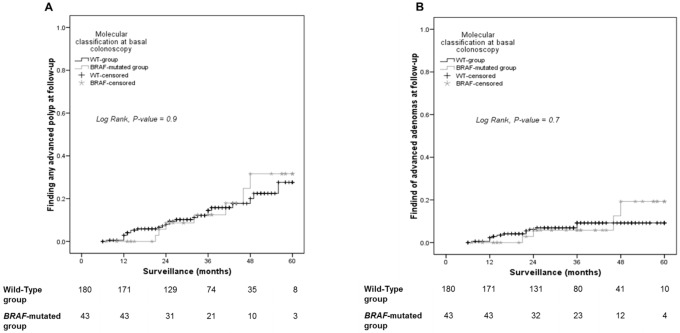
We retrospectively included 308 patients with colonic polyps. A total of 995 polyps were collected and tested for somatic BRAF and KRAS mutations. Patients were classified into 3 subgroups, based on the polyp mutational profile at baseline, as follows: non-mutated polyps (Wild-type), at least one BRAF-mutated polyp, or at least one KRAS-mutated polyp. At surveillance, advanced adenomas were defined as adenomas ≥ 10 mm and/or with high grade dysplasia or a villous component. In contrast, advanced serrated polyps were defined as serrated polyps ≥ 10 mm in any location, located proximal to the splenic flexure with any size or with dysplasia.
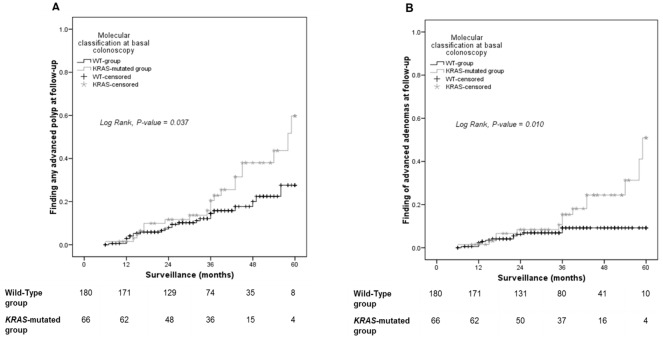
At baseline, 289 patients could be classified as wild-type (62.3%), BRAF mutated (14.9%), or KRAS mutated (22.8%). In the univariate analysis, KRAS mutations were associated with the development of metachronous advanced polyps (OR: 2.36, 95% CI: 1.22-4.58; P = 0.011), and specifically, advanced adenomas (OR: 2.42, 95% CI: 1.13-5.21; P = 0.023). The multivariate analysis, adjusted for age and sex, also showed associations with the development of metachronous advanced polyps (OR: 2.27, 95% CI: 1.15-4.46) and advanced adenomas (OR: 2.23, 95% CI: 1.02-4.85).
Our results suggested that somatic KRAS mutations in polyps represent a potential molecular marker for the risk of developing advanced neoplasia.
结肠息肉的高危特征基于大小、数量和病理特征。通常根据这些发现建议进行监测结肠镜检查。本研究旨在确定息肉的分子特征是否可能提供有关异时性晚期肿瘤风险的信息。
我们回顾性纳入了308例结肠息肉患者。共收集了995个息肉,并检测了体细胞BRAF和KRAS突变。根据基线时息肉的突变情况,将患者分为3个亚组,如下:未突变息肉(野生型)、至少一个BRAF突变息肉或至少一个KRAS突变息肉。在监测时,晚期腺瘤定义为腺瘤≥10毫米和/或伴有高级别异型增生或绒毛成分。相比之下,晚期锯齿状息肉定义为任何位置的锯齿状息肉≥10毫米、位于脾曲近端的任何大小的息肉或伴有异型增生的息肉。
在基线时,289例患者可分类为野生型(62.3%)、BRAF突变型(14.9%)或KRAS突变型(22.8%)。在单变量分析中,KRAS突变与异时性晚期息肉的发生相关(比值比:2.36,95%置信区间:1.22 - 4.58;P = 0.011),具体而言,与晚期腺瘤相关(比值比:2.42,95%置信区间:1.13 - 5.21;P = 0.023)。在对年龄和性别进行调整的多变量分析中,也显示与异时性晚期息肉的发生相关(比值比:2.27,95%置信区间:1.15 - 4.46)和晚期腺瘤相关(比值比:2.23,95%置信区间:1.02 - 4.85)。
我们的结果表明,息肉中的体细胞KRAS突变代表了发生晚期肿瘤风险的潜在分子标志物。