Department of Molecular Diagnostic Pathology, School of Medicine, Iwate Medical University, 19-1, Uchimaru, Morioka, 020-8505, Japan.
Division of Gastroenterology, Department of Internal Medicine, School of Medicine, Iwate Medical University, 19-1, Uchimaru, Morioka, 020-8505, Japan.
Dig Dis Sci. 2018 Oct;63(10):2626-2638. doi: 10.1007/s10620-018-5167-4. Epub 2018 Jul 5.
The aim of your study is to characterize serrated lesions according to their molecular patterns, specifically BRAF/KRAS mutation, methylation, and microsatellite statuses. We evaluated the molecular patterns of 163 serrated lesions, including 37 microvesicular hyperplastic polyps, 73 sessile serrated adenomas/polyps (SSA/Ps), 31 traditional serrated adenomas, and 22 SSA/Ps with cytological dysplasia/adenocarcinoma.
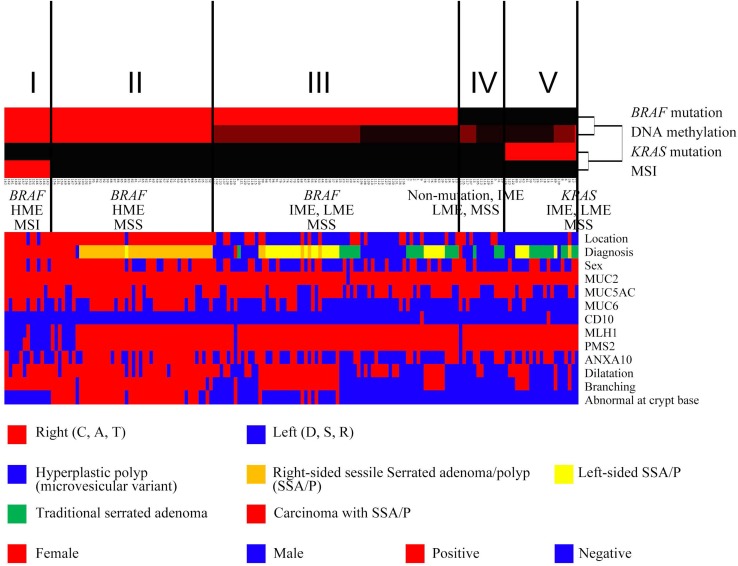
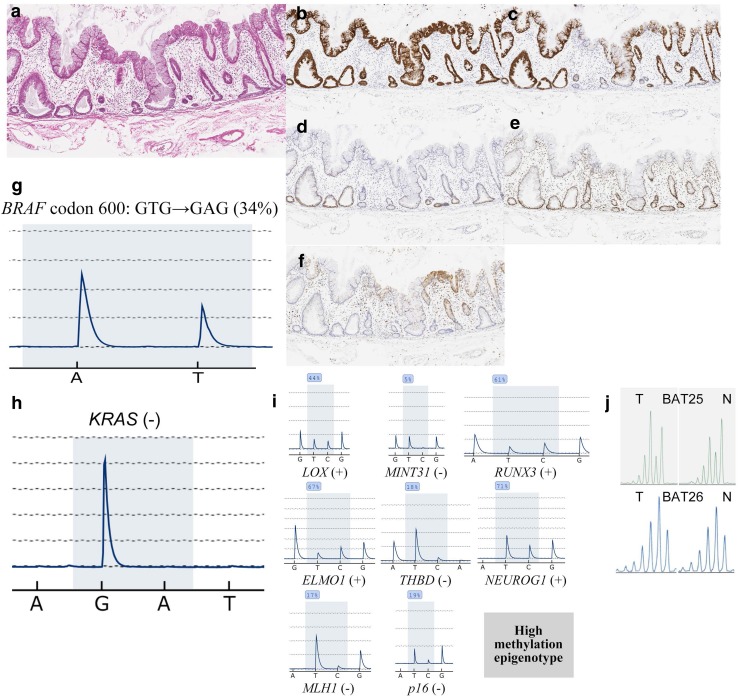
Mutations in BRAF (V600E)/KRAS (exon 2) and microsatellite status [microsatellite stability (MSS) vs. MSI] were examined using a pyrosequencer and the PCR-based microsatellite method, respectively. DNA methylation status was classified as low (LME), intermediate (IME), or high methylation epigenotype (HME) according to a PCR-based two-step method. In addition, mucin and annexin A10 expression was examined. Finally, we performed a hierarchical clustering analysis of the BRAF/KRAS mutation, DNA methylation, and microsatellite statuses.
The molecular patterns observed in the serrated lesions could be divided into five subgroups: lesions characterized by (1) BRAF mutation, HME, and MSI; (2) BRAF mutation, HME, and MSS; (3) BRAF mutation, LME/IME, and MSS; (4) no BRAF/KRAS mutations, LME/IME, and MSS; and (5) KRAS mutation, LME/IME, and MSS. In addition, we demonstrated that these observed molecular patterns help identify the associations of the molecular patterns and markers (i.e., mucin and annexin A10) with the clinicopathological findings, including histological features and histological diagnosis.
We suggest that the identified molecular patterns play an important role in the pathway of serrated lesion development.
你的研究旨在根据锯齿状病变的分子模式(特别是 BRAF/KRAS 突变、甲基化和微卫星状态)对其进行特征描述。我们评估了 163 个锯齿状病变的分子模式,包括 37 个微泡性增生性息肉、73 个无蒂锯齿状腺瘤/息肉(SSA/Ps)、31 个传统锯齿状腺瘤和 22 个伴有细胞学异型增生/腺癌的 SSA/Ps。
使用焦磷酸测序仪和基于 PCR 的微卫星方法分别检测 BRAF(V600E)/KRAS(外显子 2)突变和微卫星状态(微卫星稳定(MSS)与微卫星不稳定(MSI))。根据基于 PCR 的两步法,将 DNA 甲基化状态分为低(LME)、中(IME)或高甲基化表型(HME)。此外,还检测了黏蛋白和膜联蛋白 A10 的表达。最后,我们对 BRAF/KRAS 突变、DNA 甲基化和微卫星状态进行了层次聚类分析。
锯齿状病变的分子模式可分为五个亚组:(1)BRAF 突变、HME 和 MSI;(2)BRAF 突变、HME 和 MSS;(3)BRAF 突变、LME/IME 和 MSS;(4)无 BRAF/KRAS 突变、LME/IME 和 MSS;(5)KRAS 突变、LME/IME 和 MSS。此外,我们证明这些观察到的分子模式有助于确定分子模式与标志物(即黏蛋白和膜联蛋白 A10)与临床病理发现之间的关联,包括组织学特征和组织学诊断。
我们认为鉴定的分子模式在锯齿状病变发展的途径中发挥重要作用。