Servicio de Medicina Digestiva, Instituto de Investigación Sanitaria ISABIAL, Hospital General Universitario Dr. Balmis, Alicante, Spain.
Departamento de Medicina Clínica, Universidad Miguel Hernández, Alicante, Spain.
United European Gastroenterol J. 2024 Nov;12(9):1179-1189. doi: 10.1002/ueg2.12667. Epub 2024 Oct 13.
The potential of molecular markers in the removed polys as reliable predictors of metachronous lesions is still uncertain.
Our aim was to evaluate the role of somatic mutations in KRAS in polyps of patients with high-risk adenomas to predict the risk of advanced polyps or colorectal cancer (CRC) within 3 years.
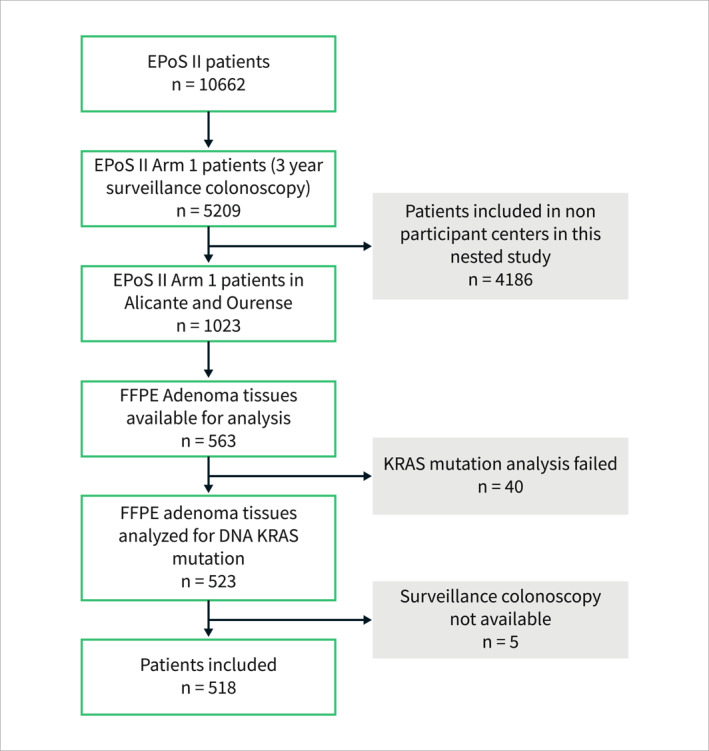
A total of 518 patients were prospectively enrolled. The included patients had adenomas ≥10 mm, high-grade dysplasia, villous component or ≥3 more adenomas at baseline and were scheduled to undergo surveillance colonoscopy at 3 years ± 6 months. Somatic KRAS mutation was performed on 1189 polyps collected from these patients. At surveillance, advanced lesions were defined as adenomas with a size of ≥10 mm. High-grade dysplasia or villous component, serrated polyps ≥10 mm or with dysplasia or CRC.
At baseline, 81 patients (15.6%) had KRAS mutations in at least one polyp. Patients with KRAS mutated polyps had more frequent villous histological lesions and size ≥20 mm. In the multivariate analysis, adjusted for age and sex, only age (odds ratios [OR], 1.06; 95% confidence interval [CI], 1.02-1.09; p < 0.001), ≥5 adenomas (OR, 3.92; 95% CI, 1.96-7.82), and KRAS mutation (OR, 2.54; 95% CI, 1.48-4.34; p < 0.01) were independently associated with the development of advanced lesions at surveillance.
Our results show that, in patients with high-risk adenomas, the presence of somatic mutations in KRAS is an independent risk factor for the development of advanced metachronous polyps.
分子标志物在切除的息肉中作为预测异时性病变的可靠指标的潜力尚不确定。
我们的目的是评估 KRAS 中的体细胞突变在高风险腺瘤患者的息肉中的作用,以预测 3 年内进展性息肉或结直肠癌(CRC)的风险。
共前瞻性纳入 518 例患者。纳入患者的基线腺瘤≥10mm、高级别异型增生、绒毛成分或≥3 个以上腺瘤,并计划在 3 年±6 个月时进行结肠镜监测。对这些患者的 1189 个息肉进行了 KRAS 体细胞突变检测。在监测时,进展性病变定义为腺瘤大小≥10mm、高级别异型增生或绒毛成分、锯齿状息肉≥10mm 或伴异型增生或 CRC。
基线时,81 例(15.6%)患者至少有一个息肉存在 KRAS 突变。KRAS 突变息肉患者的绒毛组织学病变更常见,且大小≥20mm。多变量分析调整年龄和性别后,仅年龄(比值比[OR],1.06;95%置信区间[CI],1.02-1.09;p<0.001)、≥5 个腺瘤(OR,3.92;95% CI,1.96-7.82)和 KRAS 突变(OR,2.54;95% CI,1.48-4.34;p<0.01)与监测时进展性病变的发生独立相关。
我们的结果表明,在高风险腺瘤患者中,KRAS 中的体细胞突变是发生进展性异时性息肉的独立危险因素。