Boamponsem Georgina A, Leung David W M, Lister Carolyn
School of Biological Sciences, University of CanterburyChristchurch, New Zealand.
The New Zealand Institute for Plant and Food Research Limited, Canterbury Agriculture and Science CentreLincoln, New Zealand.
Front Plant Sci. 2017 Sep 13;8:1581. doi: 10.3389/fpls.2017.01581. eCollection 2017.
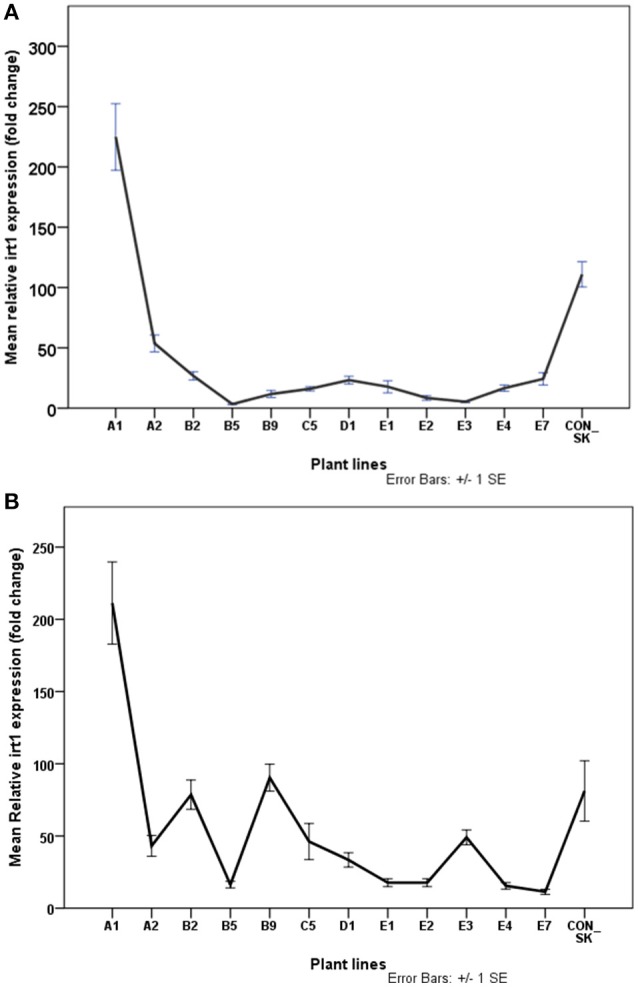
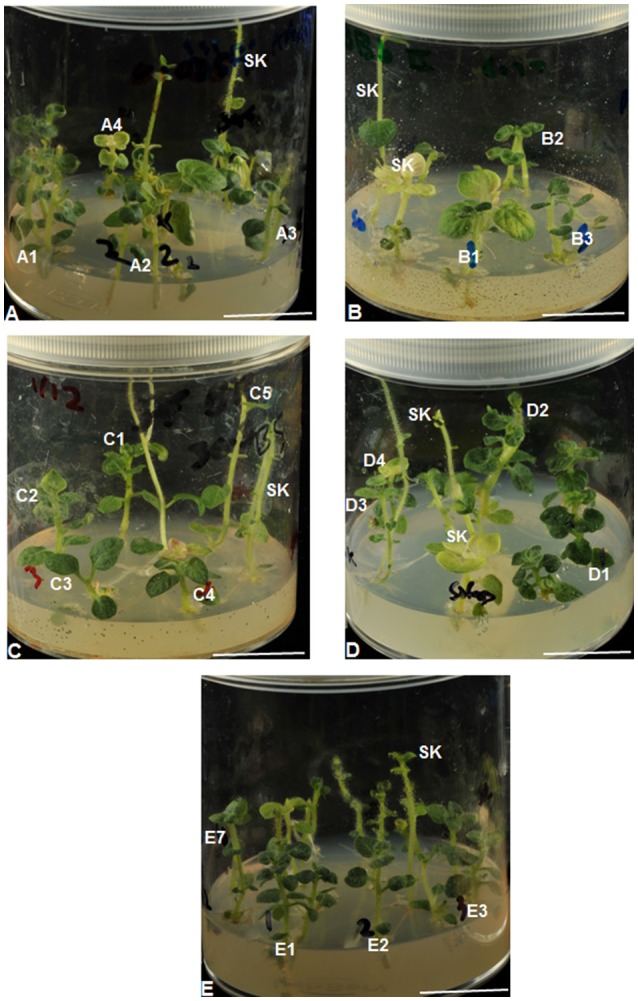
Iron (Fe) deficiency induces chlorosis (IDC) in plants and can result in reduced plant productivity. Therefore, development of Fe-efficient plants is of great interest. To gain a better understanding of the physiology of Fe-efficient plants, putative novel plant variants were regenerated from potato ( L. var. 'Iwa') callus cultures selected under Fe deficient or low Fe supply (0-5 μM Fe). Based on visual chlorosis rating (VCR), 23% of callus-derived regenerants were classified as Fe-efficient (EF) and 77% as Fe-inefficient (IFN) plant lines when they were grown under Fe deficiency conditions. Stem height was found to be highly correlated with internodal distance, leaf and root lengths in the EF plant lines grown under Fe deficiency conditions. In addition, compared to the IFN plant lines and control parental biotype, the EF plants including the lines named A1, B2, and B9, exhibited enhanced formation of lateral roots and root hairs as well as increased expression of ferritin () in the leaf and iron-regulated transporter () in the root. These morphological adaptations and changes in expression the and genes of the selected EF potato lines suggest that they are associated with resistance to low Fe supply stress.
铁(Fe)缺乏会导致植物出现黄化现象(缺铁性黄化,IDC),并可能导致植物生产力下降。因此,培育铁高效植物备受关注。为了更好地了解铁高效植物的生理特性,从在缺铁或低铁供应(0 - 5 μM铁)条件下筛选的马铃薯(Solanum tuberosum L. var. 'Iwa')愈伤组织培养物中再生出了假定的新型植物变体。根据视觉黄化评级(VCR),当在缺铁条件下生长时,23%的愈伤组织再生植株被归类为铁高效(EF)植株系,77%为铁低效(IFN)植株系。发现在缺铁条件下生长的EF植株系中,茎高与节间距离、叶长和根长高度相关。此外,与IFN植株系和对照亲本生物型相比,包括A1、B2和B9等品系在内的EF植株表现出侧根和根毛形成增强,以及叶片中铁蛋白(ferritin)表达增加和根中铁调节转运蛋白(iron-regulated transporter)表达增加。所选EF马铃薯品系的这些形态适应以及ferritin和iron-regulated transporter基因表达的变化表明它们与耐低铁供应胁迫有关。