
通过原子力显微镜研究HPV16/抗HPV16对的动态响应及解离事件
Dynamic response of HPV16/anti-HPV16 pairs with unbinding events studied by atomic force microscopy.
作者信息
Lin Shiming, Hong Chung-Hung, Sheu Bor-Ching, Wu Long-Xin, Huang Wan-Chen, Huang Wei-Chih, Guo Cheng-Yan
机构信息
Institute of Medical Device and Imaging, National Taiwan University, Taipei, Taiwan.
Graduate Institute of Electronics Engineering, National Taiwan University, Taipei, Taiwan.
出版信息
Biochem Biophys Rep. 2016 Apr 16;6:203-208. doi: 10.1016/j.bbrep.2016.04.008. eCollection 2016 Jul.
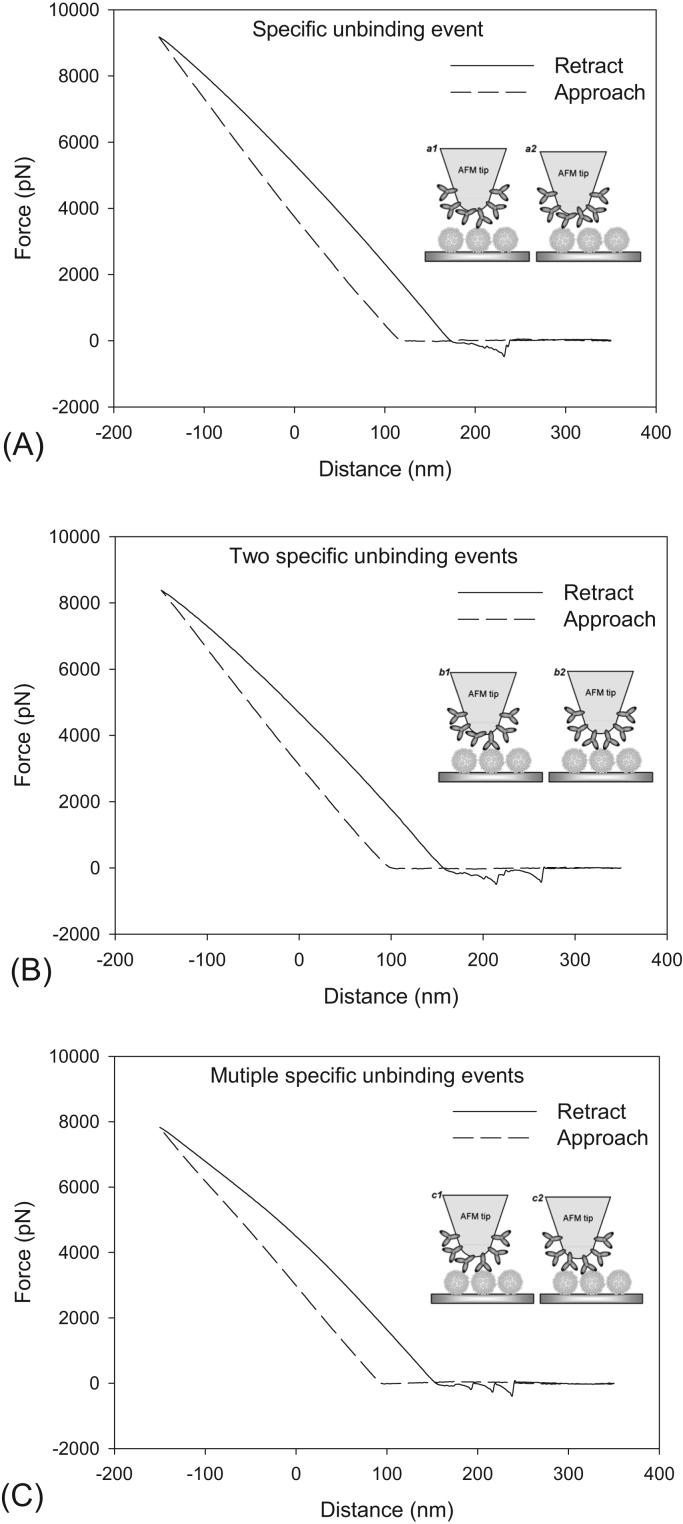
This paper proposes an effective approach to distinguish whether samples include Human Papilloma virus type-16 (HPV16) by Atomic force microscopy (AFM). AFM is an important instrument in nanobiotechnology field. At first we identified the HPV16 by Polymerase chain reaction (PCR) analysis and Western blotting from specimen of the HPV patient (E12) and the normal (C2), and then we used an AFM to observe the surface ultrastructure by tapping mode and to measure the unbinding force between HPV16 coupled to an AFM tip and anti-HPV16 L1 coated on the substrate surface by contact mode. The experimental results by tapping mode show that the size of a single HPV viron was similar to its SEM image from the previous literatures; moreover, based on the purposed methods and the analysis, two obvious findings that we can determine whether or not the subject is a HPV patient can be derived from the results; one is based on the distribution of unbinding forces, and the other is based on the distribution of the stiffness. Furthermore, the proposed method could be a useful technique for further investigating the potential role among subtypes of HPVs in the oncogenesis of human cervical cancer.
本文提出了一种通过原子力显微镜(AFM)区分样本是否包含16型人乳头瘤病毒(HPV16)的有效方法。AFM是纳米生物技术领域的一种重要仪器。首先,我们通过聚合酶链反应(PCR)分析和蛋白质印迹法从HPV患者(E12)和正常人(C2)的样本中鉴定出HPV16,然后我们使用AFM通过轻敲模式观察表面超微结构,并通过接触模式测量连接到AFM针尖的HPV16与包被在基底表面的抗HPV16 L1之间的解离力。轻敲模式的实验结果表明,单个HPV病毒体的大小与其先前文献中的扫描电子显微镜(SEM)图像相似;此外,基于所提出的方法和分析,我们可以从结果中得出两个明显的发现,即可以确定受试者是否为HPV患者;一个基于解离力的分布,另一个基于硬度的分布。此外,所提出的方法可能是进一步研究HPV各亚型在人类宫颈癌发生过程中潜在作用的有用技术。


 Zotero 插件