Koehler Melanie, Fis Anny, Gruber Hermann J, Hinterdorfer Peter
Institute of Biophysics, Johannes Kepler University, 4020 Linz, Austria.
Louvain Institute of Biomolecular Science and Technology, Université Catholique de Louvain, 1348 Louvain-La-Neuve, Belgium.
Methods Protoc. 2019 Jan 8;2(1):6. doi: 10.3390/mps2010006.
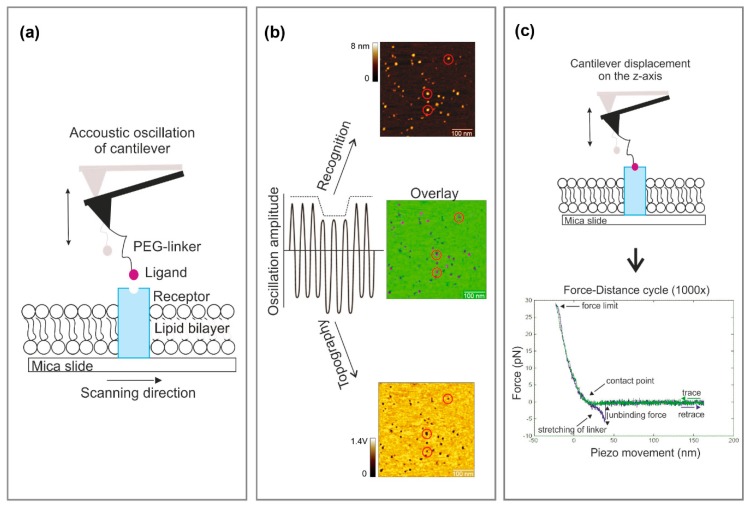
Ligand binding to receptors is one of the most important regulatory elements in biology as it is the initiating step in signaling pathways and cascades. Thus, precisely localizing binding sites and measuring interaction forces between cognate receptor-ligand pairs leads to new insights into the molecular recognition involved in these processes. Here we present a detailed protocol about applying a technique, which combines atomic force microscopy (AFM)-based recognition imaging and force spectroscopy for studying the interaction between (membrane) receptors and ligands on the single molecule level. This method allows for the selection of a single receptor molecule reconstituted into a supported lipid membrane at low density, with the subsequent quantification of the receptor-ligand unbinding force. Based on AFM tapping mode, a cantilever tip carrying a ligand molecule is oscillated across a membrane. Topography and recognition images of reconstituted receptors are recorded simultaneously by analyzing the downward and upward parts of the oscillation, respectively. Functional receptor molecules are selected from the recognition image with nanometer resolution before the AFM is switched to the force spectroscopy mode, using positional feedback control. The combined mode allows for dynamic force probing on different pre-selected molecules. This strategy results in higher throughput when compared with force mapping. Applied to two different receptor-ligand pairs, we validated the presented new mode.
配体与受体的结合是生物学中最重要的调节元件之一,因为它是信号通路和级联反应的起始步骤。因此,精确地定位结合位点并测量同源受体 - 配体对之间的相互作用力,能够让我们对这些过程中涉及的分子识别有新的认识。在此,我们展示了一个详细的实验方案,该方案应用了一种技术,即将基于原子力显微镜(AFM)的识别成像和力谱技术相结合,用于在单分子水平上研究(膜)受体与配体之间的相互作用。这种方法允许选择低密度重构于支撑脂质膜中的单个受体分子,随后对受体 - 配体解离力进行定量分析。基于AFM轻敲模式,一个携带配体分子的悬臂尖端在膜上振荡。通过分别分析振荡的向下和向上部分,同时记录重构受体的形貌和识别图像。在AFM切换到力谱模式之前,利用位置反馈控制从具有纳米分辨率的识别图像中选择功能性受体分子。这种组合模式允许对不同的预选分子进行动态力探测。与力映射相比,该策略具有更高的通量。应用于两对不同的受体 - 配体对,我们验证了所展示的新模式。