Wei Binnian, McGuffey James E, Blount Benjamin C, Wang Lanqing
Tobacco and Volatiles Branch, Division of Laboratory Sciences, National Center for Environmental Health, Centers for Disease Control and Prevention, 4770 Buford Hwy, Atlanta, Georgia 30341, United States.
ACS Omega. 2016;1(6):1307-1313. doi: 10.1021/acsomega.6b00253. Epub 2016 Dec 20.
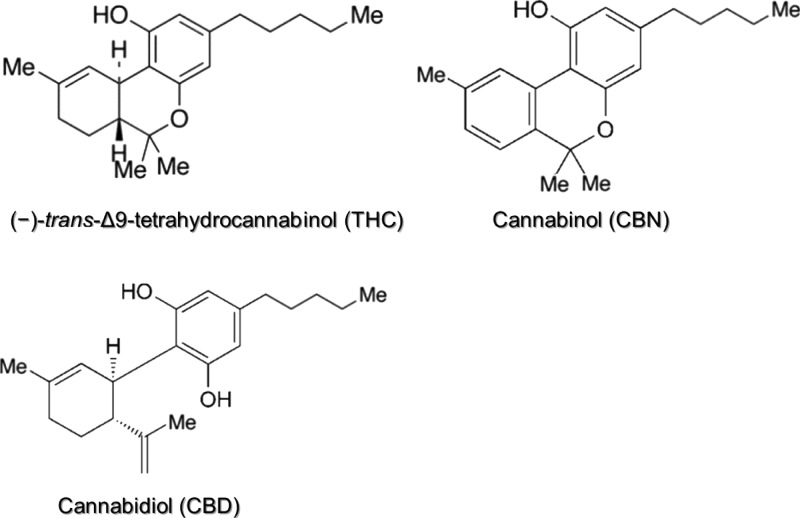
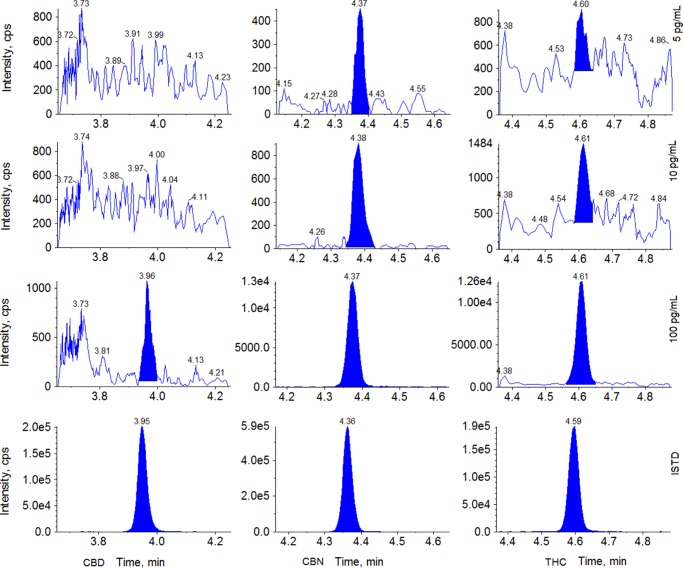
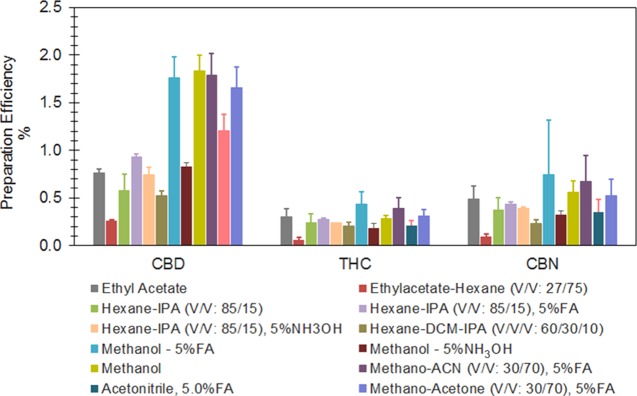
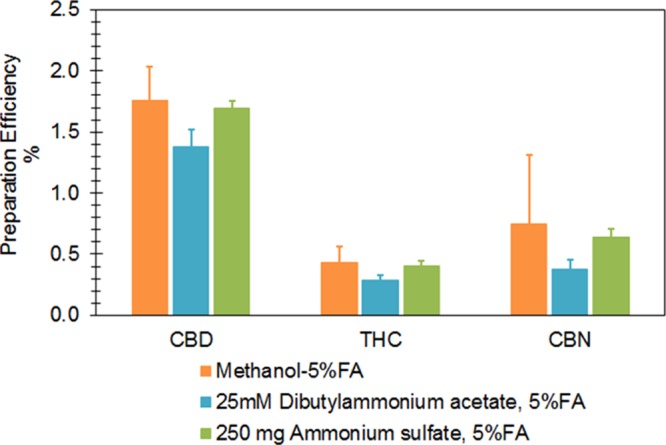
Maternal exposure to marijuana during the lactation period-either active or passive-has prompted concerns about transmission of cannabinoids to breastfed infants and possible subsequent adverse health consequences. Assessing these health risks requires a sensitive analytical approach that is able to quantitatively measure trace-level cannabinoids in breast milk. Here, we describe a saponification-solid phase extraction approach combined with ultra-high-pressure liquid chromatography-tandem mass spectrometry for simultaneously quantifying Δ9-tetrahydrocannabinol (THC), cannabidiol (CBD), and cannabinol (CBN) in breast milk. We demonstrate for the first time that constraints on sensitivity can be overcome by utilizing alkaline saponification of the milk samples. After extensively optimizing the saponification procedure, the validated method exhibited limits of detections of 13, 4, and 66 pg/mL for THC, CBN, and CBD, respectively. Notably, the sensitivity achieved was significantly improved, for instance, the limits of detection for THC is at least 100-fold more sensitive compared to that previously reported in the literature. This is essential for monitoring cannabinoids in breast milk resulting from passive or nonrecent active maternal exposure. Furthermore, we simultaneously acquired multiple reaction monitoring transitions for C- and C-analyte isotopes. This combined analysis largely facilitated data acquisition by reducing the repetitive analysis rate for samples exceeding the linear limits of C-analytes. In addition to high sensitivity and broad quantitation range, this method delivers excellent accuracy (relative error within ±10%), precision (relative standard deviation <10%), and efficient analysis. In future studies, we expect this method to play a critical role in assessing infant exposure to cannabinoids through breastfeeding.
哺乳期母亲主动或被动接触大麻引发了人们对大麻素传递给母乳喂养婴儿以及随后可能产生的不良健康后果的担忧。评估这些健康风险需要一种灵敏的分析方法,能够定量测量母乳中的痕量大麻素。在此,我们描述了一种皂化-固相萃取方法,结合超高压液相色谱-串联质谱法,用于同时定量母乳中的Δ9-四氢大麻酚(THC)、大麻二酚(CBD)和大麻酚(CBN)。我们首次证明,通过对牛奶样品进行碱性皂化可以克服灵敏度方面的限制。在对皂化程序进行广泛优化后,该经过验证的方法对THC、CBN和CBD的检测限分别为13、4和66 pg/mL。值得注意的是,所实现的灵敏度有了显著提高,例如,THC的检测限比文献中先前报道的至少灵敏100倍。这对于监测因被动或非近期主动母亲接触而在母乳中产生的大麻素至关重要。此外,我们同时获得了C-和C-分析物同位素的多反应监测转换。这种联合分析通过降低超过C-分析物线性范围的样品的重复分析率,极大地促进了数据采集。除了高灵敏度和宽定量范围外,该方法还具有出色的准确度(相对误差在±10%以内)、精密度(相对标准偏差<10%)和高效分析。在未来的研究中,我们期望该方法在评估婴儿通过母乳喂养接触大麻素方面发挥关键作用。