Moelling Karin, Broecker Felix, Russo Giancarlo, Sunagawa Shinichi
Institute of Medical Microbiology, University of ZurichZurich, Switzerland.
Max Planck Institute for Molecular GeneticsBerlin, Germany.
Front Microbiol. 2017 Sep 14;8:1745. doi: 10.3389/fmicb.2017.01745. eCollection 2017.
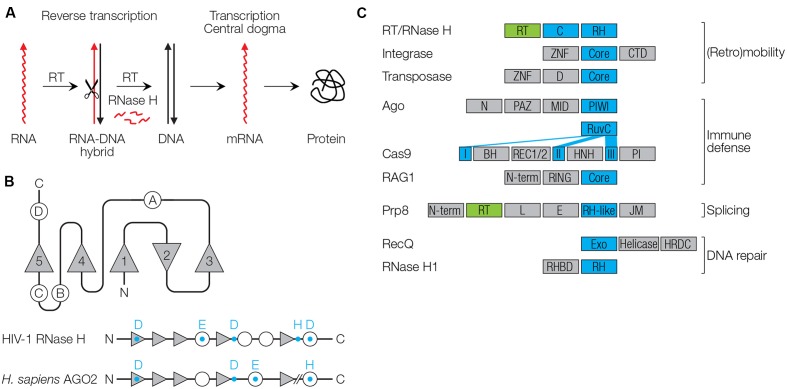
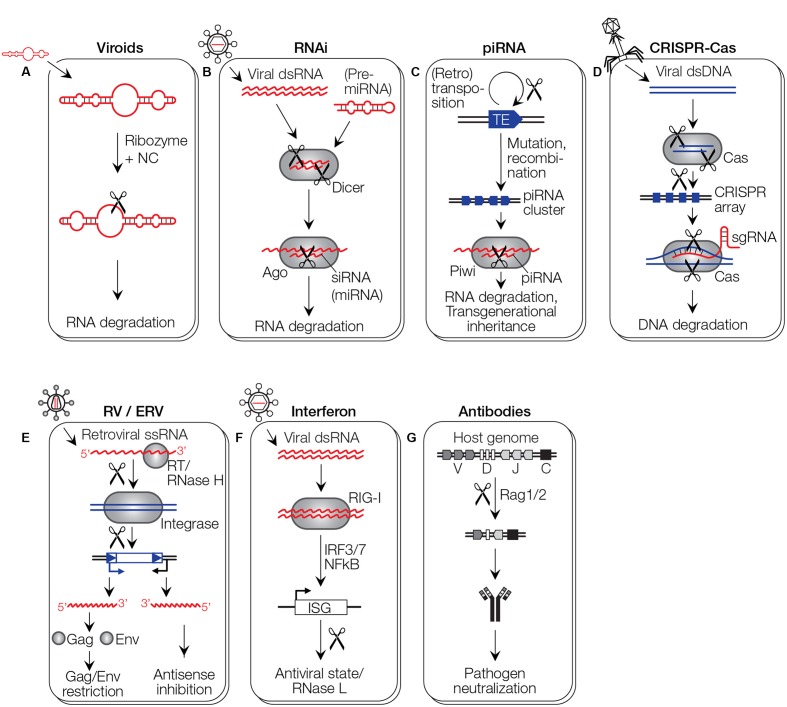
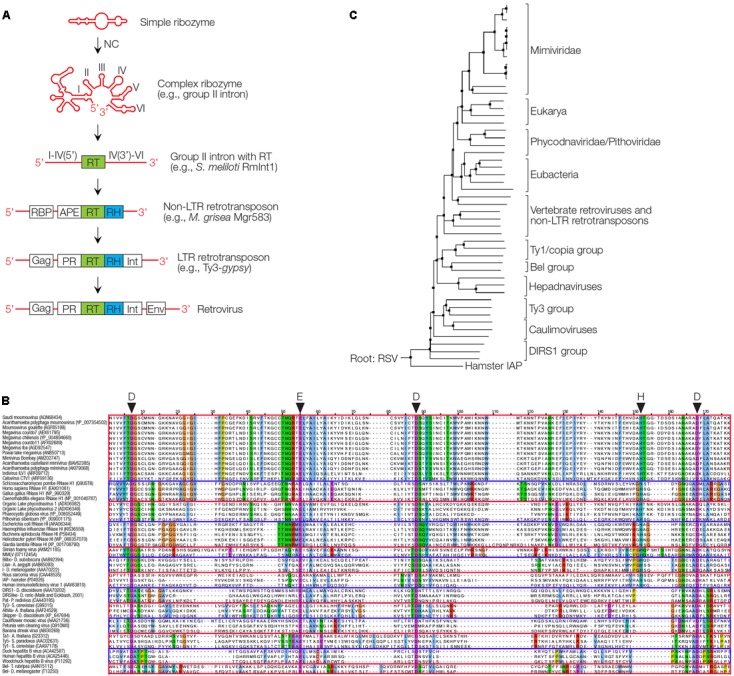
Retroviral infections are 'mini-symbiotic' events supplying recipient cells with sequences for viral replication, including the reverse transcriptase (RT) and ribonuclease H (RNase H). These proteins and other viral or cellular sequences can provide novel cellular functions including immune defense mechanisms. Their high error rate renders RT-RNases H drivers of evolutionary innovation. Integrated retroviruses and the related transposable elements (TEs) have existed for at least 150 million years, constitute up to 80% of eukaryotic genomes and are also present in prokaryotes. Endogenous retroviruses regulate host genes, have provided novel genes including the syncytins that mediate maternal-fetal immune tolerance and can be experimentally rendered infectious again. The RT and the RNase H are among the most ancient and abundant protein folds. RNases H may have evolved from ribozymes, related to viroids, early in the RNA world, forming ribosomes, RNA replicases and polymerases. Basic RNA-binding peptides enhance ribozyme catalysis. RT and ribozymes or RNases H are present today in bacterial group II introns, the precedents of TEs. Thousands of unique RTs and RNases H are present in eukaryotes, bacteria, and viruses. These enzymes mediate viral and cellular replication and antiviral defense in eukaryotes and prokaryotes, splicing, R-loop resolvation, DNA repair. RNase H-like activities are also required for the activity of small regulatory RNAs. The retroviral replication components share striking similarities with the RNA-induced silencing complex (RISC), the prokaryotic CRISPR-Cas machinery, eukaryotic V(D)J recombination and interferon systems. Viruses supply antiviral defense tools to cellular organisms. TEs are the evolutionary origin of siRNA and miRNA genes that, through RISC, counteract detrimental activities of TEs and chromosomal instability. Moreover, piRNAs, implicated in transgenerational inheritance, suppress TEs in germ cells. Thus, virtually all known immune defense mechanisms against viruses, phages, TEs, and extracellular pathogens require RNase H-like enzymes. Analogous to the prokaryotic CRISPR-Cas anti-phage defense possibly originating from TEs termed casposons, endogenized retroviruses ERVs and amplified TEs can be regarded as related forms of inheritable immunity in eukaryotes. This survey suggests that RNase H-like activities of retroviruses, TEs, and phages, have built up innate and adaptive immune systems throughout all domains of life.
逆转录病毒感染是一种“微型共生”事件,为宿主细胞提供病毒复制所需的序列,包括逆转录酶(RT)和核糖核酸酶H(RNase H)。这些蛋白质以及其他病毒或细胞序列能够赋予细胞新功能,包括免疫防御机制。其高错误率使RT-RNases H成为进化创新的驱动因素。整合的逆转录病毒及相关转座元件(TEs)已经存在了至少1.5亿年,在真核生物基因组中所占比例高达80%,在原核生物中也有存在。内源性逆转录病毒可调控宿主基因,提供了包括介导母胎免疫耐受的合胞素在内的新基因,并且可以通过实验再次使其具有感染性。RT和RNase H是最古老且最丰富的蛋白质折叠类型之一。RNases H可能在RNA世界早期从与类病毒相关的核酶进化而来,形成了核糖体、RNA复制酶和聚合酶。基本的RNA结合肽可增强核酶催化作用。如今,RT和核酶或RNases H存在于细菌的II类内含子中,这是TEs的前身。真核生物、细菌和病毒中存在数千种独特的RT和RNases H。这些酶在真核生物和原核生物中介导病毒和细胞复制以及抗病毒防御、剪接、R环解决、DNA修复。小调节RNA的活性也需要RNase H样活性。逆转录病毒复制成分与RNA诱导沉默复合体(RISC)、原核生物的CRISPR-Cas机制、真核生物的V(D)J重组和干扰素系统有着显著的相似性。病毒为细胞生物体提供抗病毒防御工具。TEs是siRNA和miRNA基因的进化起源,这些基因通过RISC抵消TEs的有害活性和染色体不稳定性。此外,与跨代遗传有关的piRNA可抑制生殖细胞中的TEs。因此,几乎所有已知的针对病毒、噬菌体、TEs和细胞外病原体的免疫防御机制都需要RNase H样酶。类似于可能起源于被称为casposons的TEs的原核生物CRISPR-Cas抗噬菌体防御,内源性逆转录病毒ERVs和扩增的TEs可被视为真核生物中可遗传免疫的相关形式。这项综述表明,逆转录病毒、TEs和噬菌体的RNase H样活性在生命的所有领域构建了先天性和适应性免疫系统。