Morera-Fumero Armando L, Abreu-Gonzalez Pedro, Henry-Benitez Manuel, Fernandez-Lopez Lourdes, Diaz-Mesa Estefania, Del Rosario Cejas-Mendez Maria, Guillen-Pino Fernando
Departamento de Medicina Interna, Dermatologia y Psiquiatria, Facultad de Ciencias de la Salud, Universidad de la Laguna (ULL), La Laguna, Santa Cruz de Tenerife, Spain.
Consultoria Psiquiatrica SC, Santa Cruz de Tenerife, Spain.
Med Chem. 2018;14(3):225-229. doi: 10.2174/1573406413666171002123158.
Seasonal and circadian changes are two factors described to affect blood levels of some biological molecules. The Total Antioxidant Capacity (TAC) is one global measure of the antioxidant capacity of a system. There is no agreement about the existence of day/night changes in TAC levels as well as there is no information about seasonal changes in TAC levels.
The aims of this research are studying if there are summer/winter changes in TAC concentrations or if TAC concentrations have day/night changes.
Ninety-eight healthy subjects took part in the summer study of whom 64 participated in the winter one. Blood was sampled at 09:00, 12:00 and 00:00 h. TAC was measured by the ABTS radical cation technique. Results are expressed in mmol/L of trolox equivalents.
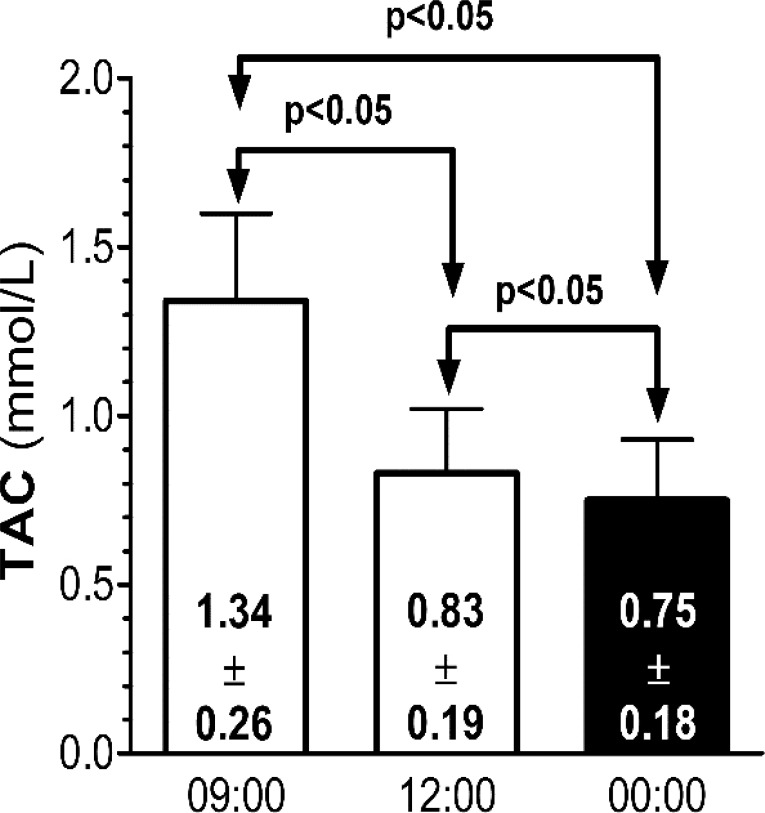
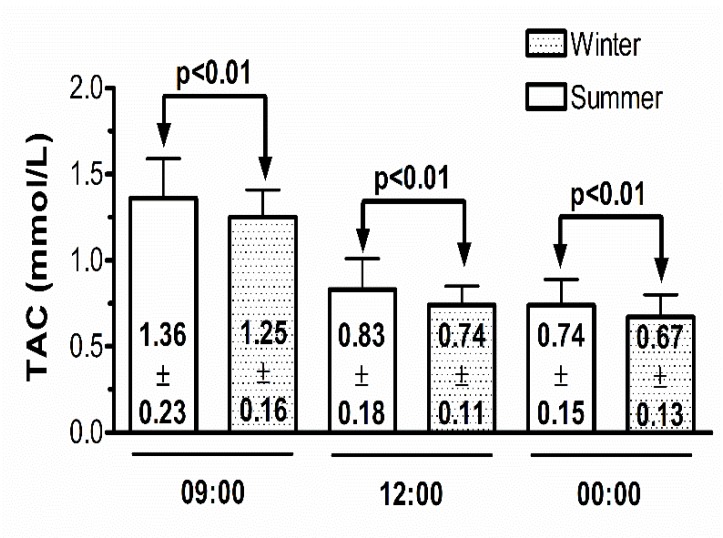
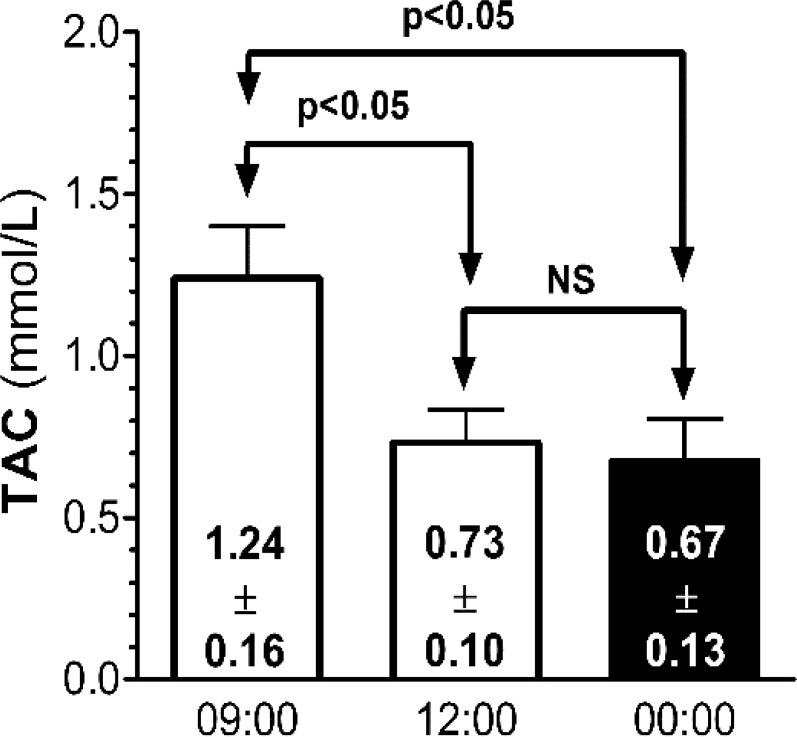
The subjects had significantly higher TAC levels in summer than winter at the three-time point studied. Summer 09:00 TAC concentration was significantly higher than the 12:00 and 00:00 h concentrations (1.34±0.26 vs 0.83±0.19, 0.75±0.18). Summer TAC 12:00 h concentrations were significantly higher than the 00:00 h concentrations (0.83±0.19 vs. 0.75±0.18). Winter 09:00 TAC concentrations were significantly higher than the 12:00 and 00:00 h concentrations (1.24±0.16 vs. 0.73±0.10, 0.67±0.13). There were no significant differences between the 12:00 and 00:00 h TAC concentrations.
Strong methodological biases may be made if the seasonal and circadian changes in serum TAC concentration are not taken into account when researching in this area.
季节和昼夜变化是影响某些生物分子血液水平的两个因素。总抗氧化能力(TAC)是系统抗氧化能力的一项综合指标。关于TAC水平是否存在昼夜变化尚无定论,也没有关于TAC水平季节性变化的信息。
本研究的目的是探讨TAC浓度是否存在夏季/冬季变化,或者TAC浓度是否存在昼夜变化。
98名健康受试者参与了夏季研究,其中64人参与了冬季研究。在09:00、12:00和00:00采集血液样本。采用ABTS自由基阳离子技术测定TAC。结果以每升毫摩尔的Trolox当量表示。
在研究的三个时间点,受试者夏季的TAC水平显著高于冬季。夏季09:00的TAC浓度显著高于12:00和00:00的浓度(1.34±0.26对0.83±0.19,0.75±0.18)。夏季12:00的TAC浓度显著高于00:00的浓度(0.83±0.19对0.75±0.18)。冬季09:00的TAC浓度显著高于12:00和00:00的浓度(1.24±0.16对0.73±0.10,0.67±0.13)。12:00和00:00的TAC浓度之间没有显著差异。
在该领域进行研究时,如果不考虑血清TAC浓度的季节性和昼夜变化,可能会产生严重的方法学偏差。