Department of Biology, Masaryk University, Kamenice 5/A7, CZ-62500, Brno, Czech Republic.
National Centre for Biomolecular Research, Masaryk University, Kamenice 5/A4, CZ-62500, Brno, Czech Republic.
BMC Biol. 2017 Oct 2;15(1):90. doi: 10.1186/s12915-017-0429-8.
Proper DNA replication is essential for faithful transmission of the genome. However, replication stress has serious impact on the integrity of the cell, leading to stalling or collapse of replication forks, and has been determined as a driving force of carcinogenesis. Mus81-Mms4 complex is a structure-specific endonuclease previously shown to be involved in processing of aberrant replication intermediates and promotes POLD3-dependent DNA synthesis via break-induced replication. However, how replication components might be involved in this process is not known.
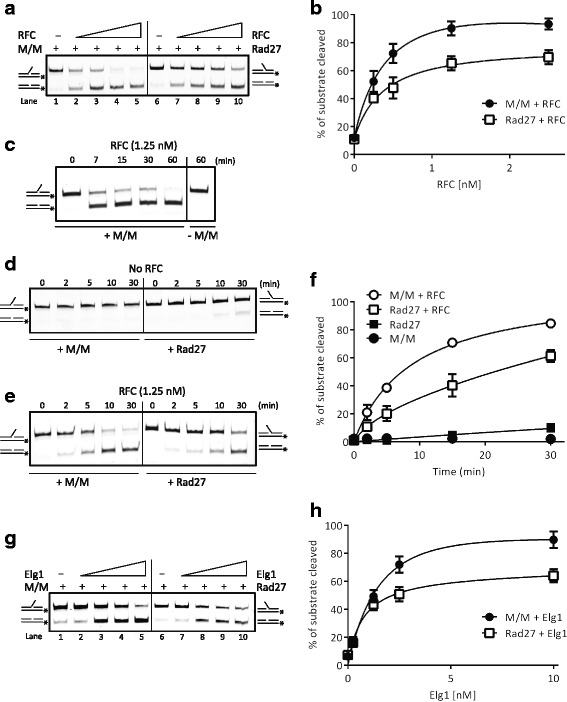
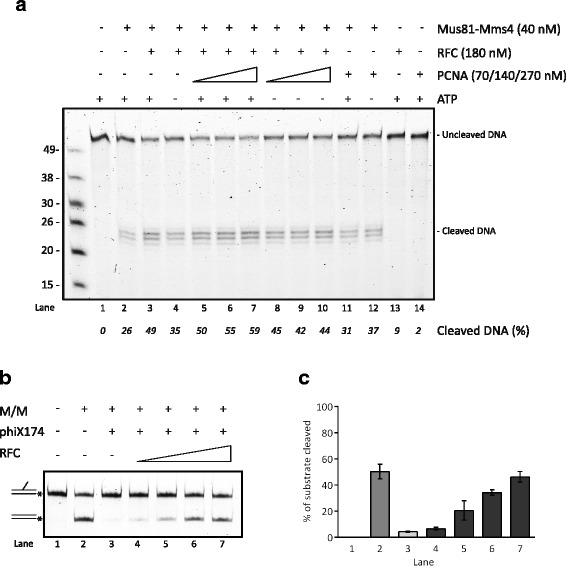
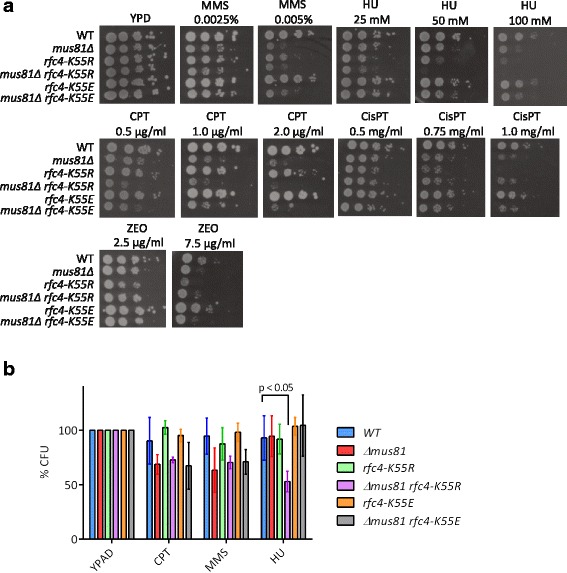
Herein, we show the interaction and robust stimulation of Mus81-Mms4 nuclease activity by heteropentameric replication factor C (RFC) complex, the processivity factor of replicative DNA polymerases that is responsible for loading of proliferating cell nuclear antigen (PCNA) during DNA replication and repair. This stimulation is enhanced by RFC-dependent ATP hydrolysis and by PCNA loading on the DNA. Moreover, this stimulation is not specific to Rfc1, the largest of subunit of this complex, thus indicating that alternative clamp loaders may also play a role in the stimulation. We also observed a targeting of Mus81 by RFC to the nick-containing DNA substrate and we provide further evidence that indicates cooperation between Mus81 and the RFC complex in the repair of DNA lesions generated by various DNA-damaging agents.
Identification of new interacting partners and modulators of Mus81-Mms4 nuclease, RFC, and PCNA imply the cooperation of these factors in resolution of stalled replication forks and branched DNA structures emanating from the restarted replication forks under conditions of replication stress.
正确的 DNA 复制对于基因组的忠实传递至关重要。然而,复制压力对细胞的完整性有严重影响,导致复制叉停滞或崩溃,并已被确定为致癌的驱动力。Mus81-Mms4 复合物是一种结构特异性内切酶,先前被证明参与处理异常复制中间体,并通过引发复制促进 POLD3 依赖性 DNA 合成。然而,复制成分如何参与这个过程尚不清楚。
本文显示,异五聚体复制因子 C(RFC)复合物与 Mus81-Mms4 核酸酶活性相互作用并强烈刺激,RFC 复合物是复制 DNA 聚合酶的进程因子,负责在 DNA 复制和修复过程中加载增殖细胞核抗原(PCNA)。这种刺激受 RFC 依赖性 ATP 水解和 PCNA 在 DNA 上的加载增强。此外,这种刺激不仅特异性地针对 Rfc1,即该复合物中最大的亚基,因此表明替代的夹取器 loader 也可能在刺激中发挥作用。我们还观察到 RFC 将 Mus81 靶向含有切口的 DNA 底物,并且我们提供了进一步的证据表明 Mus81 和 RFC 复合物在修复各种 DNA 损伤剂产生的 DNA 损伤方面的合作。
鉴定 Mus81-Mms4 核酸酶、RFC 和 PCNA 的新相互作用伙伴和调节剂表明,在复制压力条件下,这些因素在解决停滞的复制叉和从重新启动的复制叉中出现的分支 DNA 结构方面合作。