Lorem Geir Fagerjord, Schirmer Henrik, Emaus Nina
Department of Health and Care Sciences, Faculty of Health Sciences, UiT The Arctic University of Norway, Tromsø, Norway.
Department of Clinical Medicine, Faculty of Health Sciences, UiT The Arctic University of Norway, Tromsø, Norway.
Health Qual Life Outcomes. 2017 Oct 2;15(1):191. doi: 10.1186/s12955-017-0766-x.
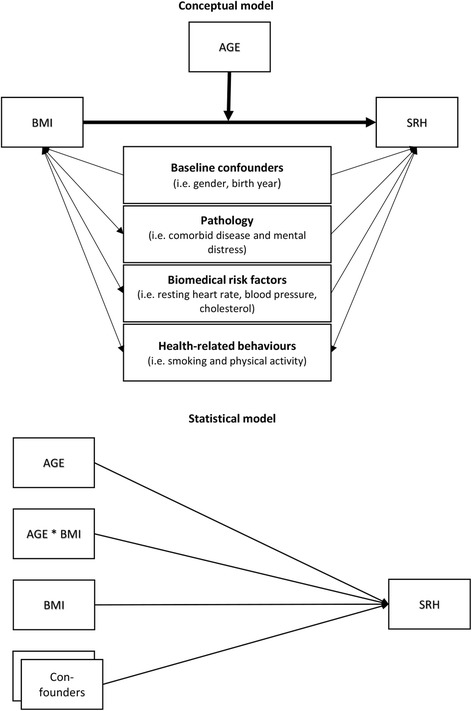
Utilizing a cohort study design combining a survey approach with repeated physical examinations, we examined the independent effects of BMI on mortality and self-reported health (SRH) and whether these independent effects change as people grow older.
The Tromsø Study consists of six surveys conducted in the municipality of Tromsø, Norway, with large representative samples of a general population. In total, 31,985 subjects participated in at least one of the four surveys administered between 1986 and 2008. Outcomes of interest were SRH and all-cause mortality.
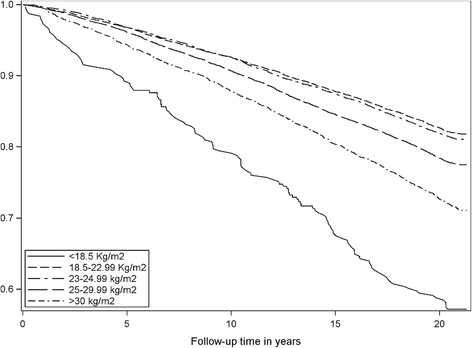
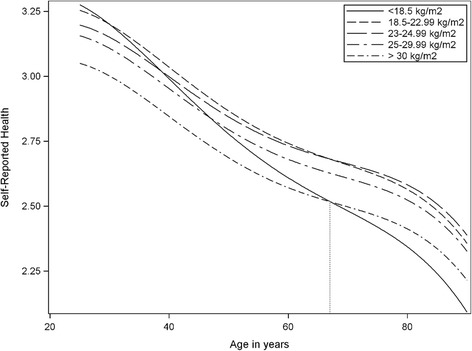
Overweight and underweight subjects reported significantly lower levels of SRH, but age affected the thinnest subjects more than all others. The SRH trajectory of underweight subjects at age 25 was slightly above the other categories (0.08), but it fell to -.30 below the reference category at age 90. For obese subjects, the difference was -0.15 below the reference category at age 25 and -0.18 below at age 90. This implies that even though a low BMI was slightly beneficial at a young age, it represented an increasing risk with age that crossed the reference curve at age 38 and even crossed the obese trajectory at age 67 in the full fitted model. The proportional hazard ratio for those who were underweight was 1.69 (95% CI: 1.38-2.06) for all-cause death as compared to 1.12 (95% CI: 1.02-1.23) for obese subjects.
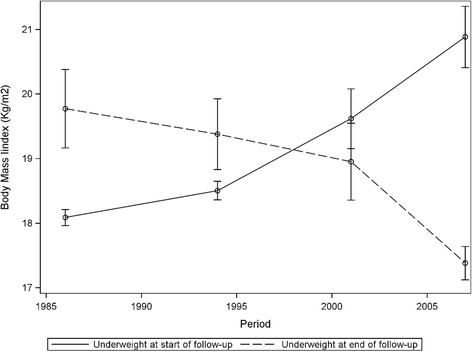
BMI affected SRH and all-cause mortality independently from comorbidity, mental health, health-related behaviors and other biological risk factors. Being underweight was associated with excess mortality as compared to all others, and age affected the thinnest subjects more than all others. Weight increase was beneficial for mortality but not for SRH among the underweight. The rapid decline of SRH with increasing age suggests that particular attention should be paid to underweight after 38 years of age.
采用队列研究设计,结合调查方法与重复体格检查,我们研究了体重指数(BMI)对死亡率和自我报告健康状况(SRH)的独立影响,以及这些独立影响是否会随着人们年龄增长而变化。
特罗姆瑟研究包括在挪威特罗姆瑟市进行的六项调查,样本来自普通人群且具有广泛代表性。共有31985名受试者参与了1986年至2008年间进行的四项调查中的至少一项。感兴趣的结果是SRH和全因死亡率。
超重和体重过轻的受试者报告的SRH水平显著较低,但年龄对最瘦的受试者影响比对其他所有人的影响更大。25岁时体重过轻的受试者的SRH轨迹略高于其他类别(0.08),但在90岁时降至比参考类别低0.30。对于肥胖受试者,25岁时比参考类别低0.15,90岁时低0.18。这意味着,尽管低BMI在年轻时略有益处,但随着年龄增长,其风险不断增加,在完全拟合模型中,38岁时超过参考曲线,67岁时甚至超过肥胖轨迹。体重过轻的人的全因死亡比例风险比为1.69(95%置信区间:1.38 - 2.06),而肥胖受试者为1.12(95%置信区间:1.02 - 1.23)。
BMI独立于合并症、心理健康、健康相关行为和其他生物风险因素影响SRH和全因死亡率。与其他所有人相比,体重过轻与额外死亡率相关,且年龄对最瘦的受试者影响比对其他所有人的影响更大。体重增加对体重过轻的人的死亡率有益,但对SRH无益。随着年龄增长,SRH迅速下降表明,38岁以后应特别关注体重过轻的情况。