Bates Janine, Francis Nick A, White Patrick, Gillespie David, Thomas-Jones Emma, Breen Rachel, Kirby Nigel, Hood Kerry, Gal Micaela, Phillips Rhiannon, Naik Gurudutt, Cals Jochen, Llor Carl, Melbye Hasse, Wootton Mandy, Riga Evgenia, Cochrane Ann, Howe Robin, Fitzsimmons Deborah, Sewell Bernadette, Alam Mohammed Fasihul, Butler Christopher C
South East Wales Trials Unit, Centre for Trials Research, Cardiff University, Neuadd Meirionnydd, Heath Park, Cardiff, CF14 4XW, UK.
Department of Population Medicine, Cardiff University School of Medicine, 5th Floor, Neuadd Meirionnydd, Heath Park, Cardiff, CF14 4YS, UK.
Trials. 2017 Sep 29;18(1):442. doi: 10.1186/s13063-017-2144-8.
Most patients presenting with acute exacerbations of chronic obstructive pulmonary disease (AECOPD) in primary care are prescribed an antibiotic, which may not always be appropriate and may cause harm. C-reactive protein (CRP) is an acute-phase biomarker that can be rapidly measured at the point of care and may predict benefit from antibiotic treatment in AECOPD. It is not clear whether the addition of a CRP point-of-care test (POCT) to clinical assessment leads to a reduction in antibiotic consumption without having a negative impact on COPD health status.
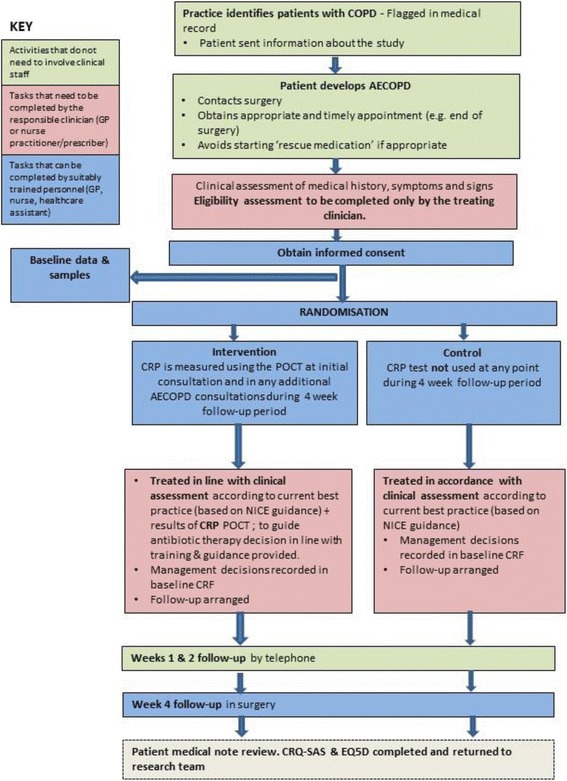
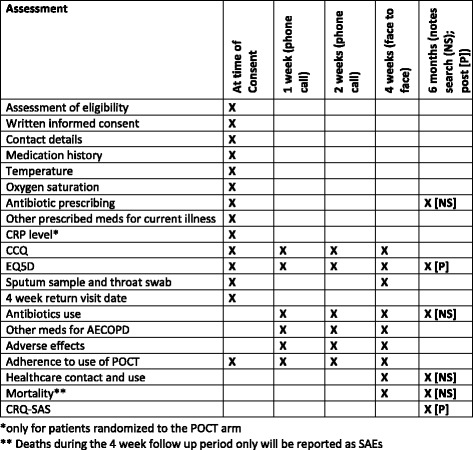
METHODS/DESIGN: This is a multicentre, individually randomised controlled trial (RCT) aiming to include 650 participants with a diagnosis of AECOPD in primary care. Participants will be randomised to be managed according to usual care (control) or with the addition of a CRP POCT to guide antibiotic prescribing. Antibiotic consumption for AECOPD within 4 weeks post randomisation and COPD health status (total score) measured by the Clinical COPD Questionnaire (CCQ) at 2 weeks post randomisation will be co-primary outcomes. Primary analysis (by intention-to-treat) will determine differences in antibiotic consumption for superiority and COPD health status for non-inferiority. Secondary outcomes include: COPD health status, CCQ domain scores, use of other COPD treatments (weeks 1, 2 and 4), EQ-5D utility scores (weeks 1, 2 and 4 and month 6), disease-specific, health-related quality of life (HRQoL) at 6 months, all-cause antibiotic consumption (antibiotic use for any condition) during first 4 weeks post randomisation, total antibiotic consumption (number of days during first 4 weeks of antibiotic consumed for AECOPD/any reason), antibiotic prescribing at the index consultation and during following 4 weeks, adverse effects over the first 4 weeks, incidence of pneumonia (weeks 4 and 6 months), health care resource use and cost comparison over the 6 months following randomisation. Prevalence and resistance profiles of bacteria will be assessed using throat and sputum samples collected at baseline and 4-week follow-up. A health economic evaluation and qualitative process evaluation will be carried out.
If shown to be effective (i.e. leads to a reduction in antibiotic use with no worse COPD health status), the use of the CRP POCT could lead to better outcomes for patients with AECOPD and help reduce selective pressures driving the development of antimicrobial resistance. PACE will be one of the first studies to evaluate the cost-effectiveness of a POCT biomarker to guide clinical decision-making in primary care on patient-reported outcomes, antibiotic prescribing and antibiotic resistance for AECOPD.
ISRCTN registry, ID: ISRCTN24346473 . Registered on 20 August 2014.
在基层医疗中,大多数慢性阻塞性肺疾病急性加重期(AECOPD)患者会被开具抗生素处方,而这可能并不总是恰当的,且可能造成伤害。C反应蛋白(CRP)是一种急性期生物标志物,可在医疗点快速检测,并且可能预测AECOPD患者接受抗生素治疗的获益情况。目前尚不清楚在临床评估中增加CRP即时检验(POCT)是否会减少抗生素使用量,同时又不对慢性阻塞性肺疾病(COPD)健康状况产生负面影响。
方法/设计:这是一项多中心、个体随机对照试验(RCT),旨在纳入650名在基层医疗中被诊断为AECOPD的参与者。参与者将被随机分配,按照常规治疗(对照组)进行管理,或在常规治疗基础上增加CRP POCT以指导抗生素处方。随机分组后4周内AECOPD的抗生素使用量,以及随机分组后2周通过临床COPD问卷(CCQ)测量的COPD健康状况(总分)将作为共同主要结局指标。主要分析(意向性分析)将确定抗生素使用量的优效性差异以及COPD健康状况的非劣效性差异。次要结局指标包括:COPD健康状况、CCQ领域得分、其他COPD治疗的使用情况(第1、2和4周)、EQ-5D效用得分(第1、2和4周以及第6个月)、6个月时疾病特异性的健康相关生活质量(HRQoL)、随机分组后前4周的全因抗生素使用量(用于任何病症的抗生素使用情况)、总抗生素使用量(因AECOPD/任何原因在抗生素使用的前4周内使用抗生素的天数)、初次会诊时及随后4周的抗生素处方、前4周的不良反应、肺炎发病率(第4周和第6个月)、随机分组后6个月内的医疗资源使用情况和成本比较。将使用在基线和4周随访时采集的咽喉和痰液样本评估细菌的流行情况和耐药谱。将进行卫生经济学评估和定性过程评估。
如果证明有效(即减少抗生素使用量且不使COPD健康状况变差),CRP POCT的使用可能会为AECOPD患者带来更好的结局,并有助于降低推动抗菌药物耐药性发展的选择压力。PACE将是首批评估POCT生物标志物在基层医疗中指导临床决策对于患者报告结局、抗生素处方和AECOPD抗生素耐药性的成本效益的研究之一。
ISRCTN注册库,编号:ISRCTN24346473。于2014年8月20日注册。