Department of Head and Neck Surgery, David Geffen School of Medicine, University of California Los Angeles, Los Angeles, California, 90095, USA.
Sci Rep. 2017 Oct 2;7(1):12500. doi: 10.1038/s41598-017-12298-3.
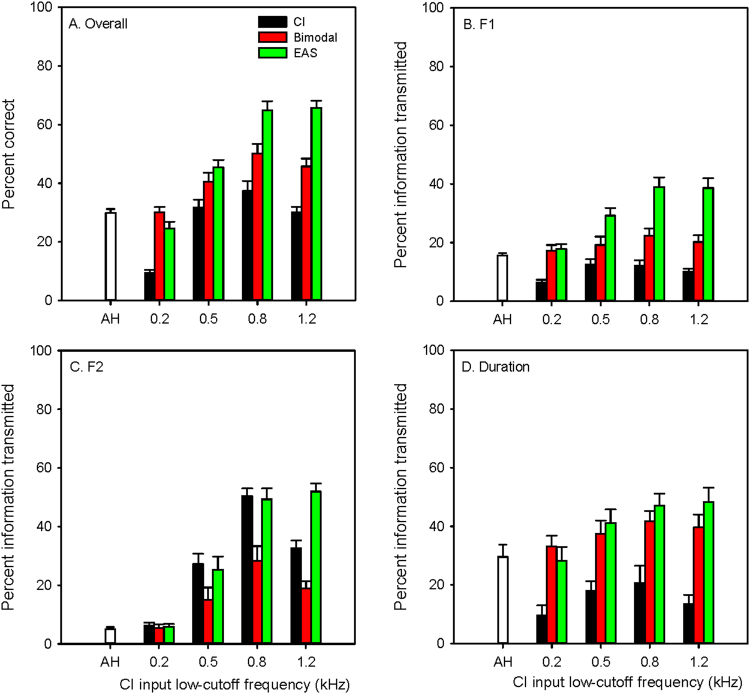
Advances in cochlear implant (CI) technology allow for acoustic and electric hearing to be combined within the same ear (electric-acoustic stimulation, or EAS) and/or across ears (bimodal listening). Integration efficiency (IE; the ratio between observed and predicted performance for acoustic-electric hearing) can be used to estimate how well acoustic and electric hearing are combined. The goal of this study was to evaluate factors that affect IE in EAS and bimodal listening. Vowel recognition was measured in normal-hearing subjects listening to simulations of unimodal, EAS, and bimodal listening. The input/output frequency range for acoustic hearing was 0.1-0.6 kHz. For CI simulations, the output frequency range was 1.2-8.0 kHz to simulate a shallow insertion depth and the input frequency range was varied to provide increasing amounts of speech information and tonotopic mismatch. Performance was best when acoustic and electric hearing was combined in the same ear. IE was significantly better for EAS than for bimodal listening; IE was sensitive to tonotopic mismatch for EAS, but not for bimodal listening. These simulation results suggest acoustic and electric hearing may be more effectively and efficiently combined within rather than across ears, and that tonotopic mismatch should be minimized to maximize the benefit of acoustic-electric hearing, especially for EAS.
人工耳蜗(CI)技术的进步使得同一耳内(电-声刺激,EAS)和/或双耳内(双模式聆听)可以同时结合声学和电听觉。整合效率(IE;电-声听觉观察到的和预测的性能之间的比值)可用于估计声学和电听觉的结合程度。本研究的目的是评估影响 EAS 和双模式聆听中 IE 的因素。在正常听力受试者中测量了元音识别,这些受试者聆听了单模态、EAS 和双模式聆听的模拟。声学听觉的输入/输出频率范围为 0.1-0.6 kHz。对于 CI 模拟,输出频率范围为 1.2-8.0 kHz,以模拟浅插入深度,输入频率范围变化以提供更多的语音信息和音位失配。当同一耳内同时结合声学和电听觉时,性能最佳。EAS 的 IE 明显优于双模式聆听;EAS 的 IE 对音位失配敏感,但双模式聆听则不然。这些模拟结果表明,声学和电听觉在同一耳内可能比在双耳内更有效地结合,并且应该最小化音位失配以最大限度地提高电-声听觉的益处,特别是对于 EAS。