Estonian Veterinary and Food Laboratory (VFL), Kreutzwaldi 30, 51006, Tartu, Estonia.
Estonian University of Life Science, Institute of Veterinary Medicine and Animal Sciences, Kreutzwaldi 62, 51014, Tartu, Estonia.
Sci Rep. 2017 Oct 2;7(1):12562. doi: 10.1038/s41598-017-12952-w.
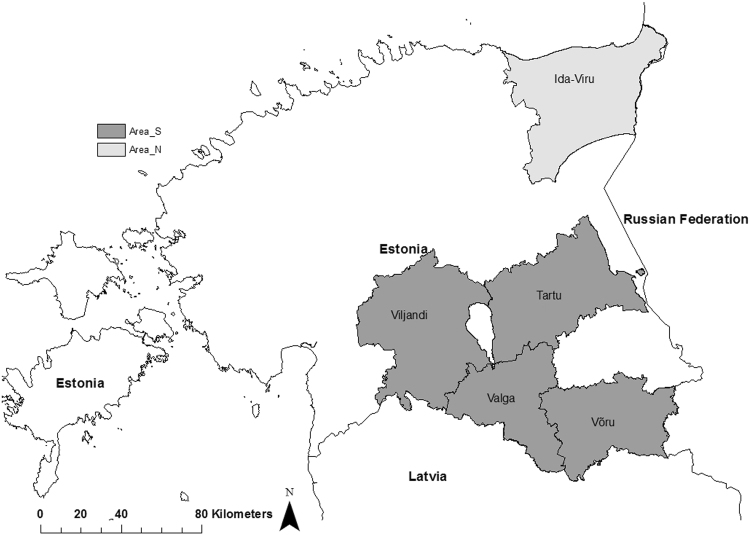
African swine fever (ASF) in wild boar emerged in Estonia for the first time in September 2014. The first affected region was located in the South of Estonia close to the border with Latvia. It was considered to be epidemiologically connected to the outbreaks in the North of Latvia. About two weeks later, cases were detected in the North of Estonia, close to the Russian border. In the present study, we aimed to investigate the epidemiological courses of the disease in the South and in the North of Estonia. Potential associations between risk factors and the laboratory test results for ASF were examined. A hierarchical Bayesian space-time model was used to analyze the temporal trend of the ASF seroprevalence in the two areas. Young wild boar were statistically significant more likely to be ASF-positive by both, serology and virus detection, than older animals. A statistically significant difference between the two areas in the temporal course of the seroprevalence was found. While the seroprevalence clearly increased in the South, it remained relatively constant in the North. These findings led to the hypothesis that ASF might have been introduced earlier into the North of Estonia then into the South of the country.
非洲猪瘟(ASF)于 2014 年 9 月首次在爱沙尼亚的野猪中出现。第一个受影响的地区位于爱沙尼亚南部,靠近拉脱维亚边境。据认为,这与拉脱维亚北部的疫情有流行病学联系。大约两周后,在爱沙尼亚北部靠近俄罗斯边境的地区发现了病例。在本研究中,我们旨在调查爱沙尼亚南部和北部的疾病流行过程。检查了风险因素与 ASF 实验室检测结果之间的潜在关联。使用分层贝叶斯时空模型分析了两个地区 ASF 血清阳性率的时间趋势。通过血清学和病毒检测,年轻的野猪比老年动物更有可能呈 ASF 阳性,这具有统计学意义。在血清阳性率的时间过程中,两个地区之间存在统计学上的显著差异。虽然南部的血清阳性率明显增加,但北部的血清阳性率则相对稳定。这些发现导致了 ASF 可能更早地传入爱沙尼亚北部的假设。