Chatterjee Sharmila, Bhattacharya Mahuya, Todi Subhash Kumar
Department of Academics and Research, AMRI Hospitals, Kolkata, West Bengal, India.
Department of Critical Care Medicine, AMRI Hospitals, Kolkata, West Bengal, India.
Indian J Crit Care Med. 2017 Sep;21(9):573-577. doi: 10.4103/ijccm.IJCCM_240_17.
Sepsis is a major worldwide cause of morbidity and mortality. Most sepsis epidemiologic data are from the Western literature. Sparse data from India describe the epidemiology of infection rather than sepsis which is a host response to infection. This study describes the epidemiology of sepsis in the Intensive Care Unit (ICU) of an Indian tertiary care hospital.
A prospective study conducted between June 2006 and May 2011. All consecutively admitted patients during the 5 year study >=18 years of age were included and data obtained from hospital in-patient records. Variables measured were the incidence of severe sepsis, ICU, hospital, and 28-day mortality, the median length of ICU stay, median Acute Physiology and Chronic Health Evaluation II (APACHE II) score, infection site, and microbial profile.
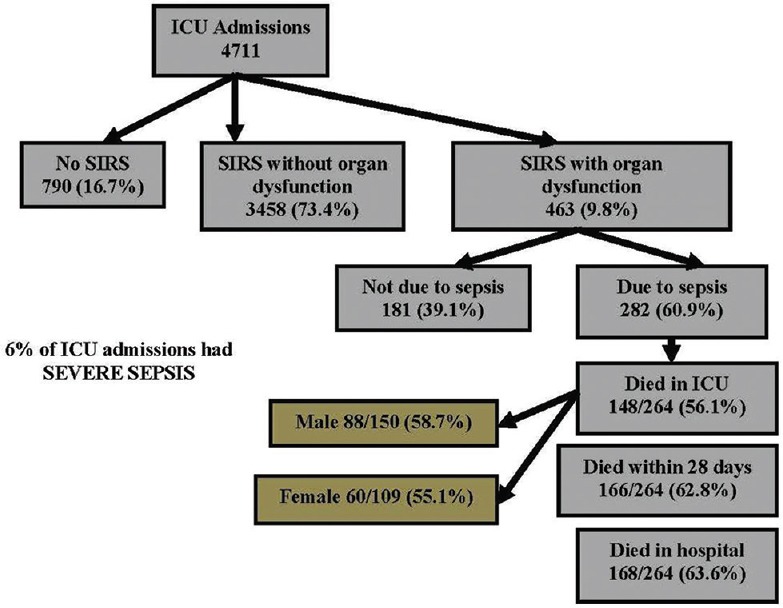
There were 4711 admissions during the study with 282 (6.2%, 95% confidence interval 2.3, 13.1) admissions with severe sepsis. ICU mortality, hospital mortality, and 28-day mortality were 56%, 63.6%, and 62.8%, respectively. Predominant infection site was respiratory tract. The most common organisms were Gram-negative microbes. The most common microbe was Acinetobacter baumanni. Median APACHE II score on admission was 22 (interquartile range 16-28) and median length of ICU stay was 8 days. Severe sepsis attributable mortality was 85%.
Severe sepsis is common in Indian ICUs and is mainly due to Gram-negative organisms. ICU mortality is high in this group and care is resource intensive due to increased length of stay.
脓毒症是全球发病和死亡的主要原因。大多数脓毒症流行病学数据来自西方文献。来自印度的稀疏数据描述的是感染的流行病学,而非作为宿主对感染反应的脓毒症。本研究描述了一家印度三级护理医院重症监护病房(ICU)中脓毒症的流行病学情况。
于2006年6月至2011年5月进行一项前瞻性研究。纳入所有在5年研究期间连续入院的年龄≥18岁的患者,并从医院住院记录中获取数据。测量的变量包括严重脓毒症的发病率、ICU死亡率、医院死亡率和28天死亡率、ICU住院时间中位数、急性生理与慢性健康状况评分系统II(APACHE II)中位数评分、感染部位和微生物谱。
研究期间共入院4711例,其中282例(6.2%,95%置信区间2.3,13.1)为严重脓毒症。ICU死亡率、医院死亡率和28天死亡率分别为56%、63.6%和62.8%。主要感染部位是呼吸道。最常见的病原体是革兰氏阴性菌。最常见的微生物是鲍曼不动杆菌。入院时APACHE II评分中位数为22(四分位间距16 - 28),ICU住院时间中位数为8天。严重脓毒症所致死亡率为85%。
严重脓毒症在印度ICU中很常见,主要由革兰氏阴性菌引起。该组患者的ICU死亡率很高,且由于住院时间延长,护理资源消耗大。