College of Life Sciences, Laboratory Center of Life Sciences, Nanjing Agricultural University, Nanjing 210095, China.
Wuhan Shizhen Water Structure Research Institute Co., Ltd., Wuhan 430200, China.
Int J Mol Sci. 2017 Oct 3;18(10):2084. doi: 10.3390/ijms18102084.
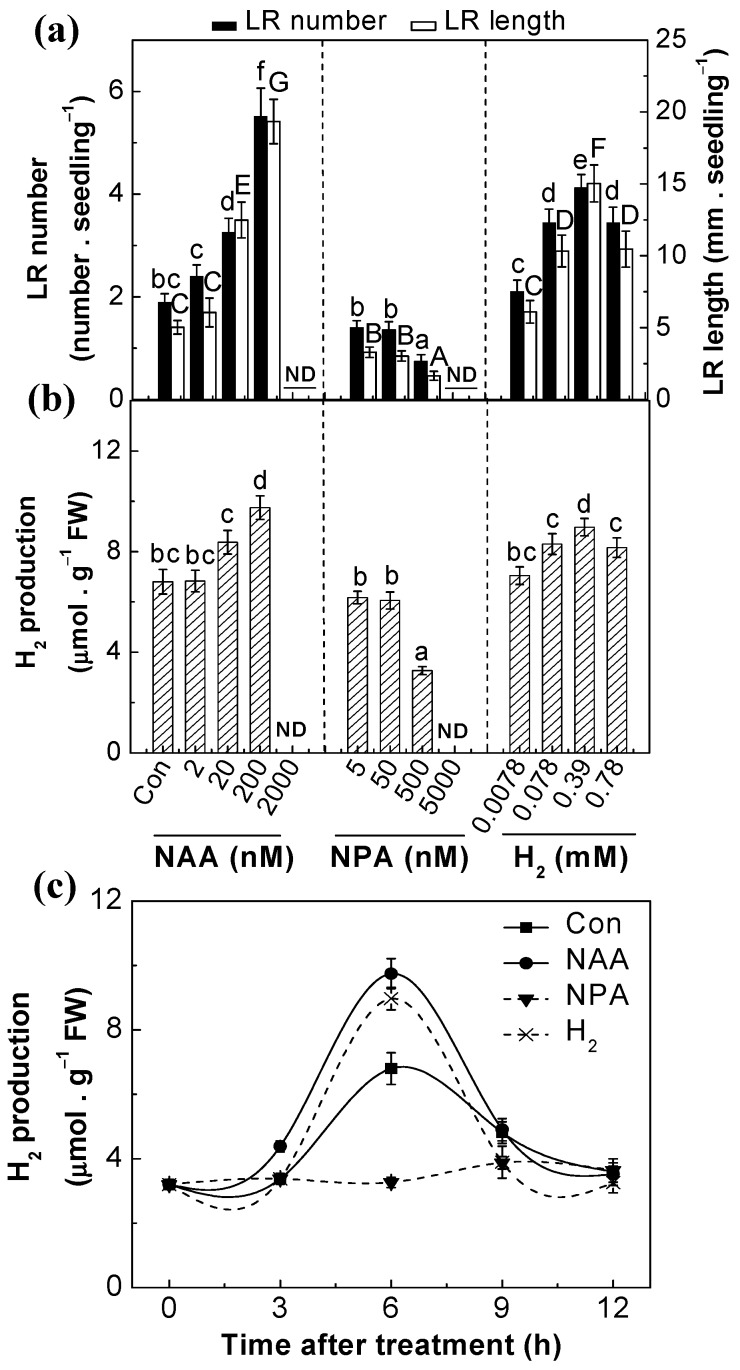
Metabolism of molecular hydrogen (H₂) in bacteria and algae has been widely studied, and it has attracted increasing attention in the context of animals and plants. However, the role of endogenous H₂ in lateral root (LR) formation is still unclear. Here, our results showed that H₂-induced lateral root formation is a universal event. Naphthalene-1-acetic acid (NAA; the auxin analog) was able to trigger endogenous H₂ production in tomato seedlings, and a contrasting response was observed in the presence of -1-naphthyphthalamic acid (NPA), an auxin transport inhibitor. NPA-triggered the inhibition of H₂ production and thereafter lateral root development was rescued by exogenously applied H₂. Detection of endogenous nitric oxide (NO) by the specific probe 4-amino-5-methylamino-2',7'-difluorofluorescein diacetate (DAF-FM DA) and electron paramagnetic resonance (EPR) analyses revealed that the NO level was increased in both NAA- and H₂-treated tomato seedlings. Furthermore, NO production and thereafter LR formation induced by auxin and H₂ were prevented by 2-4-carboxyphenyl-4,4,5,5-tetramethylimidazoline-1-oxyl-3-oxide (cPTIO; a specific scavenger of NO) and the inhibitor of nitrate reductase (NR; an important NO synthetic enzyme). Molecular evidence confirmed that some representative NO-targeted cell cycle regulatory genes were also induced by H₂, but was impaired by the removal of endogenous NO. Genetic evidence suggested that in the presence of H₂, Arabidopsis mutants (in particular) and (two nitrate reductases (NR)-defective mutants) exhibited defects in lateral root length. Together, these results demonstrated that auxin-induced H₂ production was associated with lateral root formation, at least partially via a NR-dependent NO synthesis.
氢气(H₂)在细菌和藻类中的代谢已得到广泛研究,并且在动物和植物方面受到越来越多的关注。然而,内源性 H₂在侧根(LR)形成中的作用仍不清楚。在这里,我们的结果表明,H₂诱导的侧根形成是普遍事件。萘乙酸(NAA;生长素类似物)能够触发番茄幼苗内源性 H₂的产生,而在生长素运输抑制剂 1-萘基邻氨甲酰苯甲酸(NPA)存在的情况下则观察到相反的反应。NPA 触发 H₂产生的抑制,随后通过外源施加 H₂挽救了侧根发育。通过特异性探针 4-氨基-5-甲基氨基-2',7'-二氟荧光素二乙酸酯(DAF-FM DA)和电子顺磁共振(EPR)分析检测内源性一氧化氮(NO),结果表明在 NAA 和 H₂处理的番茄幼苗中NO 水平均增加。此外,生长素和 H₂诱导的 NO 产生和随后的 LR 形成被 2-4-羧基苯基-4,4,5,5-四甲基咪唑啉-1-氧-3-氧化物(cPTIO;NO 的特异性清除剂)和硝酸盐还原酶(NR;重要的 NO 合成酶)抑制剂所阻止。分子证据证实,一些代表性的 NO 靶向细胞周期调节基因也被 H₂诱导,但被去除内源性 NO 所损害。遗传证据表明,在 H₂存在的情况下,拟南芥突变体(特别是)和(两个硝酸盐还原酶(NR)缺陷突变体)在侧根长度方面表现出缺陷。总之,这些结果表明,生长素诱导的 H₂产生与侧根形成有关,至少部分通过 NR 依赖性 NO 合成。