Ibrahim Azianah, Singh Devinder Kaur Ajit, Shahar Suzana
Physiotherapy Programme, School of Rehabilitation Sciences, Faculty of Health Sciences, Universiti Kebangsaan Malaysia, Jalan Raja Muda Abdul Aziz, Kuala Lumpur, Malaysia.
Pantai Integrated Rehab Services Sdn Bhd, Pandan Indah, Kuala Lumpur, Malaysia.
PLoS One. 2017 Oct 3;12(10):e0185641. doi: 10.1371/journal.pone.0185641. eCollection 2017.
The aim of this study was to establish 'Timed up and Go' test (TUG) normative data among community dwelling older adults stratified based on cognitive status, gender and age groups.
A total of 2084 community dwelling older adults from wave I and II were recruited through a multistage random sampling method. TUG was performed using the standard protocol and scores were then stratified based on with and without mild cognitive impairment (MCI), gender and in a 5-year age groups ranging from ages of 60's to 80's.
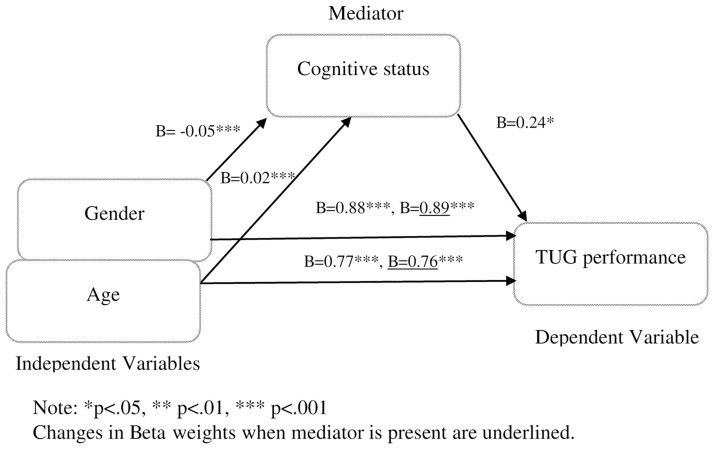
529(16%) participants were identified to have MCI. Past history of falls and medical history of hypertension, heart disease, joint pain, hearing and vision problem, and urinary incontinence were found to have influenced TUG performance. Cognitive status as a mediator, predicted TUG performance even when both gender and age were controlled for (B 0.24, 95% CI (0.02-0.47), β 0.03, t 2.10, p = 0.36). Further descriptive analysis showed, participants with MCI, women and older in age took a longer time to complete TUG, as compared to men with MCI across all age groups with exceptions for some age groups.
These results suggested that MCI needs to be taken into consideration when testing older adults using TUG, besides age and gender factors. Data using fast speed TUG may be required among older adults with and without MCI for further understanding.
本研究的目的是在社区居住的老年人中,根据认知状态、性别和年龄组建立“起立行走”测试(TUG)的规范数据。
通过多阶段随机抽样方法招募了来自第一波和第二波的总共2084名社区居住的老年人。使用标准方案进行TUG测试,然后根据有无轻度认知障碍(MCI)、性别以及60多岁至80多岁的5年年龄组对分数进行分层。
529名(16%)参与者被确定患有MCI。发现跌倒既往史以及高血压、心脏病、关节疼痛、听力和视力问题以及尿失禁的病史会影响TUG测试表现。即使在控制了性别和年龄的情况下,认知状态作为一个中介变量,仍能预测TUG测试表现(B 0.24,95%可信区间(0.02 - 0.47),β 0.03,t 2.10,p = 0.36)。进一步的描述性分析表明,与所有年龄组中患有MCI的男性相比,患有MCI的参与者、女性和年龄较大者完成TUG测试所需的时间更长,但某些年龄组除外。
这些结果表明,在使用TUG测试老年人时,除了年龄和性别因素外,还需要考虑MCI。对于患有和未患有MCI的老年人,可能需要使用快速TUG测试的数据以进一步了解情况。