Holm Kristine Lillebø, Syljuåsen Randi Gussgard, Hasvold Grete, Alsøe Lene, Nilsen Hilde, Ivanauskiene Kristina, Collas Philippe, Shaposhnikov Sergey, Collins Andrew, Indrevær Randi Larsen, Aukrust Pål, Fevang Børre, Blomhoff Heidi Kiil
Department of Molecular Medicine, Institute of Basic Medical Sciences, University of Oslo, Oslo, Norway.
Department of Radiation Biology, Institute for Cancer Research, Oslo University Hospital, Radiumhospitalet, Oslo, Norway.
PLoS One. 2017 Oct 3;12(10):e0185708. doi: 10.1371/journal.pone.0185708. eCollection 2017.
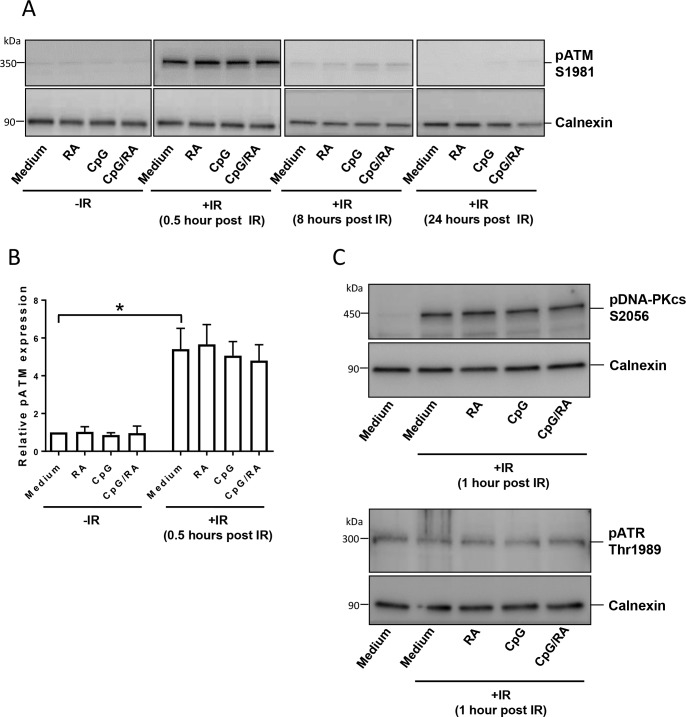
In the present study, we address the important issue of whether B-cells protected from irradiation-induced cell death, may survive with elevated levels of DNA damage. If so, such cells would be at higher risk of gaining mutations and undergoing malignant transformation. We show that stimulation of B-cells with the TLR9 ligands CpG-oligodeoxynucleotides (CpG-ODN) prevents spontaneous and irradiation-induced death of normal peripheral blood B-cells, and of B-cells from patients diagnosed with Common variable immunodeficiency (CVID). The TLR9-mediated survival is enhanced by the vitamin A metabolite retinoic acid (RA). Importantly, neither stimulation of B-cells via TLR9 alone or with RA increases irradiation-induced DNA strand breaks and DNA damage responses such as activation of ATM and DNA-PKcs. We prove that elevated levels of γH2AX imposed by irradiation of stimulated B-cells is not due to induction of DNA double strand breaks, but merely reflects increased levels of total H2AX upon stimulation. Interestingly however, we unexpectedly find that TLR9 stimulation of B-cells induces low amounts of inactive p53, explained by transcriptional induction of TP53. Taken together, we show that enhanced survival of irradiated B-cells is not accompanied by elevated levels of DNA damage. Our results imply that TLR9-mediated activation of B-cells not only promotes cell survival, but may via p53 provide cells with a barrier against harmful consequences of enhanced activation and proliferation. As CVID-derived B-cells are more radiosensitive and prone to undergo apoptosis than normal B-cells, our data support treatment of CVID patients with CpG-ODN and RA.
在本研究中,我们探讨了一个重要问题:免受辐射诱导细胞死亡的B细胞,是否会在DNA损伤水平升高的情况下存活。如果是这样,这些细胞获得突变并发生恶性转化的风险会更高。我们发现,用Toll样受体9(TLR9)配体CpG-寡脱氧核苷酸(CpG-ODN)刺激B细胞,可防止正常外周血B细胞以及被诊断为常见变异型免疫缺陷(CVID)患者的B细胞发生自发性死亡和辐射诱导的死亡。维生素A代谢产物视黄酸(RA)可增强TLR9介导的细胞存活。重要的是,单独通过TLR9或与RA一起刺激B细胞,均不会增加辐射诱导的DNA链断裂以及诸如共济失调毛细血管扩张症突变基因(ATM)和DNA依赖蛋白激酶催化亚基(DNA-PKcs)激活等DNA损伤反应。我们证明,受刺激的B细胞经辐射后γH2AX水平升高并非由于DNA双链断裂的诱导,而仅仅反映了刺激后总H2AX水平的增加。然而,有趣的是,我们意外地发现,TLR9刺激B细胞会诱导少量无活性的p53,这可由TP53的转录诱导来解释。综上所述,我们表明受辐射B细胞存活率的提高并未伴随DNA损伤水平的升高。我们的结果表明,TLR9介导的B细胞激活不仅促进细胞存活,还可能通过p53为细胞提供一道屏障,抵御激活和增殖增强带来的有害后果。由于CVID来源的B细胞比正常B细胞对辐射更敏感且更容易发生凋亡,我们的数据支持用CpG-ODN和RA治疗CVID患者。