Department of Biomedical and Molecular Sciences, Queen's University, Kingston, Ontario, Canada.
Cancer Biology & Genetics Division, Queen's Cancer Research Institute, Kingston, Ontario, Canada.
Breast Cancer Res. 2017 Oct 3;19(1):110. doi: 10.1186/s13058-017-0900-z.
Human epidermal growth factor receptor-2 (HER2) is amplified and a clinical target in a subset of human breast cancers with high rates of metastasis. Targeted therapies involving the antibody trastuzumab and trastuzumab-emtansine (T-DM1) have greatly improved outcomes for HER2-positive (HER2+) breast cancer patients. However, resistance to these targeted therapies can develop and limit their efficacy. Here, we test the involvement of the endocytic adaptor protein endophilin A2 (Endo II) in HER2+ breast cancer models, and their responses to treatments with trastuzumab and T-DM1.
Endo II expression in human breast tumors and lymph node metastases were analyzed by immunohistochemistry. Stable silencing of Endo II was achieved in HER2+ cancer cell lines (SK-BR-3 and HCC1954) to test Endo II effects on HER2 levels, localization and signaling, cell motility and tumor metastasis. The effects of Endo II silencing on the responses of HER2+ cancer cells to trastuzumab or T-DM1 treatments were tested using real-time cell motility and cytotoxicity assays.
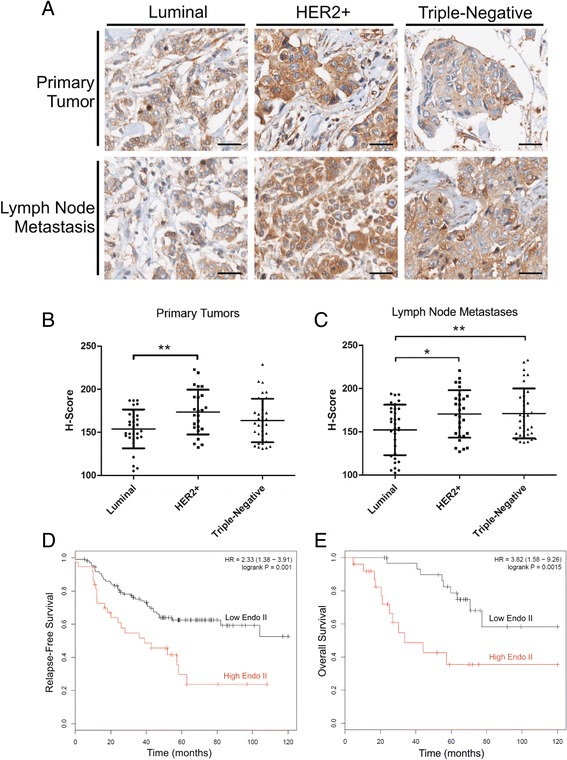
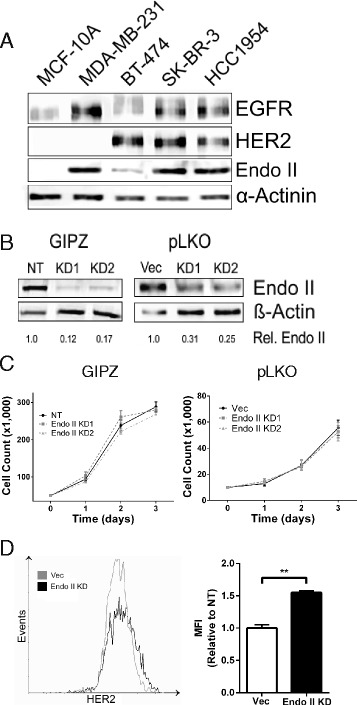
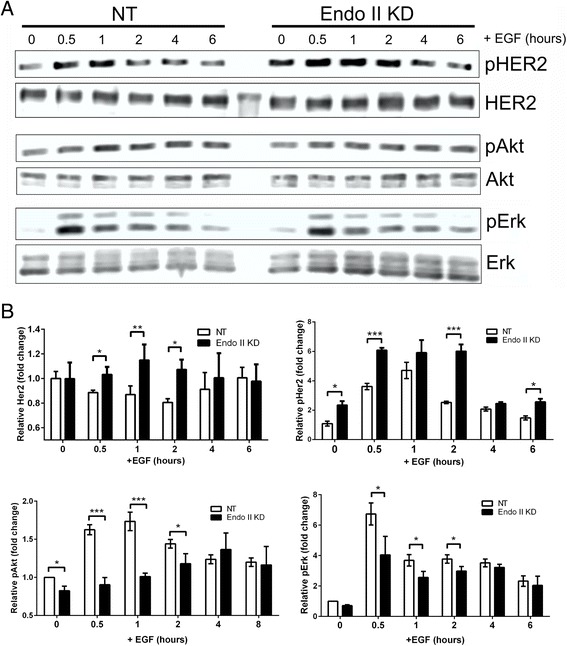
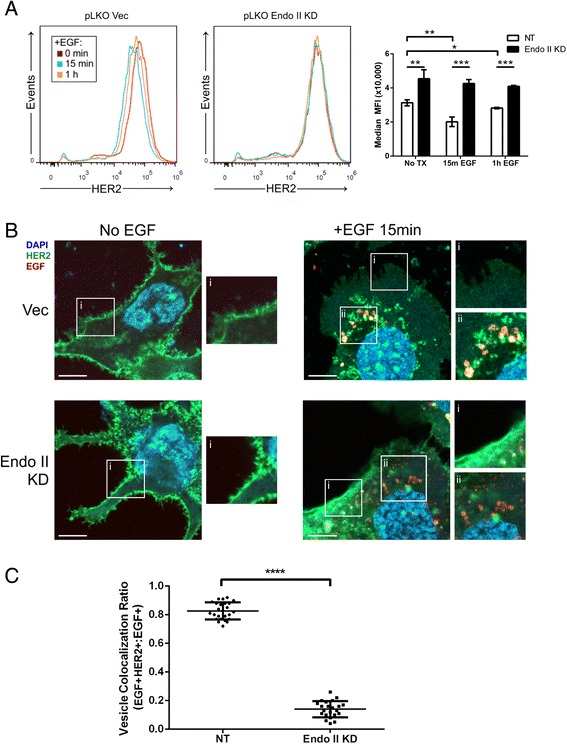
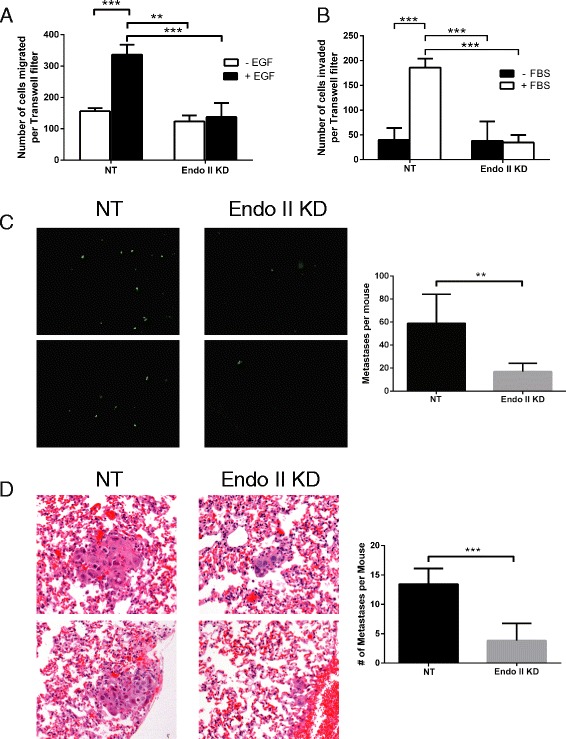
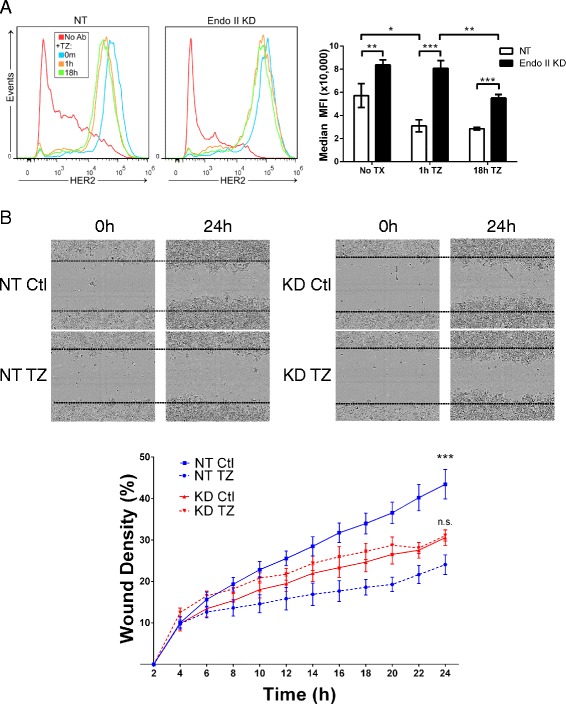
High Endo II protein expression was detected in HER2-positive tumors, and was linked to worse overall survival in node-positive HER2+ breast cancers at the mRNA level. Stable silencing of Endo II in HER2+ cell lines led to elevated levels of HER2 on the cell surface, impaired epidermal growth factor-induced HER2 internalization, and reduced signaling to downstream effector kinases Akt and Erk. Endo II silencing also led to decreased migration and invasion of HER2+ cancer cells in vitro, and impaired lung seeding following tail vein injection in mice. In addition, Endo II silencing also impaired HER2 internalization in response to Trastuzumab, and led to reduced cytotoxicity response in HER2+ cancer cells treated with T-DM1.
Our study provides novel evidence of Endo II function in HER2+ cancer cell motility and trafficking of HER2 that relates to effective treatments with trastuzumab or T-DM1. Thus, differential expression of Endo II may relate to sensitivity or resistance to trastuzumab-based therapies for HER2+ cancers.
人类表皮生长因子受体-2(HER2)在一些具有高转移率的人类乳腺癌中扩增并成为临床靶点。涉及抗体曲妥珠单抗和曲妥珠单抗-美坦新(T-DM1)的靶向治疗极大地改善了 HER2 阳性(HER2+)乳腺癌患者的预后。然而,对这些靶向治疗的耐药性可能会发展并限制其疗效。在这里,我们测试了内吞衔接蛋白内吞素 A2(Endo II)在 HER2+乳腺癌模型及其对曲妥珠单抗和 T-DM1 治疗的反应中的作用。
通过免疫组织化学分析人乳腺癌肿瘤和淋巴结转移中 Endo II 的表达。HER2+癌细胞系(SK-BR-3 和 HCC1954)中稳定沉默 Endo II,以测试 Endo II 对 HER2 水平、定位和信号、细胞迁移和肿瘤转移的影响。使用实时细胞迁移和细胞毒性测定测试 Endo II 沉默对 HER2+癌细胞对曲妥珠单抗或 T-DM1 治疗的反应的影响。
在 HER2 阳性肿瘤中检测到高 Endo II 蛋白表达,并在 mRNA 水平上与淋巴结阳性 HER2+乳腺癌的总体生存率较差相关。HER2+细胞系中 Endo II 的稳定沉默导致细胞表面 HER2 水平升高,表皮生长因子诱导的 HER2 内化受损,下游效应激酶 Akt 和 Erk 的信号减少。Endo II 沉默还导致体外 HER2+癌细胞迁移和侵袭减少,并在小鼠尾静脉注射后肺播种受损。此外,Endo II 沉默也损害了曲妥珠单抗对 HER2 的内化作用,并导致 T-DM1 治疗的 HER2+癌细胞的细胞毒性反应降低。
我们的研究提供了内吞素 A2 在 HER2+癌细胞迁移和 HER2 转运中的作用的新证据,这与曲妥珠单抗或 T-DM1 的有效治疗有关。因此,Endo II 的差异表达可能与 HER2+癌症对曲妥珠单抗为基础的治疗的敏感性或耐药性有关。