Bertrand Nicolas, Grenier Philippe, Mahmoudi Morteza, Lima Eliana M, Appel Eric A, Dormont Flavio, Lim Jong-Min, Karnik Rohit, Langer Robert, Farokhzad Omid C
David H. Koch Institute for Integrative Cancer Research, Massachusetts Institute of Technology (MIT), 500 Main Street, Building 76-661, Cambridge, MA, 02139, USA.
Faculty of Pharmacy, CHU de Quebec Research Center, Université Laval, 2705 Laurier Blvd, Québec, Canada, G1V 4G2.
Nat Commun. 2017 Oct 3;8(1):777. doi: 10.1038/s41467-017-00600-w.
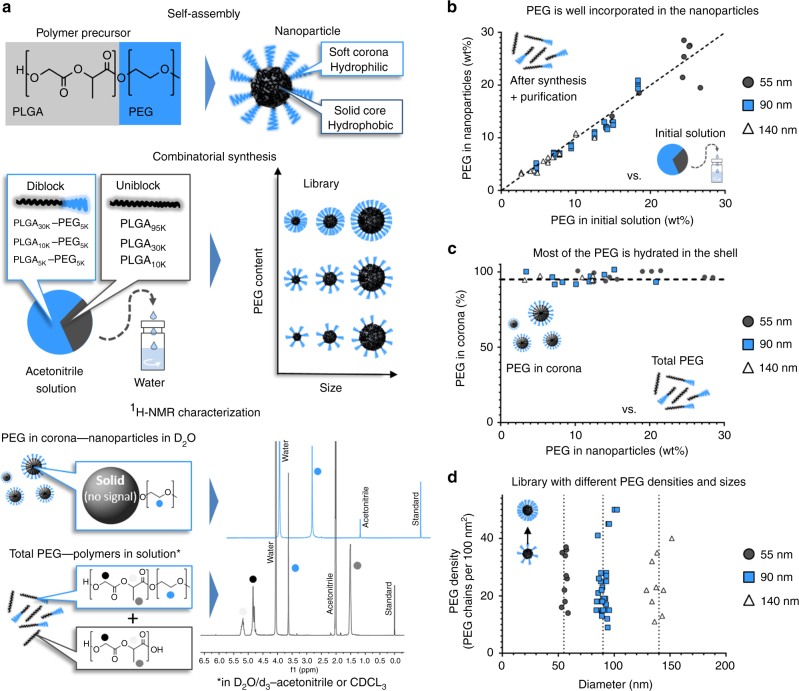
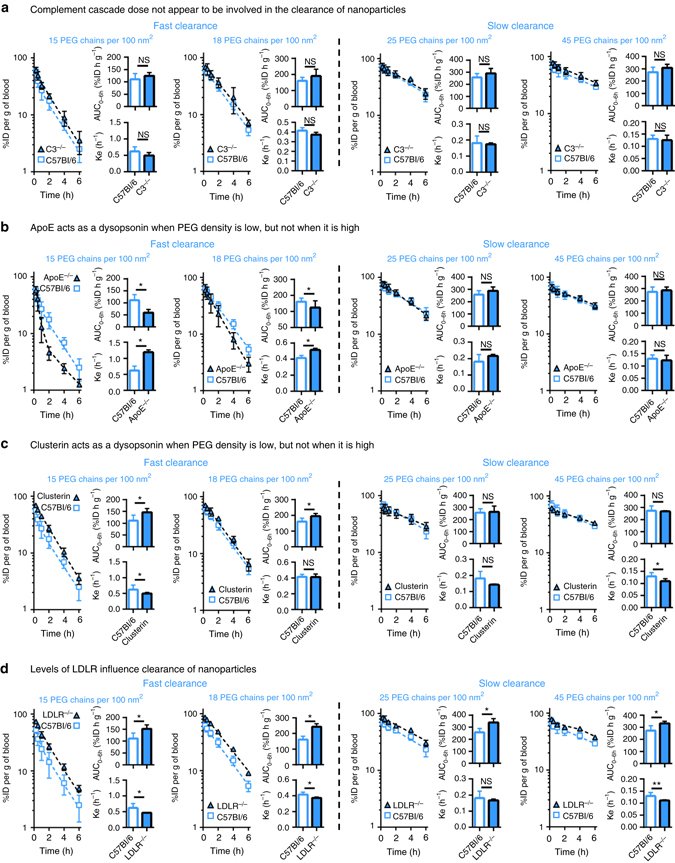
In vitro incubation of nanomaterials with plasma offer insights on biological interactions, but cannot fully explain the in vivo fate of nanomaterials. Here, we use a library of polymer nanoparticles to show how physicochemical characteristics influence blood circulation and early distribution. For particles with different diameters, surface hydrophilicity appears to mediate early clearance. Densities above a critical value of approximately 20 poly(ethylene glycol) chains (MW 5 kDa) per 100 nm prolong circulation times, irrespective of size. In knockout mice, clearance mechanisms are identified for nanoparticles with low and high steric protection. Studies in animals deficient in the C3 protein showed that complement activation could not explain differences in the clearance of nanoparticles. In nanoparticles with low poly(ethylene glycol) coverage, adsorption of apolipoproteins can prolong circulation times. In parallel, the low-density-lipoprotein receptor plays a predominant role in the clearance of nanoparticles, irrespective of poly(ethylene glycol) density. These results further our understanding of nanopharmacology.Understanding the interaction between nanoparticles and biomolecules is crucial for improving current drug-delivery systems. Here, the authors shed light on the essential role of the surface and other physicochemical properties of a library of nanoparticles on their in vivo pharmacokinetics.
纳米材料与血浆的体外孵育有助于了解生物相互作用,但无法完全解释纳米材料在体内的命运。在此,我们使用聚合物纳米颗粒库展示了物理化学特性如何影响血液循环和早期分布。对于不同直径的颗粒,表面亲水性似乎介导早期清除。每100nm高于约20条聚乙二醇链(分子量5kDa)的临界密度值可延长循环时间,与尺寸无关。在基因敲除小鼠中,确定了具有低和高空间位阻保护的纳米颗粒的清除机制。在缺乏C3蛋白的动物中的研究表明,补体激活无法解释纳米颗粒清除的差异。在聚乙二醇覆盖率低的纳米颗粒中,载脂蛋白的吸附可延长循环时间。同时,低密度脂蛋白受体在纳米颗粒的清除中起主要作用,与聚乙二醇密度无关。这些结果增进了我们对纳米药理学的理解。了解纳米颗粒与生物分子之间的相互作用对于改进当前的药物递送系统至关重要。在此,作者揭示了纳米颗粒库的表面和其他物理化学性质对其体内药代动力学的重要作用。