Khodri Myriam, Izumo Takeshi, Vialard Jérôme, Janicot Serge, Cassou Christophe, Lengaigne Matthieu, Mignot Juliette, Gastineau Guillaume, Guilyardi Eric, Lebas Nicolas, Robock Alan, McPhaden Michael J
Laboratoire d'Océanographie et du Climat: Expérimentations et approches numériques, Sorbonne Universités, UPMC Université Paris 06, IPSL, UMR CNRS/IRD/MNHN, F-75005, Paris, France.
Indo-French Cell for Water Sciences, IISc-NIO-IITM-IRD Joint International Laboratory, NIO, Goa, 403002, India.
Nat Commun. 2017 Oct 3;8(1):778. doi: 10.1038/s41467-017-00755-6.
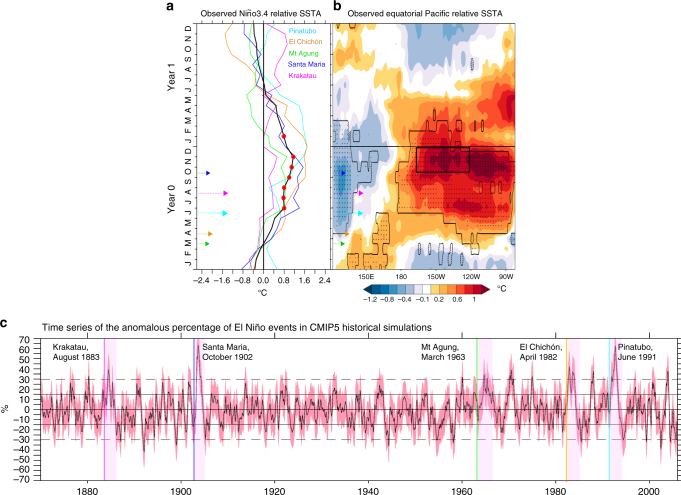
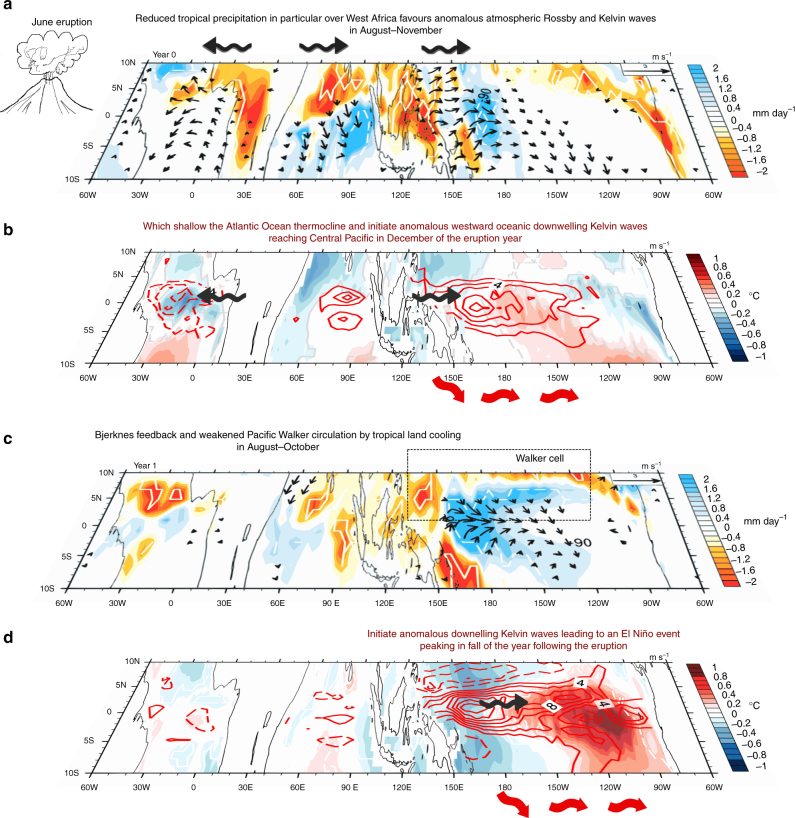
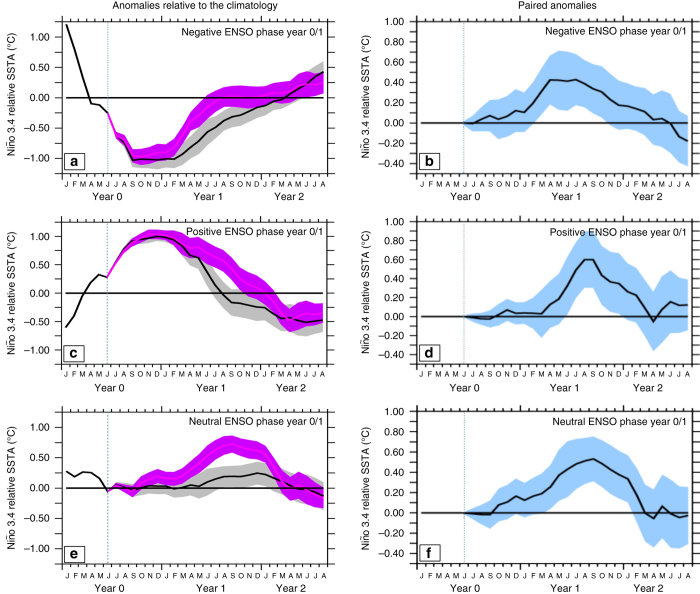
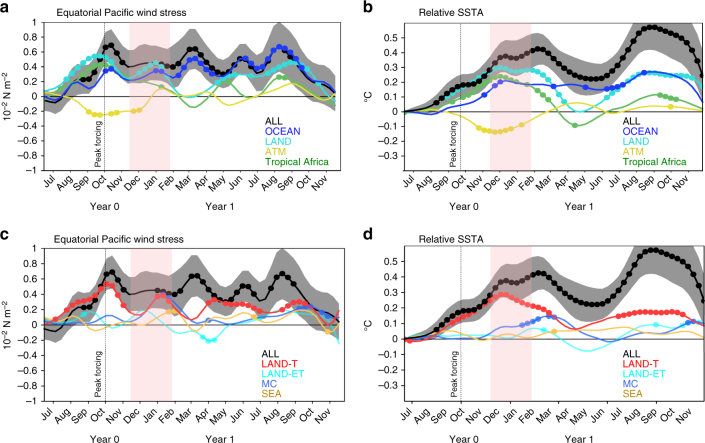
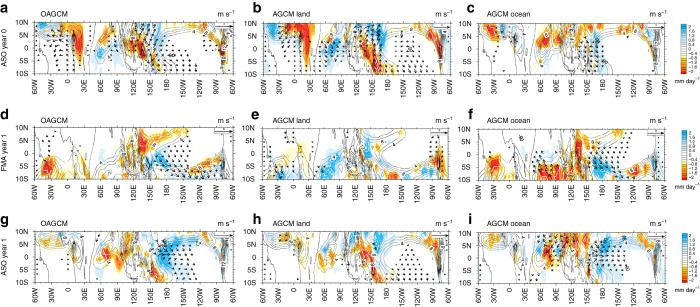
Stratospheric aerosols from large tropical explosive volcanic eruptions backscatter shortwave radiation and reduce the global mean surface temperature. Observations suggest that they also favour an El Niño within 2 years following the eruption. Modelling studies have, however, so far reached no consensus on either the sign or physical mechanism of El Niño response to volcanism. Here we show that an El Niño tends to peak during the year following large eruptions in simulations of the Fifth Coupled Model Intercomparison Project (CMIP5). Targeted climate model simulations further emphasize that Pinatubo-like eruptions tend to shorten La Niñas, lengthen El Niños and induce anomalous warming when occurring during neutral states. Volcanically induced cooling in tropical Africa weakens the West African monsoon, and the resulting atmospheric Kelvin wave drives equatorial westerly wind anomalies over the western Pacific. This wind anomaly is further amplified by air-sea interactions in the Pacific, favouring an El Niño-like response.El Niño tends to follow 2 years after volcanic eruptions, but the physical mechanism behind this phenomenon is unclear. Here the authors use model simulations to show that a Pinatubo-like eruption cools tropical Africa and drives westerly wind anomalies in the Pacific favouring an El Niño response.
来自大型热带爆发性火山喷发的平流层气溶胶会反向散射短波辐射并降低全球平均地表温度。观测表明,它们还会在火山喷发后的两年内促使厄尔尼诺现象出现。然而,到目前为止,关于厄尔尼诺现象对火山活动响应的信号或物理机制,模型研究尚未达成共识。在此我们表明,在第五次耦合模式比较计划(CMIP5)的模拟中,厄尔尼诺现象往往会在大型火山喷发后的次年达到峰值。有针对性的气候模型模拟进一步强调,类似皮纳图博火山的喷发在中性状态期间发生时,往往会缩短拉尼娜现象的持续时间,延长厄尔尼诺现象的持续时间并引发异常变暖。热带非洲地区因火山活动导致的降温会削弱西非季风,由此产生的大气开尔文波会在西太平洋上空引发赤道西风异常。这种风异常在太平洋海气相互作用下会进一步放大,从而有利于类似厄尔尼诺现象的响应。厄尔尼诺现象往往在火山喷发两年后出现,但这一现象背后的物理机制尚不清楚。在此,作者利用模型模拟表明,类似皮纳图博火山的喷发会使热带非洲地区降温,并在太平洋引发西风异常,有利于厄尔尼诺现象的响应。