Chen Yu-Hung, Lo Raymond Y
Department of Nuclear Medicine, Buddhist Tzu Chi General Hospital, Hualien, Taiwan.
Department of Neurology, Memory and Aging Center, Buddhist Tzu Chi General Hospital and Tzu Chi University, Hualien, Taiwan.
Tzu Chi Med J. 2017 Jul-Sep;29(3):138-142. doi: 10.4103/tcmj.tcmj_54_17.
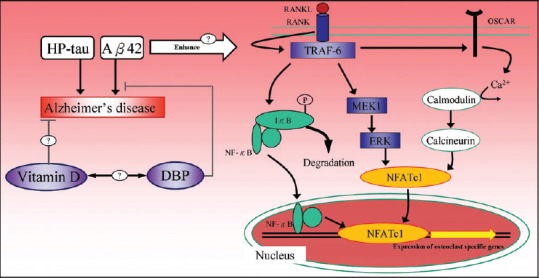
Alzheimer's disease (AD) and osteoporosis are both common degenerative diseases in the elderly population. The incidence of both diseases increases with age and will be posing enormous societal burden worldwide. It may appear that AD and osteoporosis are two distinct diseases although many risk factors are shared. Previous observational studies have shown that patients with osteoporosis have higher risks of developing AD than those who do not have osteoporosis. Although osteoporosis, falls, and fractures are more often seen in patients with AD than other older adults, the association between these two diseases may be due to a pathophysiological link rather than one condition causing the other. Several and studies lend support to this notion. Patients with AD have excessive amyloid plaques in the brain, and the pathology may extend to peripheral organs and cause skeletal amyloid deposition, which would enhance receptor activator nuclear factor-kappa B ligand signaling and lead to greater osteoclast activities. Patients with osteoporosis may have Vitamin D deficiency or lower levels of Vitamin D binding protein, which protects against amyloid aggregation, thus linking Vitamin D deficiency and AD or osteoporosis and AD. Osteoporosis coexisting with AD provides a window to examine the amyloid hypothesis from peripheral tissues. Future studies are warranted to clarify the role of genetic background regarding Vitamin D levels, exposure to sunlight, estrogen replacement therapy, and physical activity in patients with both chronic diseases.
阿尔茨海默病(AD)和骨质疏松症都是老年人群中常见的退行性疾病。这两种疾病的发病率均随年龄增长而上升,将在全球范围内带来巨大的社会负担。尽管AD和骨质疏松症有许多共同的风险因素,但它们似乎是两种截然不同的疾病。先前的观察性研究表明,骨质疏松症患者患AD的风险高于非骨质疏松症患者。虽然与其他老年人相比,AD患者中骨质疏松症、跌倒和骨折更为常见,但这两种疾病之间的关联可能是由于病理生理联系,而非一种疾病导致另一种疾病。多项研究支持了这一观点。AD患者大脑中存在过多的淀粉样斑块,且这种病理变化可能会扩展到外周器官并导致骨骼淀粉样沉积,这会增强核因子κB受体活化因子配体信号传导并导致破骨细胞活性增强。骨质疏松症患者可能存在维生素D缺乏或维生素D结合蛋白水平较低的情况,而维生素D结合蛋白可防止淀粉样蛋白聚集,从而将维生素D缺乏与AD或骨质疏松症与AD联系起来。AD合并骨质疏松症为从外周组织检验淀粉样蛋白假说提供了一个窗口。有必要开展进一步研究,以阐明遗传背景在患有这两种慢性疾病的患者中,对于维生素D水平、阳光照射、雌激素替代疗法和体育活动所起的作用。