O'Connell Karen, Sulaimani Jamal, Basdeo Sharee A, Kinsella Katie, Jordan Sinead, Kenny Orla, Kelly Siobhan B, Murphy David, Heffernan Eric, Killeen Ronan P, Mulready Keith, MacMahon Marguerite, Brady Jennifer J, McKenna Carmel, Muldowney Ciaran, Cassidy Lorraine, Walsh Cathal, O'Rourke Killian, Tubridy Niall, McGuigan Chris, Fletcher Jean M, Hutchinson Michael
Department of Neurology, St Vincent's University Hospital, Ireland.
School of Biochemistry and Immunology, Trinity College Dublin, Ireland.
Mult Scler J Exp Transl Clin. 2017 Sep 21;3(3):2055217317727296. doi: 10.1177/2055217317727296. eCollection 2017 Jul-Sep.
Lowserum vitamin D levels are associated with susceptibility to, and severity of, multiple sclerosis. High dose vitamin D has been proposed as a potential immunomodulator in multiple sclerosis.
We performed a single centre, investigator-led, exploratory, double-blind, randomised, placebo controlled, trial of vitamin D in clinically isolated syndrome and healthy control participants to assess its immunological effects. Secondary end-points included clinical and magnetic resonance imaging outcomes and safety.
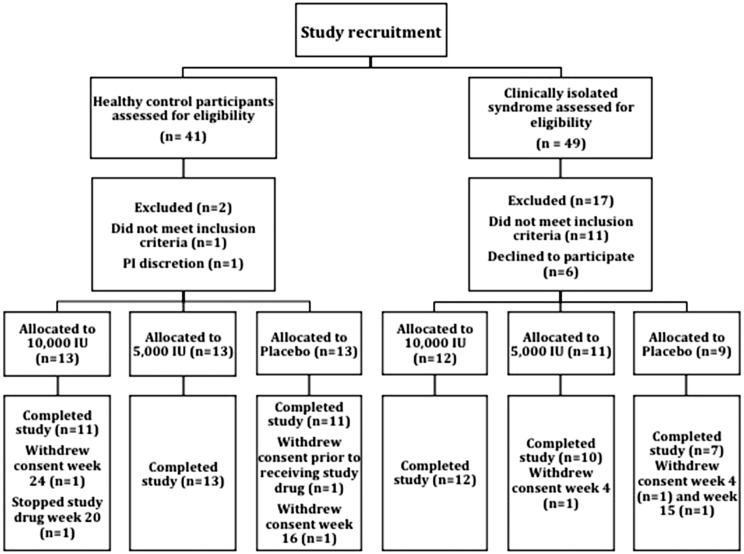
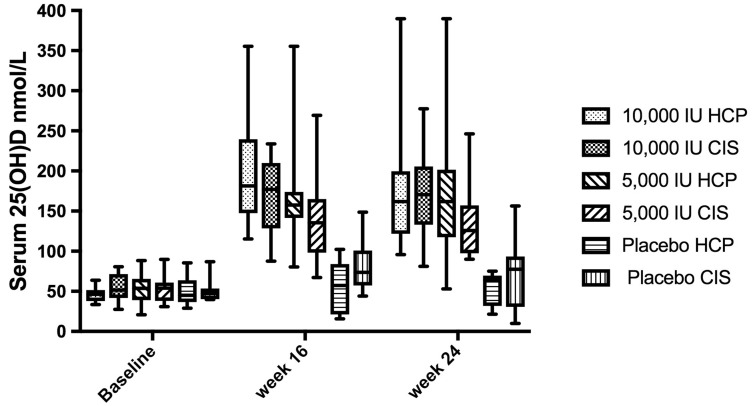
Clinically isolated syndrome patients and healthy control participants were randomised to: placebo, 5000 IU or 10,000 IU vitamin D/day (Vigantol oil). Study duration was 24 weeks.
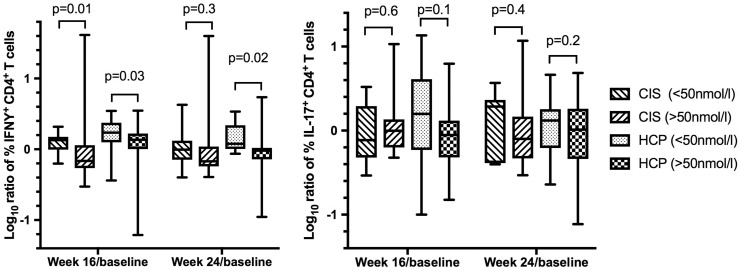
The trial did not meet its primary end point, with no difference in the frequency of pro-inflammatory CD4 T cells (interleukin (IL)-17/interferon (IFN)-γ) seen. A higher level of disease freedom (67% versus 50%) was seen in those with serum 1,25 (OH) vitamin D levels>100 nmol/l but this did not reach significance. High dose vitamin D was well tolerated with no safety signal.
High dose vitamin D over 24 weeks was well tolerated but without immunological, magnetic resonance imaging or clinical evidence of benefit. The hypothesised therapeutic effects in clinically isolated syndrome or multiple sclerosis patients may require longer periods of administration or may only be seen in patients treated with vitamin D as an adjunct to established disease modifying therapies.
血清维生素D水平低与多发性硬化症的易感性和严重程度相关。高剂量维生素D已被提议作为多发性硬化症的一种潜在免疫调节剂。
我们进行了一项单中心、研究者主导、探索性、双盲、随机、安慰剂对照试验,研究维生素D对临床孤立综合征患者和健康对照者的免疫作用。次要终点包括临床和磁共振成像结果及安全性。
将临床孤立综合征患者和健康对照者随机分为:安慰剂组、每日5000国际单位或10000国际单位维生素D组(骨化三醇油剂)。研究持续时间为24周。
该试验未达到其主要终点,促炎CD4 T细胞(白细胞介素(IL)-17/干扰素(IFN)-γ)的频率无差异。血清1,25(OH)维生素D水平>100 nmol/l的患者疾病缓解率较高(67%对50%),但未达到显著差异。高剂量维生素D耐受性良好,无安全信号。
24周的高剂量维生素D耐受性良好,但无免疫、磁共振成像或临床获益证据。在临床孤立综合征或多发性硬化症患者中假设的治疗效果可能需要更长的给药时间,或者可能仅在维生素D作为既定疾病修饰疗法的辅助治疗的患者中才能看到。