Crowther Caroline A, Middleton Philippa F, Voysey Merryn, Askie Lisa, Duley Lelia, Pryde Peter G, Marret Stéphane, Doyle Lex W
Liggins Institute, University of Auckland, Auckland, New Zealand.
Australian Research Centre for Health of Women and Babies (ARCH), The Robinson Research Institute, Discipline of Obstetrics and Gynaecology, School of Medicine, The University of Adelaide, Adelaide, Australia.
PLoS Med. 2017 Oct 4;14(10):e1002398. doi: 10.1371/journal.pmed.1002398. eCollection 2017 Oct.
Babies born preterm are at an increased risk of dying in the first weeks of life, and those who survive have a higher rate of cerebral palsy (CP) compared with babies born at term. The aim of this individual participant data (IPD) meta-analysis (MA) was to assess the effects of antenatal magnesium sulphate, compared with no magnesium treatment, given to women at risk of preterm birth on important maternal and fetal outcomes, including survival free of CP, and whether effects differed by participant or treatment characteristics such as the reason the woman was at risk of preterm birth, why treatment was given, the gestational age at which magnesium sulphate treatment was received, or the dose and timing of the administration of magnesium sulphate.
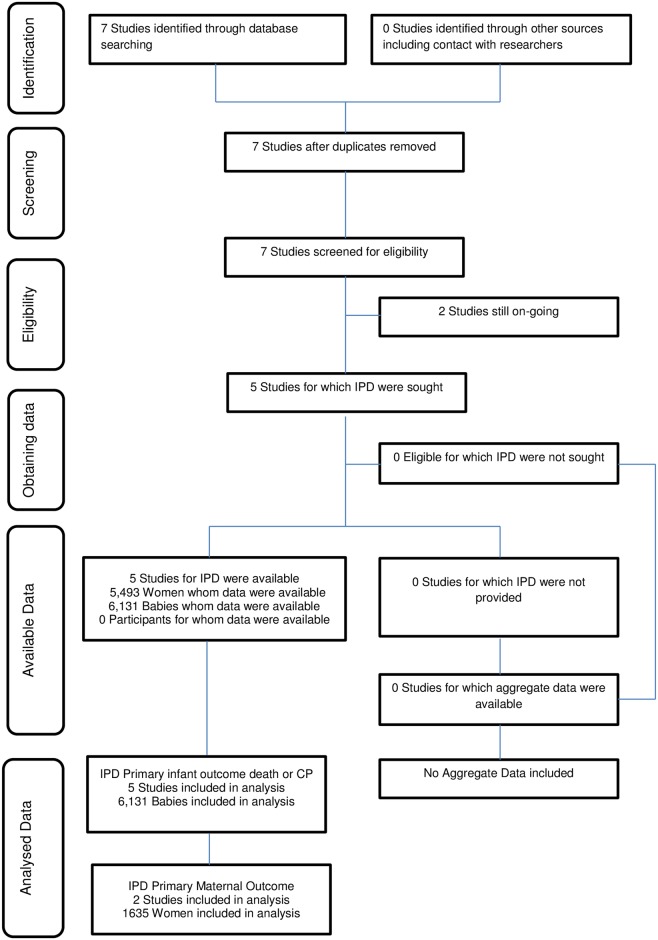
Trials in which women considered at risk of preterm birth (<37 weeks' gestation) were randomised to magnesium sulphate or control treatment and where neurologic outcomes for the baby were reported were eligible for inclusion. The primary outcomes were infant death or CP and severe maternal outcome potentially related to treatment. Studies were identified based on the Cochrane Pregnancy and Childbirth search strategy using the terms [antenatal or prenatal] and [magnesium] and [preterm or premature or neuroprotection or 'cerebral palsy']. The date of the last search was 28 February 2017. IPD were sought from investigators with eligible trials. Risk of bias was assessed using criteria from the Cochrane Collaboration. For each prespecified outcome, IPD were analysed using a 1-stage approach. All 5 trials identified were included, with 5,493 women and 6,131 babies. Overall, there was no clear effect of magnesium sulphate treatment compared with no treatment on the primary infant composite outcome of death or CP (relative risk [RR] 0.94, 95% confidence interval (CI) 0.85 to 1.05, 6,131 babies, 5 trials, p = 0.07 for heterogeneity of treatment effect across trials). In the prespecified sensitivity analysis restricted to data from the 4 trials in which the intent of treatment was fetal neuroprotection, there was a significant reduction in the risk of death or CP with magnesium sulphate treatment compared with no treatment (RR 0.86, 95% CI 0.75 to 0.99, 4,448 babies, 4 trials), with no significant heterogeneity (p = 0.28). The number needed to treat (NNT) to benefit was 41 women/babies to prevent 1 baby from either dying or having CP. For the primary outcome of severe maternal outcome potentially related to magnesium sulphate treatment, no events were recorded from the 2 trials providing data. When the individual components of the composite infant outcome were assessed, no effect was seen for death overall (RR 1.03, 95% CI 0.91 to 1.17, 6,131 babies, 5 trials) or in the analysis of death using only data from trials with the intent of fetal neuroprotection (RR 0.95, 95% CI 0.80 to 1.13, 4,448 babies, 4 trials). For cerebral palsy in survivors, magnesium sulphate treatment had a strong protective effect in both the overall analysis (RR 0.68, 95% CI 0.54 to 0.87, 4,601 babies, 5 trials, NNT to benefit 46) and the neuroprotective intent analysis (RR 0.68, 95% CI 0.53 to 0.87, 3,988 babies, 4 trials, NNT to benefit 42). No statistically significant differences were seen for any of the other secondary outcomes. The treatment effect varied little by the reason the woman was at risk of preterm birth, the gestational age at which magnesium sulphate treatment was given, the total dose received, or whether maintenance therapy was used. A limitation of the study was that not all trials could provide the data required for the planned analyses so that combined with low event rates for some important clinical events, the power to find a difference was limited.
Antenatal magnesium sulphate given prior to preterm birth for fetal neuroprotection prevents CP and reduces the combined risk of fetal/infant death or CP. Benefit is seen regardless of the reason for preterm birth, with similar effects across a range of preterm gestational ages and different treatment regimens. Widespread adoption worldwide of this relatively inexpensive, easy-to-administer treatment would lead to important global health benefits for infants born preterm.
早产婴儿在出生后的头几周死亡风险增加,与足月儿相比,存活下来的早产婴儿患脑瘫(CP)的几率更高。本个体参与者数据(IPD)荟萃分析(MA)的目的是评估与不使用镁治疗相比,对有早产风险的妇女给予产前硫酸镁治疗对重要母婴结局的影响,包括无脑瘫存活,以及影响是否因参与者或治疗特征(如妇女有早产风险的原因、给予治疗的原因、接受硫酸镁治疗时的孕周,或硫酸镁的剂量和给药时间)而有所不同。
将被认为有早产风险(妊娠<37周)的妇女随机分为硫酸镁治疗组或对照组,且报告了婴儿神经学结局的试验符合纳入标准。主要结局为婴儿死亡或脑瘫以及可能与治疗相关的严重母亲结局。根据Cochrane妊娠与分娩检索策略,使用[产前或孕期]、[镁]和[早产或未成熟或神经保护或“脑瘫”]等术语识别研究。最后一次检索日期为2017年2月28日。向符合条件试验的研究者寻求IPD。使用Cochrane协作网的标准评估偏倚风险。对于每个预先设定的结局,采用单阶段方法分析IPD。纳入了所有识别出的5项试验,涉及5493名妇女和6131名婴儿。总体而言,与不治疗相比,硫酸镁治疗对婴儿死亡或脑瘫这一主要复合结局没有明显影响(相对风险[RR]0.94,95%置信区间[CI]0.85至1.05,6131名婴儿,5项试验;各试验治疗效果的异质性p = 0.07)。在预先设定的敏感性分析中,仅限于4项以胎儿神经保护为治疗目的的试验数据,与不治疗相比,硫酸镁治疗使死亡或脑瘫风险显著降低(RR 0.86,95%CI 0.75至0.99,4448名婴儿,4项试验),且无显著异质性(p = 0.28)。受益所需治疗人数(NNT)为41名妇女/婴儿,以防止1名婴儿死亡或患脑瘫。对于可能与硫酸镁治疗相关的严重母亲结局这一主要结局,提供数据的2项试验未记录到任何事件。当评估复合婴儿结局的各个组成部分时,总体死亡方面未观察到影响(RR 1.03,95%CI 0.91至1.17,6131名婴儿,5项试验),在仅使用以胎儿神经保护为目的试验数据进行的死亡分析中也未观察到影响(RR 0.95,95%CI 0.80至1.13,4448名婴儿,4项试验)。对于存活者中的脑瘫,硫酸镁治疗在总体分析(RR 0.68,95%CI 0.54至0.87,4601名婴儿,5项试验,受益NNT为46)和神经保护目的分析(RR 0.68,95%CI 0.53至0.87,3988名婴儿,4项试验,受益NNT为42)中均有很强的保护作用。对于任何其他次要结局,均未观察到统计学上的显著差异。治疗效果因妇女有早产风险的原因、给予硫酸镁治疗时的孕周、接受的总剂量或是否使用维持治疗而变化不大。该研究的一个局限性是并非所有试验都能提供计划分析所需的数据,因此结合一些重要临床事件的低发生率,发现差异的能力有限。
早产前给予产前硫酸镁进行胎儿神经保护可预防脑瘫,并降低胎儿/婴儿死亡或脑瘫的综合风险。无论早产原因如何,均可观察到益处,在一系列早产孕周和不同治疗方案中效果相似。在全球广泛采用这种相对廉价、易于给药的治疗方法将为早产婴儿带来重要的全球健康益处。